Table of contents
Transcription
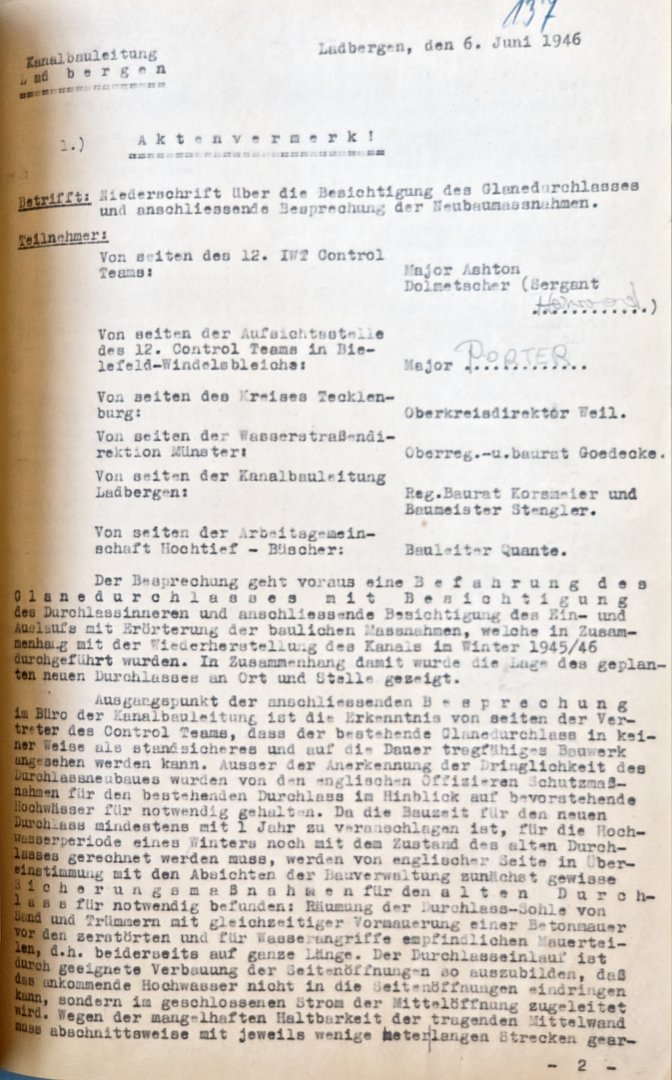
Canal Construction Management
L a d b e r g e n
Ladbergen, 6 June 1946
1.) M e m o!
Re:
Minutes of the inspection of the Glane culvert and the subsequent discussion of the new construction works.
Participants:
On behalf of the 12th IWT Control Teams:
Major Ashton
Interpreter (Sergeant Howood)
On behalf of the supervisory office of the 12th Control Team in Bielefeld-Windelsbleiche:
Major Porter
On behalf of the Tecklenburg District:
District Director Weil.
From the Münster Waterways Directorate:
Senior Government Councillor and Senior Building Officer Goedecke.
On behalf of the Ladbergen Canal Construction Authority:
Government Planning Officer Korsmeier and Master Builder Stengler.
On behalf of the Hochtief – Büscher consortium:
Site Manager Quante.
The meeting will be preceded by an i n s p e c t i o n o f t h e G l a n e c u l v e r t, including a v i e w of the interior of the culvert, followed by an inspection of the inlet and outlet, with a discussion of the structural works carried out in connection with the restoration of the canal in the winter of 1945/46. In connection with this, the location of the planned new culvert was demonstrated on site.
Starting point of the subsequent discussion in the canal construction management office is the realisation on the part of the Control Team representatives that the existing Glane culvert cannot in any way be regarded as a structurally sound and durable structure. Apart from acknowledging the urgency of constructing the new culvert, the British officers deemed protective measures for the existing culvert necessary in view of impending high water. As the construction period for the new culvert is expected to take at least one year, and as the old culvert will still be in use during the winter flood season, the British side, in agreement with the building authority, has determined that certain s a f e t y m e a s u r e s for the o l d c u l v e r t are necessary for the time being: clearing the culvert bed of sand and debris whilst simultaneously constructing a concrete retaining wall in front of the damaged sections of the wall that are vulnerable to water damage, i.e. on both sides over the entire length. The culvert inlet must be constructed by suitably shoring the side openings so that the incoming floodwater cannot penetrate the side openings, but is channelled into the closed flow of the central opening. Due to the poor durability of the load-bearing central wall, work must be carried out in sections each a few metres long. The proposed design corresponds roughly to the enclosed illustration.
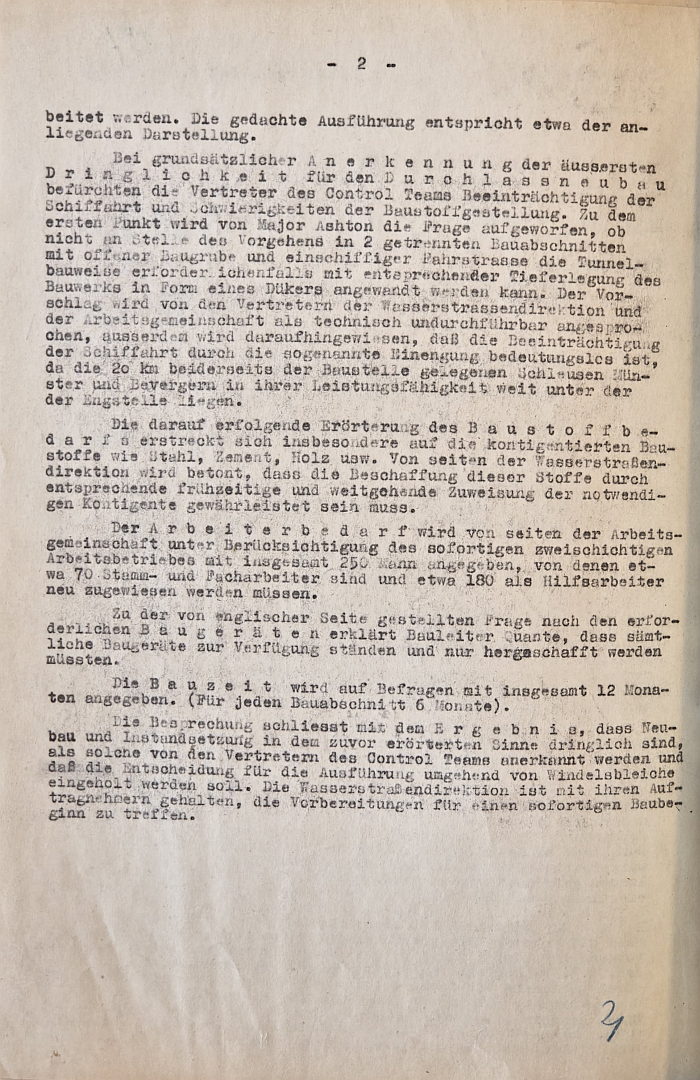
Whilst a c k n o w l e d g i n g the u r g e n t n e e d for the n e w s t r u c t u r e to be built, representatives of the Control Team fear that it will disrupt shipping and cause difficulties in the supply of building materials. Regarding the first point, Major Ashton raises the question of whether, instead of the proceeding in two separate construction phases with an open excavation pit and a single-lane access road, the tunnel construction method could be used if necessary, with the structure being lowered accordingly in the form of a culvert. The proposal is described by the representatives of the Waterways Directorate and the consortium as technically unfeasible; furthermore, it is pointed out that the disruption to shipping caused by the so-called narrowing is insignificant, as the capacity of the Münster and Bevergern locks, situated 20 km on either side of the construction site, is far below that of the bottleneck.
The subsequent discussion of b u i l d i n g m a t e r i a l r e q u i r e m e n t s focuses in particular on materials subject to rationing, such as steel, cement, timber, etc. The Waterways Directorate emphasises that the procurement of these materials must be ensured through appropriate early and extensive allocation of the necessary quotas.
The consortium estimates the l a b o u r r e q u i r e m e n t, taking into account the immediate introduction of two-shift operations, at a total of 250 workers, of whom around 70 are permanent and skilled workers and around 180 will need to be recruited as unskilled labourers.
In response to the question raised by the British side regarding the necessary c o n s t r u c t i o n e q u i p m e n t, site manager Quante explains that all construction equipment is available and simply needs to be brought here.
When asked, the c o n s t r u c t i o n p e r i o d is stated as a total of 12 months. (6 months for each construction phase).
The meeting concludes with the c o n c l u s i o n that new construction and repair are urgent in the sense previously discussed, that they are recognised as such by the representatives of the Control Team and that the decision regarding implementation is to be sought immediately from Windelsbleiche. The Waterways Directorate is required, together with its contractors, to make the necessary preparations for immediate commencement of works.
Photos of the document