Table of contents
Where in the German Reich were the most bombs dropped during the Second World War?
Although the Münsterland region was predominantly agricultural and lay far from the heavy industry in the Ruhr area, which was vital to the German war economy, the destruction of the Glane culverts in the two branches of the Dortmund-Ems Canal west of Ladbergen was a key tactical target for the British Ministry of Defence.
Nowhere else in the German Reich were more bombs dropped per square metre during the Second World War than in the area of the Glane culverts. […] 4,444.3 tonnes of bombs were dropped during this period. [Translation of the author] 1
Introduction
Anyone walking or cycling along the Dortmund-Ems Canal west of Ladbergen today will, when they reach the point where the River Glane flows through a culvert, have no idea how fiercely this spot was contested during the Second World War. With up to 212 Lancaster bombers, the air forces of the British Empire, under the command of the Royal Air Force, attacked the two canal branches that existed at the time and their respective culverts, in order to disrupt the shipping traffic between the North Sea and the Ruhr region, which was vital to the German war economy.
The Glane
The Glane⤴ is a tributary of the Ems in north-west Germany. It rises west of Bad Iburg in Lower Saxony. After about 2.5 km, it reaches the border with North Rhine-Westphalia and, after a total of about 35.3 km 2, flows into the Ems at Emsdetten-Hembergen.
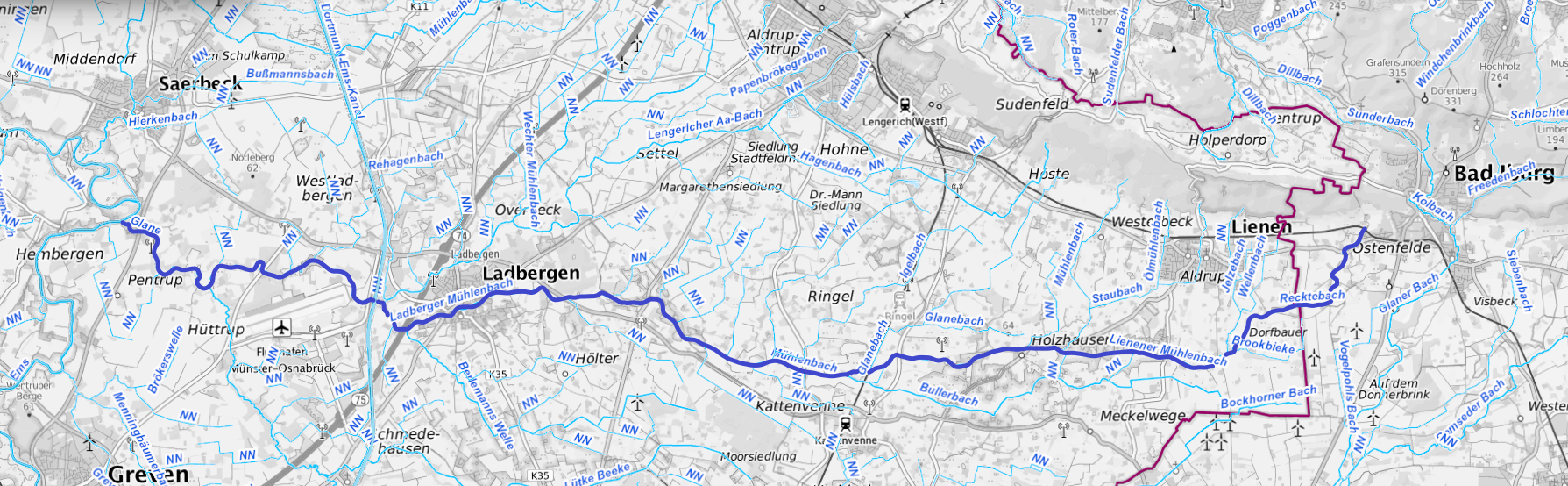
The Glane changes its name several times between its source and its mouth:
- Recktebach
- From the source to the border between Lower Saxony and North Rhine-Westphalia
- Uffelager Bach
- From the border between Lower Saxony and North Rhine-Westphalia to the confluence with the Brookbieke
- Lienener Mühlenbach
- From the confluence of the Brookbieke to the confluence of the Bullerbach
- Mühlenbach
- From the confluence of the Bullerbach to the confluence of the Igelbach
- Ladberger Mühlenbach
- From the confluence with the Igelbach to the confluence with the Eltingmühlenbach. The Ladberger Mühlenbach passes under the Dortmund-Ems Canal to the west of Ladbergen.
- Glane
- From the source of the Eltingmühlenbach to its confluence with the Ems
The Dortmund-Ems Canal
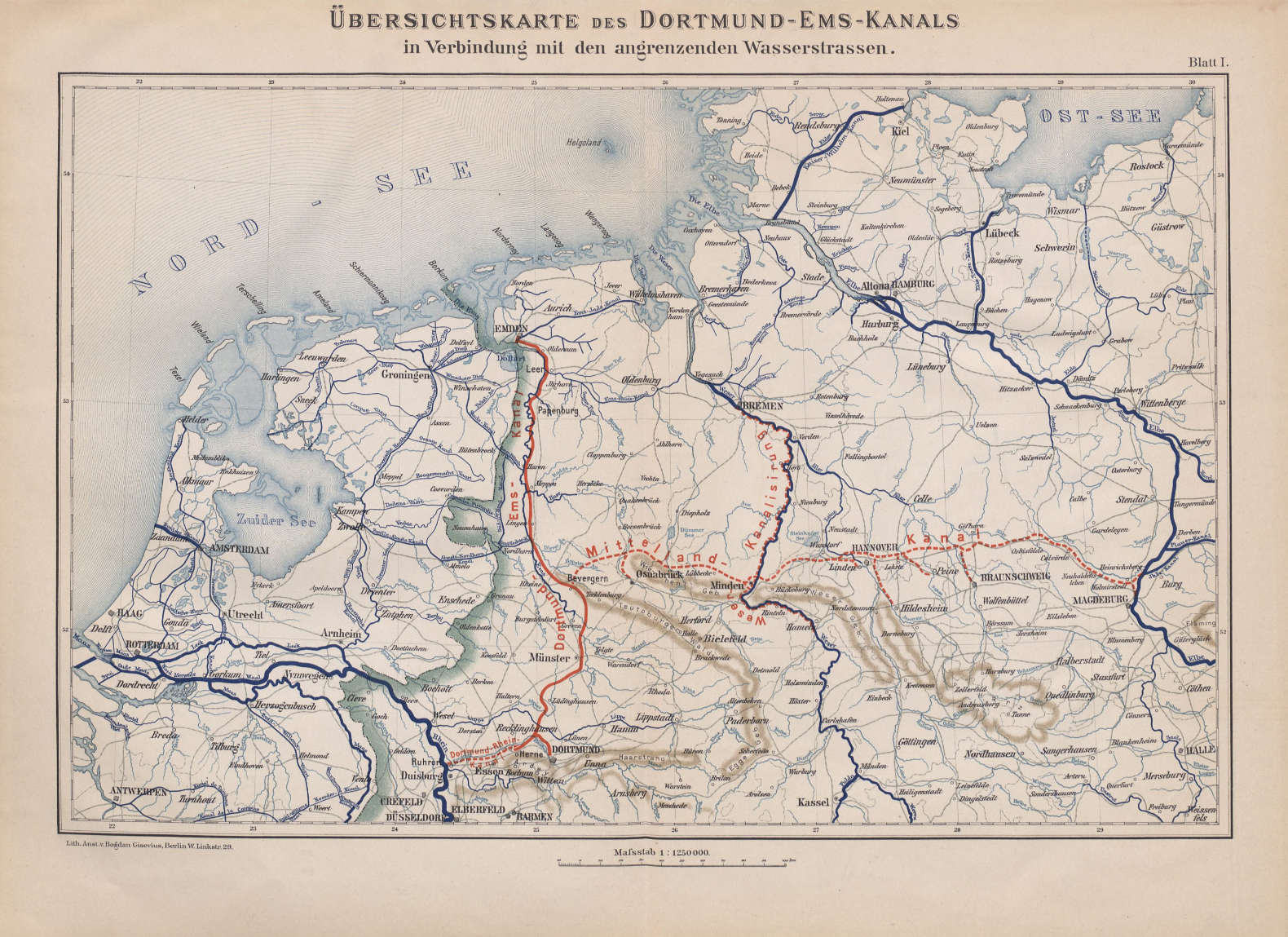
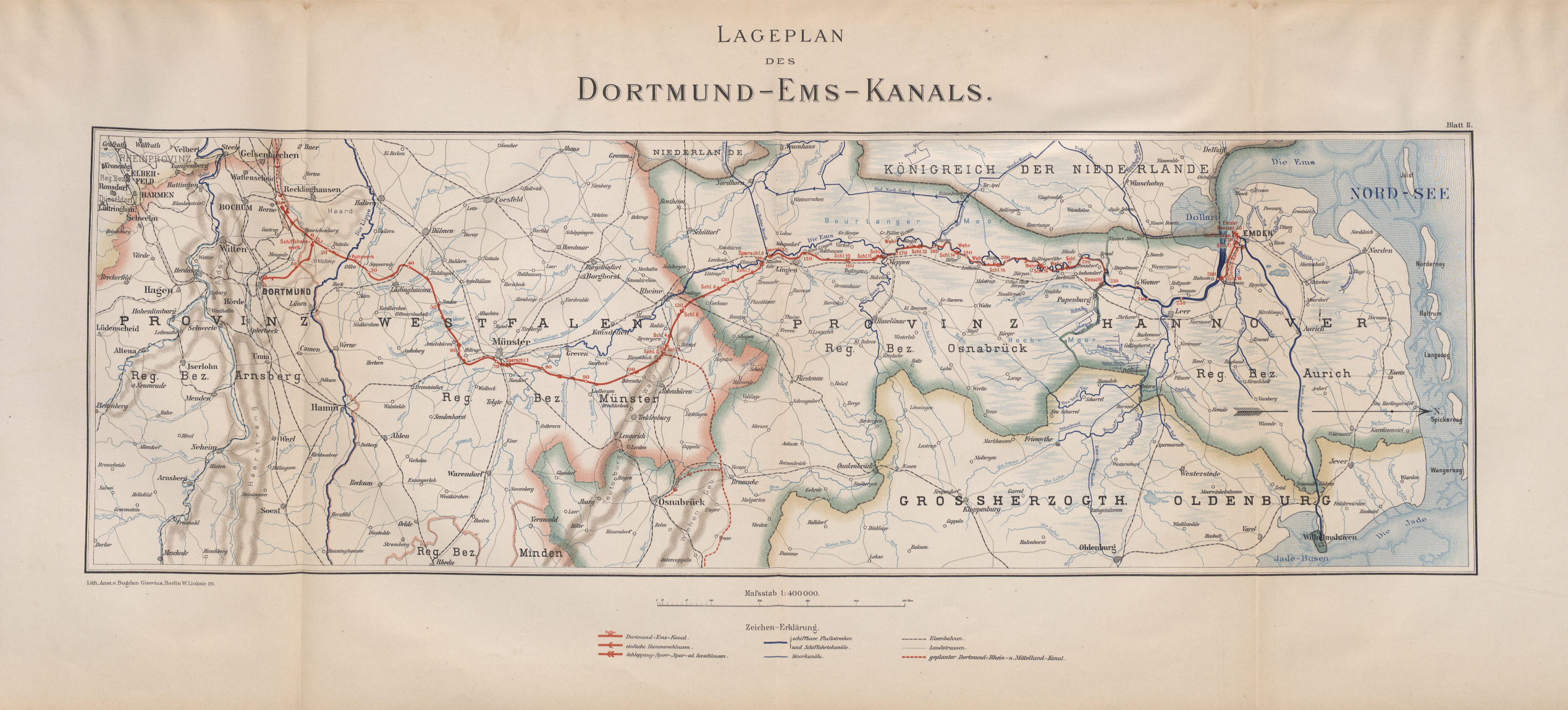
The Dortmund-Ems Canal is the most important canal in north-west Germany. Built between 1892 and 1899, it connects the Rhineland-Westphalian industrial region with the German North Sea coast and provides the Rhine with a German estuary independent of the Netherlands. It begins at Dortmund and runs to Henrichenburg, where a large ship lift facilitates the 14-metre descent; it then passes eastwards past Münster, crosses the Ems at Fuestrup and joins the river itself at Meppen. It is linked to the Rhine via the Rhine–Herne Canal (Herne–Ruhrort) and the Lippe Canal (Datteln–Wesel); to Hamm via the Lippe Side Canal; to Oldenburg via the Hunte–Ems Canal; and to Wilhelmshaven via the Ems–Jade Canal (from Emden). At Bevergern, the Mittelland Canal (see above) branches off towards Minden and Hanover. The length of the canal, which is 30 – 32 m wide and 2.3 – 2.7 m deep and overcomes a difference in height of 70 m via 20 locks and a ship lift, is 281 km (Dortmund–Dollart), of which 71.5 km is on the Ems. It is used to transport Ruhr coal to the ports on the German North Sea coast and, conversely, to transport Swedish and other overseas iron ores to the steelworks in the Ruhr region. In 1923, 1.358 million tonnes were transported over a distance of 212 km. [Translated by the author] 5
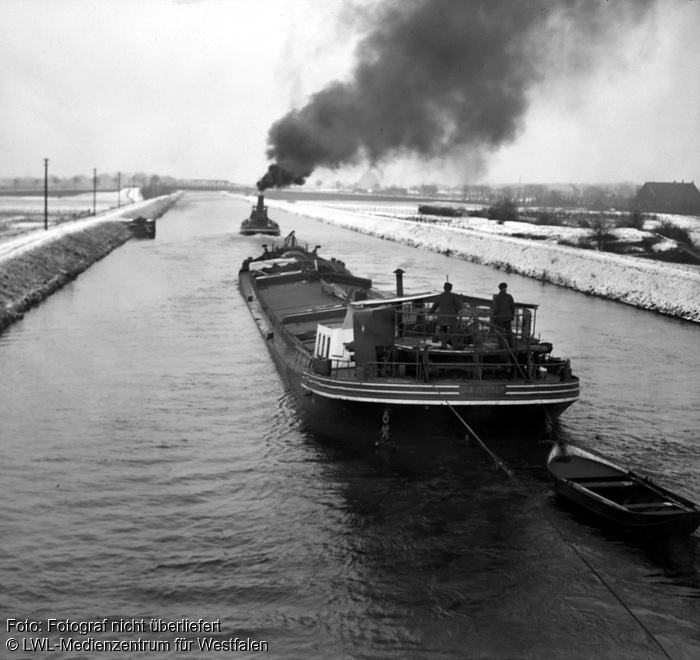
For transport, for example, unpowered barges or self-propelled barges were used. Several barges were connected by a towline and pulled by a tugboat (see Figure ). On 23 July 1938, the ‘Ordinance on the Introduction of the Towing Monopoly on the Dortmund–Ems Canal (initially only on the southern section between Herne or Dortmund and Bergeshövede)’ 7 came into force. This meant that barges were only permitted to be towed by state-owned tugboats.
From 28 July 1938, self-propelled vessels were permitted without restriction on the West German canal network. 7 These were not subject to the monopoly.
The course of the canal west of Ladbergen was altered twice following its opening in 1899.
Figure shows the original course as it was after the opening. The red arrow marks the Glane culvert.
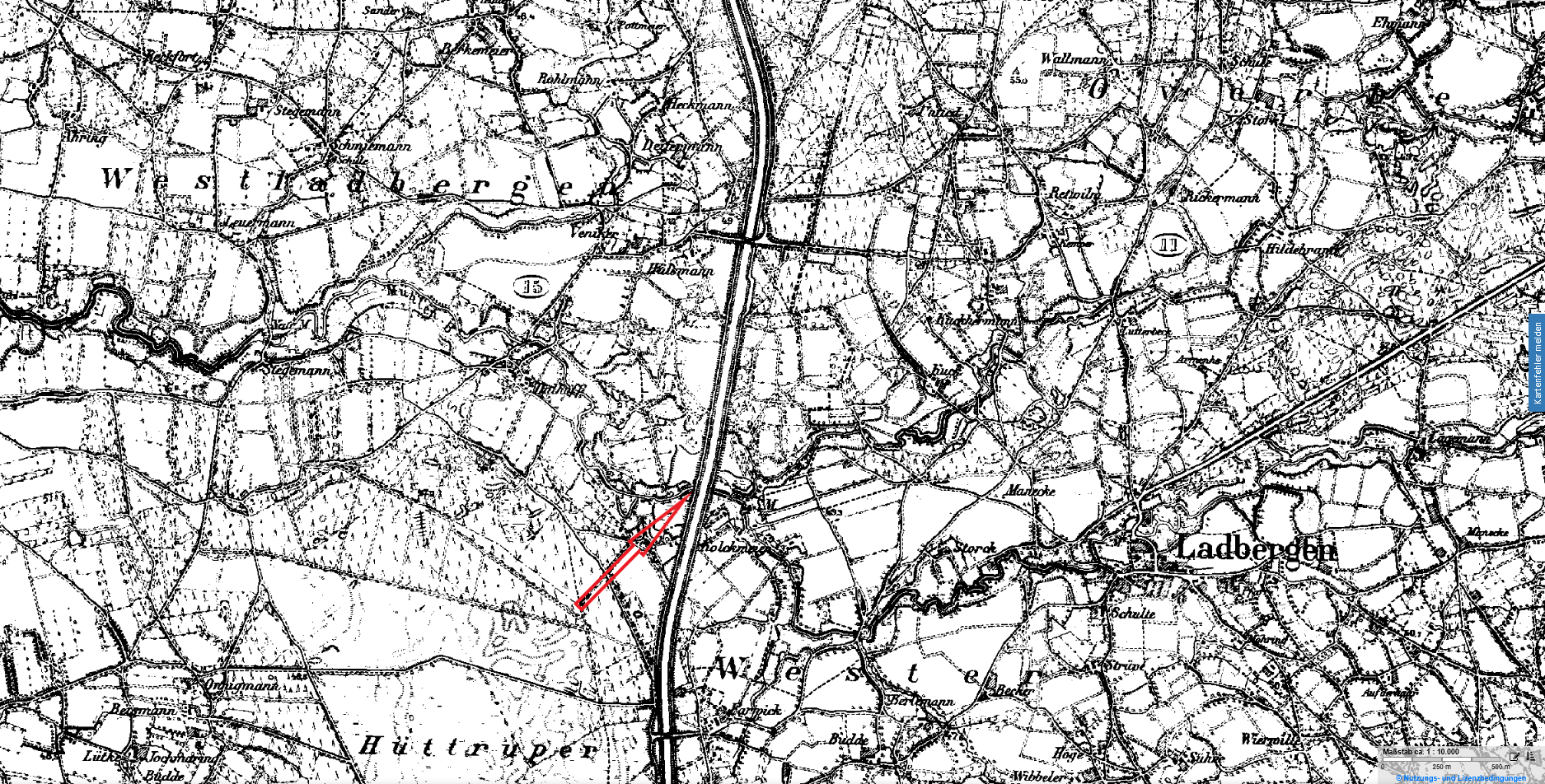
Figure shows a topographical map drawn up between 1936 and 1945. A wider branch of the canal had been built to the west of the original canal. The original canal was called the “Alte Fahrt” (english: old branch) and the new branch the “2. Fahrt” (english: second branch). The Alte Fahrt was used in parallel with the 2. Fahrt, presumably because only the Alte Fahrt had a harbour for Ladbergen.
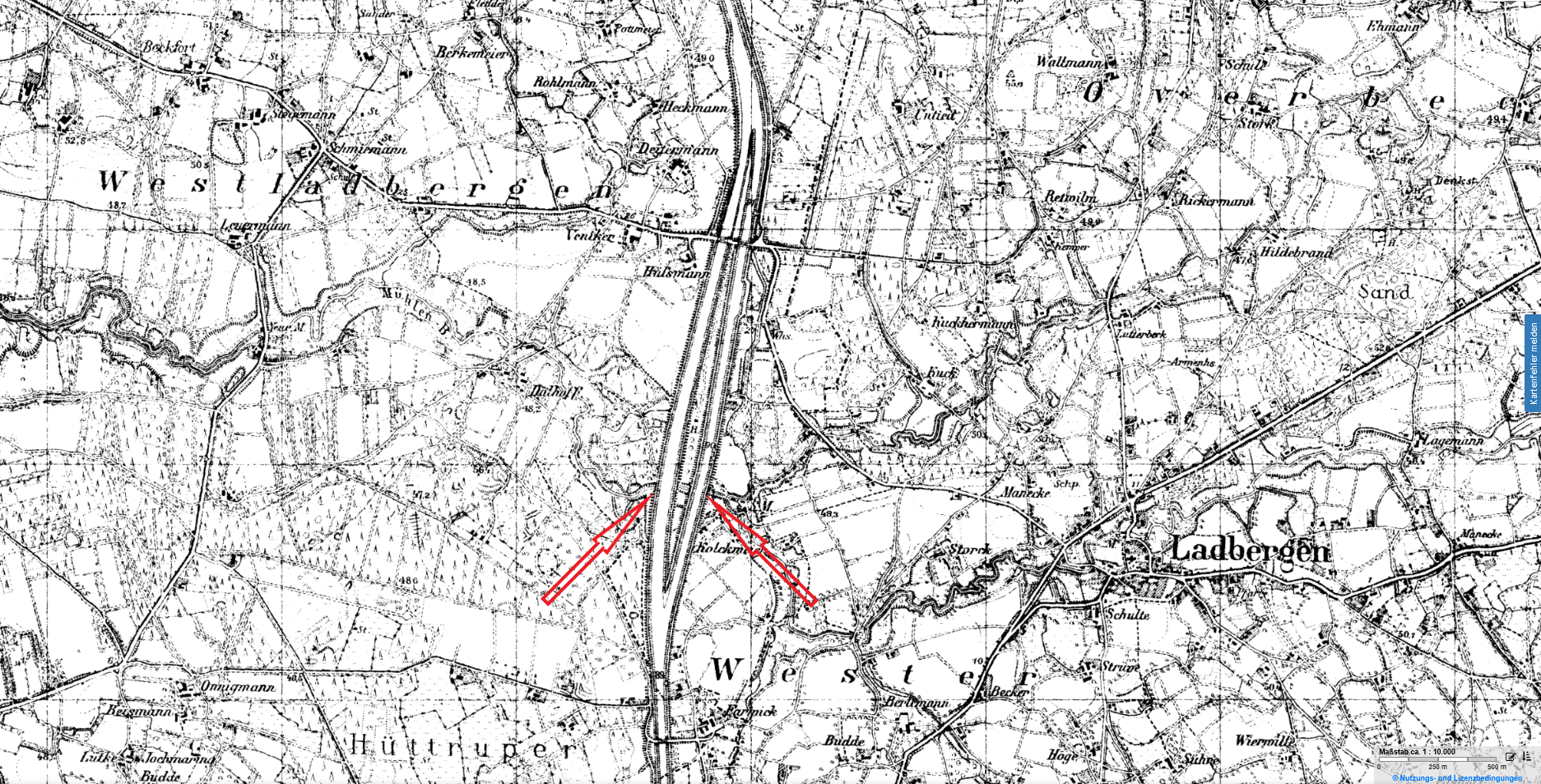
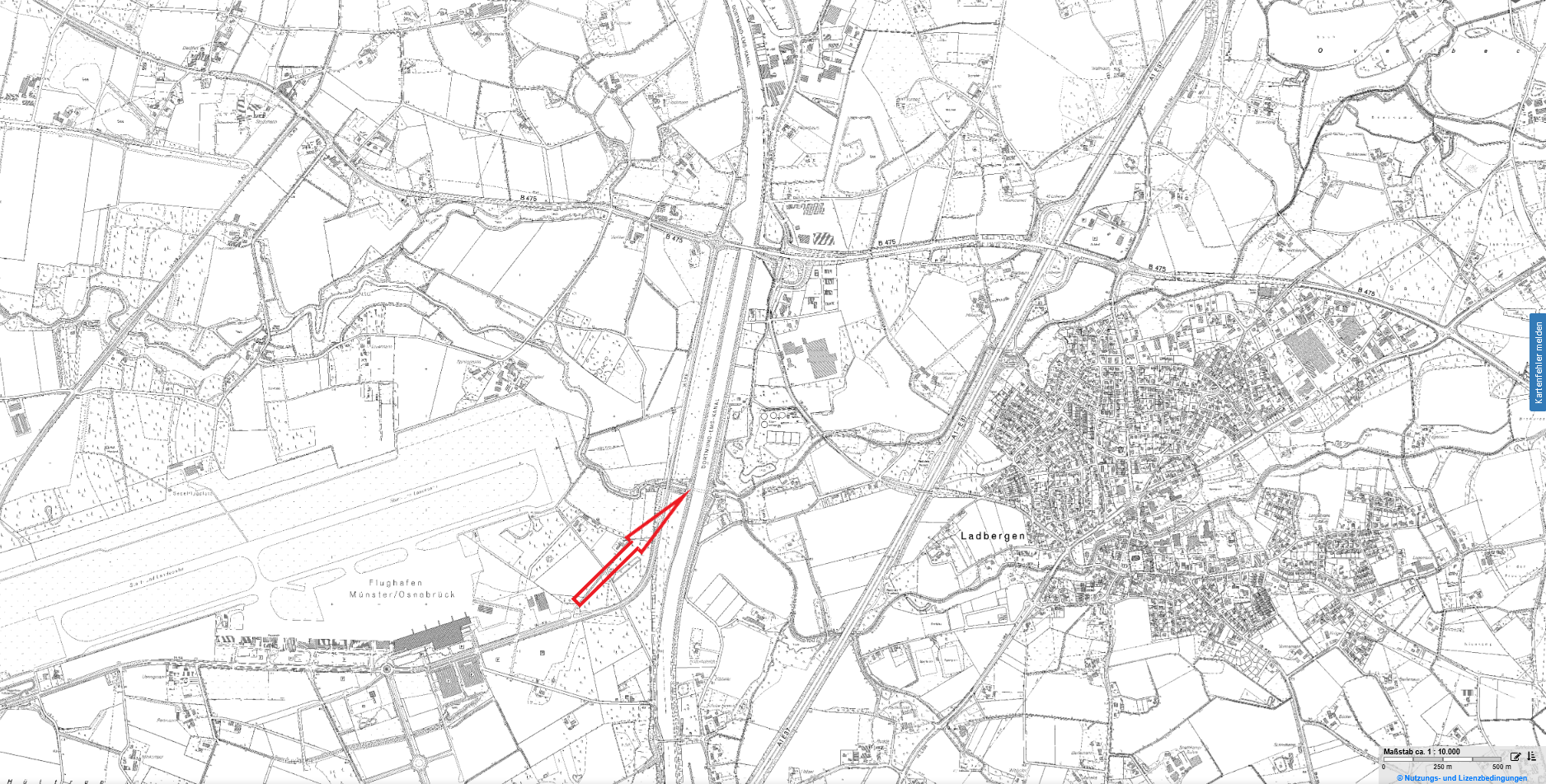
Figure shows a topographical map from 2016. Due to the extensive damage sustained by the Alte Fahrt during the Second World War, it had not been restored. When the canal was widened near Ladbergen in the 1980s and 1990s, the “3. Fahrt” (English: third branch) was built to the east of the 2. Fahrt, on the site of the original “Alte Fahrt”. The 2. Fahrt was razed to the ground. In its place, a road now runs from the B 475 federal road to Münster/Osnabrück Airport.
The Glane culvert in the Dortmund-Ems Canal
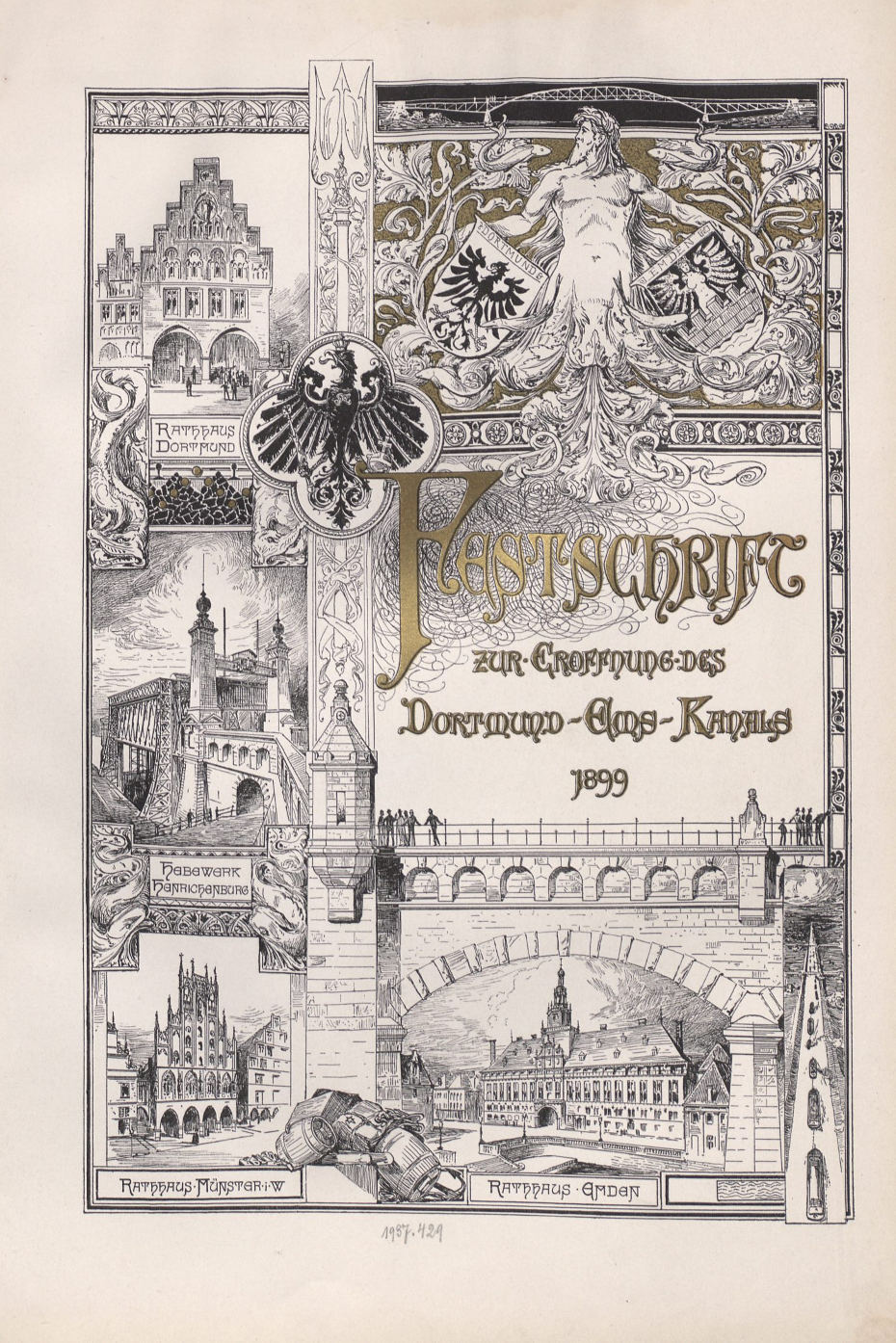
The passage of the River Glane beneath the Dortmund-Ems Canal is consistently referred to as a ‘culvert’ in the records of the Münster Waterways and Shipping Authority, which is responsible for this structure. By contrast, the term ‘aqueduct’ is generally used, particularly in publications from British sources dating from the Second World War. Less frequently, the structure is referred to as an ‘inverted siphon’ (German: Düker, formerly ‘Dücker’). For example, in the ‘Commemorative Publication on the Opening of the Dortmund-Ems Canal’ from 1899 (see Figure ): “These are followed in succession by the “Düker” for four tributaries of the Ems: the Gellenbach, the Eltingsmühlbach, the Nebenbach and the Glane.”
The three terms “aqueduct”, “inverted siphon” and “culvert” are defined as follows in the 7th edition of Meyers’ Encyclopaedia from 1924:
- Aqueduct
- (Latin for »water conduits«), bridges that carry a water channel are said to have been built as early as the time of Ramses the Great, Semiramis and Solomon for the purpose of water supply. – […] Aqueducts that carry a navigable canal are called canal bridges or bridge canals. [Translation of the author] 10
- Inverted siphon
- An underpass for a watercourse or water pipeline running transversely beneath roads, railway lines, navigable canals, rivers, valleys and other water pipelines, where the top of the underpass lies below the water level outside the structure […]. The function of the inverted siphon is therefore based on the principle of communicating vessels. Inverted siphons are constructed from brick-lined or concrete channels, or from pipes made of wood, iron, reinforced concrete or earthenware. [Translation of the author] 5
- Culvert
- A narrow channel that carries small watercourses or pools of water through road, railway or canal embankments. Culverts of this type consist of clay, iron or wooden pipes (pipe culverts) or are built of masonry. Masonry culverts are covered with slabs (culvert covers) or by a vaulted structure. [Translation of the author] 5
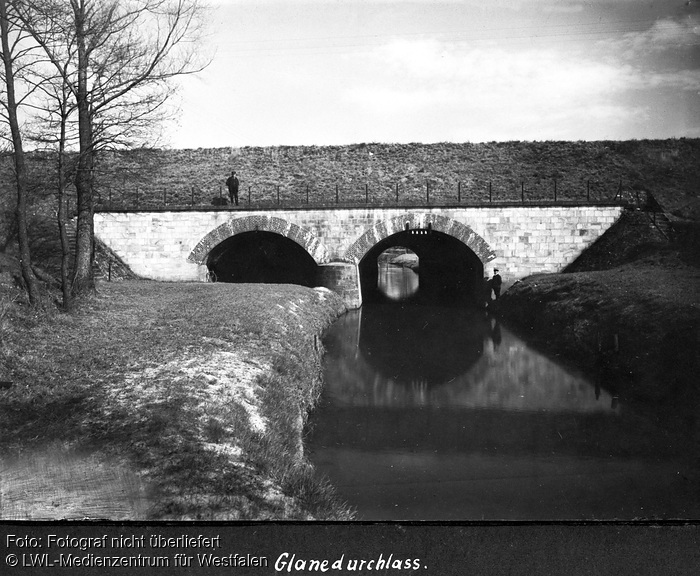
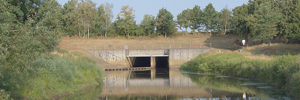
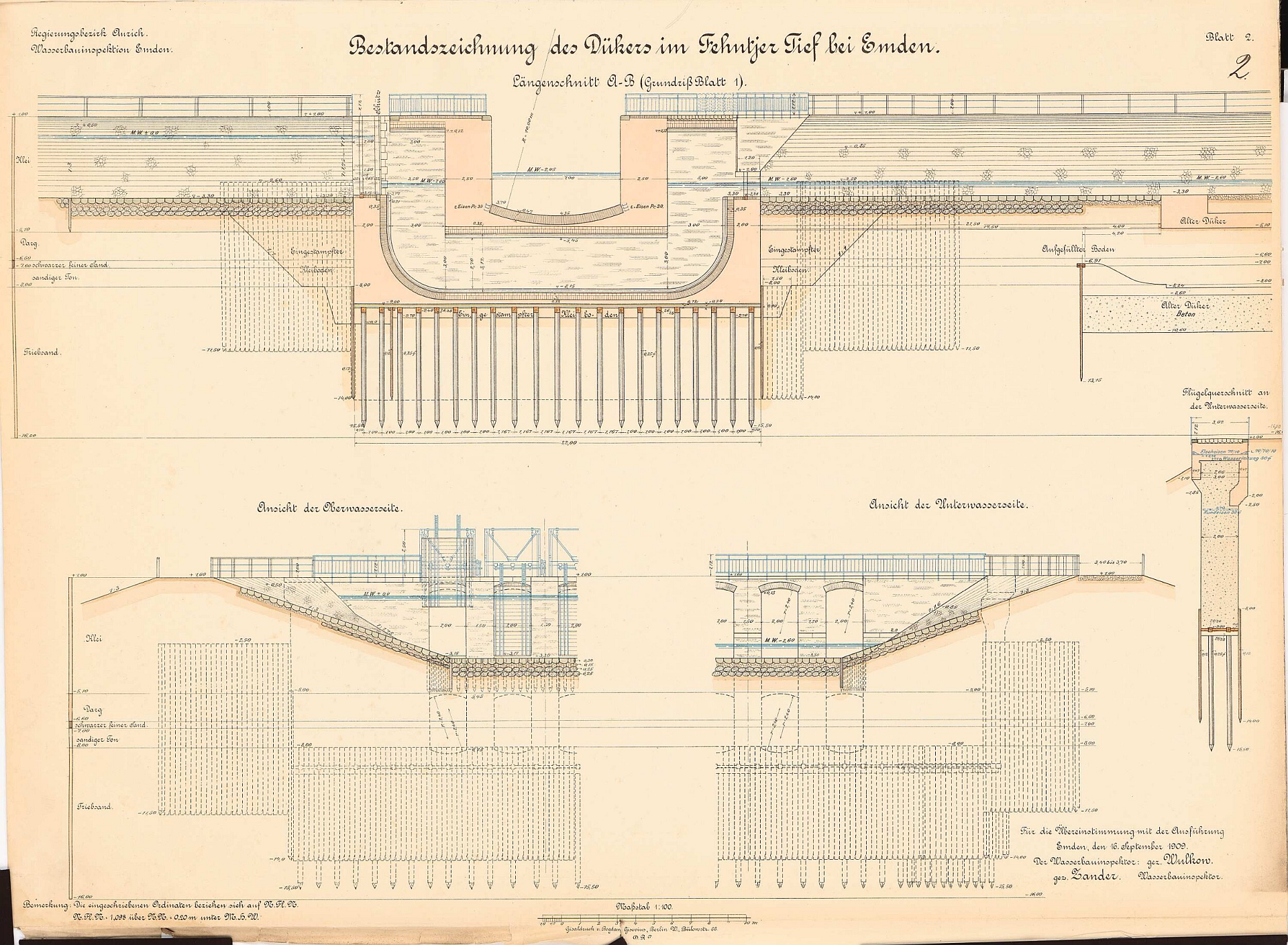
As can be seen in Figure , the outline of the eastern inlet is reflected on the opposite side of the right-hand culvert on the surface of the Glane. It is therefore possible to see right through it. In the case of an inverted siphon, ‘the top of the underpass lies below the water level outside the structure’, as can be clearly seen in the ‘As-built drawing of the inverted siphon in the Fehntjer Tief near Emden, 1909’ beneath the Dortmund-Ems Canal (see Figure ). With an inverted siphon, it is not possible to see through between the inlet and outlet. Consequently, the structure shown in Figure cannot be an inverted siphon.
Malcolm Brooke has published a historical photograph of the eastern inlet of the Glane culvert on the The Ladbergen Area⤴ webpage.
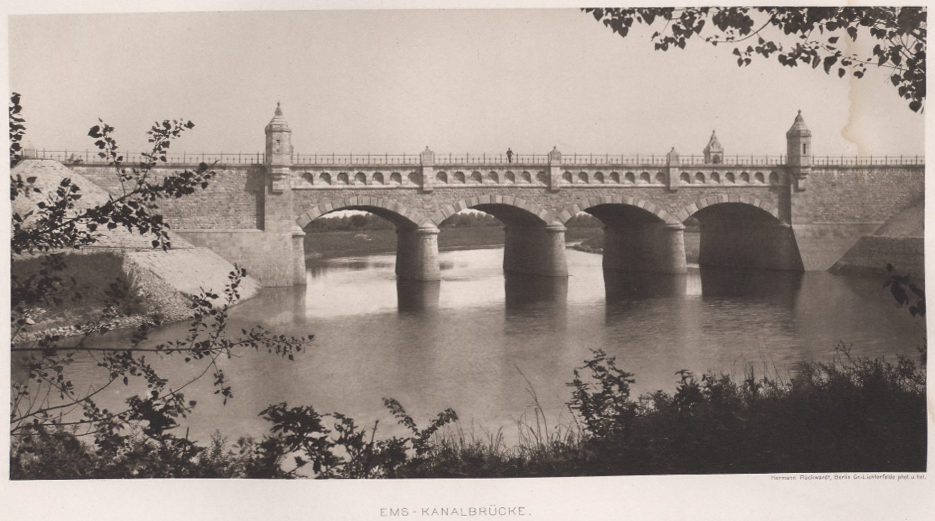
In the Figure , one can also see the area above the water passage, which appears to be overgrown with grass. This area forms part of the canal embankment of the Alte Fahrt, which was built up during the construction of the canal. In contrast to this structure, in the case of an aqueduct or a canal bridge – such as the Ems Canal Bridge near Greven-Fuestrup (see Figure ) – the masonry canal wall can be seen above the four arches.
Consequently, the structure designed to allow the River Glane to flow beneath the Dortmund-Ems Canal is not an aqueduct or a canal bridge, but a culvert.
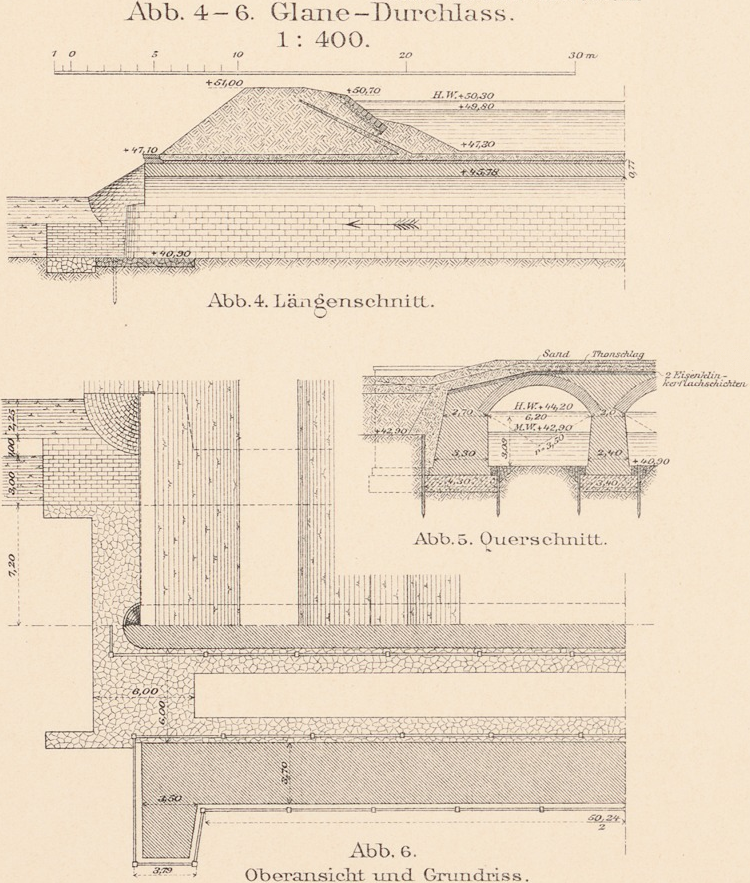
An engraving (see Figure ) in the Atlas zur Zeitschrift für Bauwesen, published by the Ministry of Public Works, Volume 51, in 1901, shows the Glane culvert on the Alte Fahrt in longitudinal section (German: Längenschnitt), cross-section (German: Querschnitt), top view (German: Oberansicht) and plan view (German: Grundriss).
History
Construction of the canal 1892 – 1899
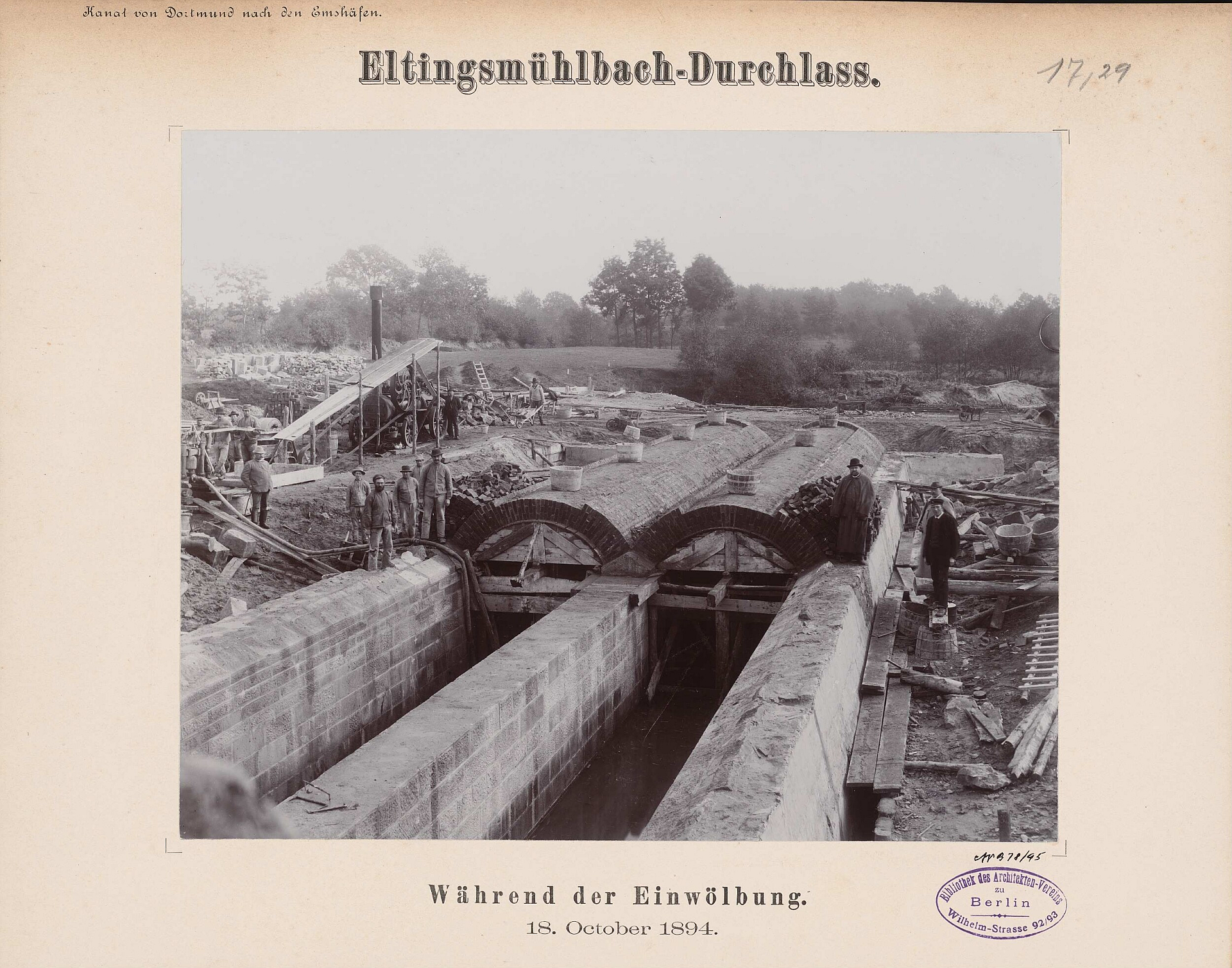
Before the Dortmund-Ems Canal was built between 1892 and 1899 and its channel bed was filled in at Ladbergen, the Glane culvert was constructed. It is thought that the same construction method was used as for the neighbouring Eltingmühlenbach to the south (see Figure ).
Construction of the second branch near Ladbergen 1935 – 1939
With the extension of the Dortmund-Ems Canal to include a second branch at Ladbergen, a new structure had to be built to divert the Glane stream beneath the canal […]. As there was sufficient head, a culvert was constructed in the form of a closed reinforced concrete frame with three openings and wing walls made of anchored steel sheet piles. […] The work was carried out before the start of the earthworks in 1935–36. The new section of the canal was completed at the end of 1939 and opened to shipping at the beginning of 1940. [Translation of the autor] 15
The church path between Ladbergen and Saerbeck
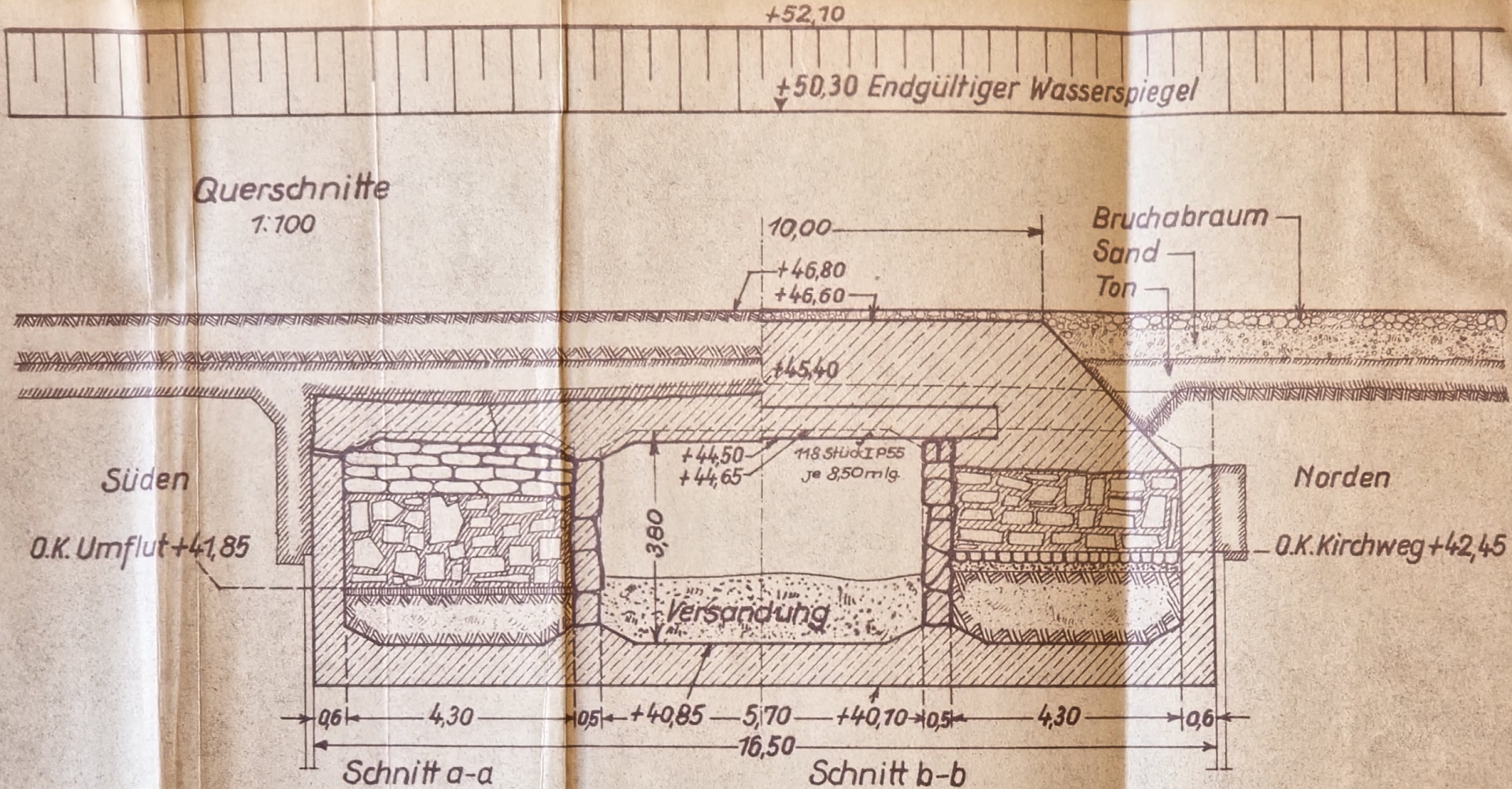
When the Dortmund-Ems Canal was built, there was a Protestant church in Ladbergen and a Catholic church in Saerbeck. To ensure that worshippers from both parishes – who attended services in the other parish – were not forced to take a considerable detour via one of the bridges because of the Dortmund-Ems Canal, the top edge of the northern culvert opening was raised. In Figure , this is the left-hand opening. The Glane only flowed through this northern opening during periods of high water.
It was not only churchgoers who used this so-called ‘Kirchweg’, but also schoolchildren and an estimated 150 to 200 local residents. 16
During the construction of the second branch, a state police inspection and the planning approval procedure of 6 April 1934 stipulated that the church path should be extended through the new Glane culvert. 16
The top edge of the floor of the northern culvert opening in the second branch was also higher than that of the other two openings (see Figure : “O.K. Kirchweg +42,45″ compared with “O.K. Umflut +41,85″ for the southern culvert opening and +40.85 for the central culvert opening)).
The Glane culverts in World War II
Along the Dortmund-Ems Canal west of Ladbergen and at the Glane culvert, it is no longer possible today to tell just how fiercely contested this area was during the World War II. Raids involving more than a hundred Lancaster bombers were carried out, leaving behind a landscape resembling a lunar crater (see Figure ).
Nowhere else in the German Reich were more bombs dropped per square metre during the Second World War than in the area of the Glane culverts. […] 4,444.3 tonnes of bombs were dropped during this period. [Translation of the author] 1
Anti-aircraft warfare (Flak) with calibres of up to 10.5 cm were deployed for defence; these were otherwise used in major cities. 18
The Dortmund-Ems Canal under attack
The importance of the Dortmund-Ems Canal to the German Empire’s war effort can be seen from the following military-economic analysis.
Military analysis of enemy attacks on Reich territory by air, artillery fire and drifting mines from 10 May to 10 July 1940
16.) Canals and harbours.
Dortmund-Ems Canal
Weser-Ems "
Mittelland "
Kaiser-Wilhelm "
were the targets of multiple attacks. In total, the canals were attacked 19 times and the ports 17 times.
During the attacks on the canals, air mines (air torpedoes) were used, amongst other things, which had a significant impact. The resulting closure of the Dortmund-Ems Canal had an extremely disruptive effect. The shortage of coal for domestic heating and industrial use, combined with the inadequate capacity of the Reichsbahn – which necessitates the full utilisation of inland waterway transport for the purposes of the war economy – makes it absolutely imperative that the locks and lifting gear of the major canals, as well as the loading facilities at inland ports, be afforded greater protection than has been the case to date. [Translation of the author] 19))
Before the Glane culverts and the Dortmund-Ems Canal near Ladbergen were bombed for the first time on 23 July 1940, the Dortmund-Ems Canal had already been attacked at the canal bridges over the Ems in Greven-Fuestrup and at the Münster lock. The war diary of Armaments Inspectorate VI in Münster contains the following assessment of the situation on 6 July 1940:
Traffic on the canal has been a cause for concern since around mid-June. Whilst the enemy previously confined itself to attacking the harbour and the Münster lock with individual aircraft, it launched a more intense attack on these two targets during the night of 1–2 July. Although around 40 bombs were dropped, they failed to cause serious damage to the harbour or the lock. However, considerable damage was caused to barges, storage areas, factories and residential buildings. Recently, the enemy has also been directing its attacks with great persistence against the canal in the vicinity of the Fuestrup Bridge, where the canal crosses the Ems. Here, alongside the old canal bed (the ‘alte Fahrt’), which is relatively narrow and struggles to cope with traffic volumes that have increased tenfold compared to peacetime, a new bed (the ‘neue Fahrt’) has been constructed. This new channel is also intended to compensate for a bend that the canal makes at this point.
This section is particularly vulnerable because the destruction of the canal bed here would result in the suspension of shipping for weeks, if not months.
Towards the end of June, enemy aircraft succeeded in dropping two large bombs onto the canal embankment; although these did not cause any major damage, they did necessitate the draining of the canal over a length of 9 km, as it was impossible to rule out the possibility that the canal embankments might have been breached by the explosion. This was not the case, but during the draining of the canal it was discovered that a bomb had already fallen into the canal and caused significant damage to the bed, which now also had to be repaired.
This brought canal shipping to a standstill for around 10 days, and operations could not resume until 1 July – a disruption which was particularly inconvenient given the heavy demand from coal and, above all, ore transport.
Whilst repair work was still underway, an aerial bomb struck the so-called trough of the new Ems crossing during a daytime raid, thereby delaying the imminent commissioning of this section by at least a few weeks. Several barges and one of the construction machines on the new crossing were also significantly damaged by aerial bombs. 20
The Glane culverts under attack
The author is not (yet) aware of any contemporary primary sources from the Royal Air Force (RAF) or the UK Ministry of Defence which set out the reasons for selecting the Glane culverts as a target for bombing. Secondary sources consistently refer to the relatively deep-cut bed of the Glane (see Figure ). From this figure, we can see that the top edge of the floor of the central opening at the eastern inlet (on the right-hand side of the image) on the second branch was at +40.85 m, the top edge of the canal bed at +46.80 m and the top edge of the water level at +50.30 m. However, this factor cannot have been decisive, as, for example, the canal bridge over the Ems (see Figure ) was higher.

Other criteria may have been decisive.
- Repairing bomb-damaged structures, such as canal embankments, canal bridges, locks, ship lifts, inverted siphons or culverts, is a time-consuming process.
- The flight path from the airfield to the target and back can be planned in such a way that as few shoot-downs as possible – for example, by anti-aircraft guns (Flak) – are to be expected.
- Particularly during night-time raids, there are clear landmarks to help identify the target.
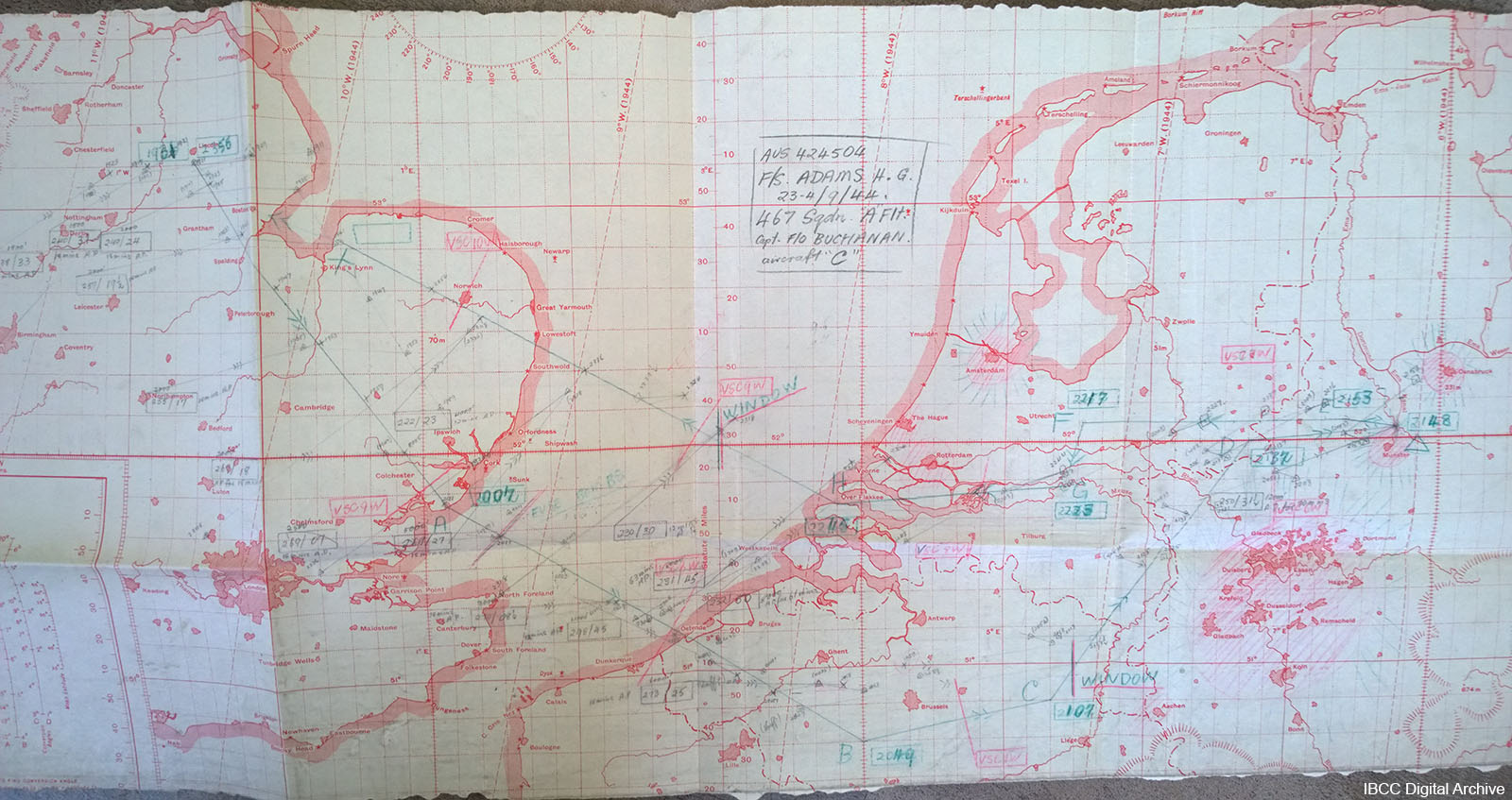
In Figure of a navigation map drawn up by Flight Sergeant (F/S) Herbert Adams⤴ for the night-time attack on the Glane culverts on 23–24 September 1944, areas such as the Ruhr region, Münster, Osnabrück, Amsterdam, Rotterdam and The Hague are hatched in red; these would have been clearly visible at night due to their lighting. The Australian Herbert Adams was a navigator with No. 467 Squadron RAAF⤴ at RAF Waddington⤴ station, south of Lincoln in the United Kingdom.
The bombing of the Glane culverts and its effects
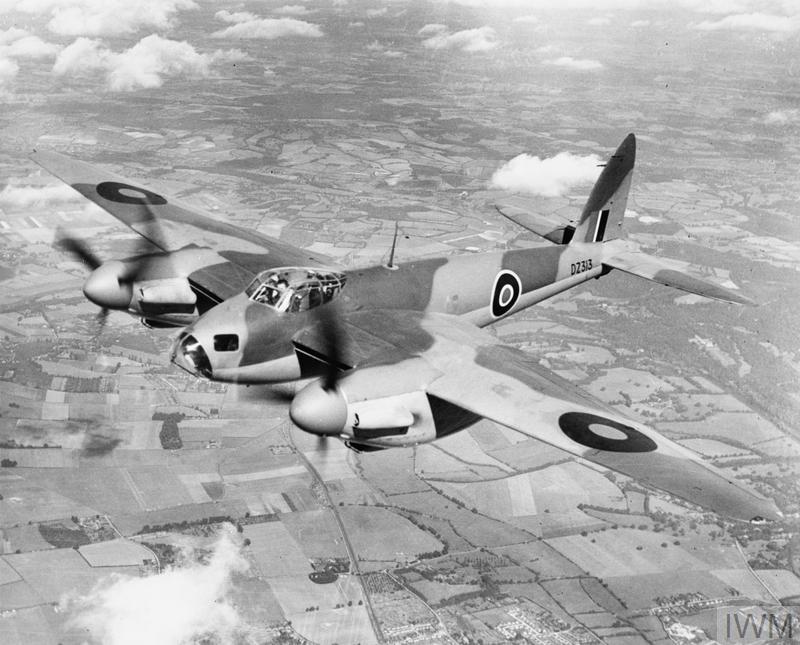
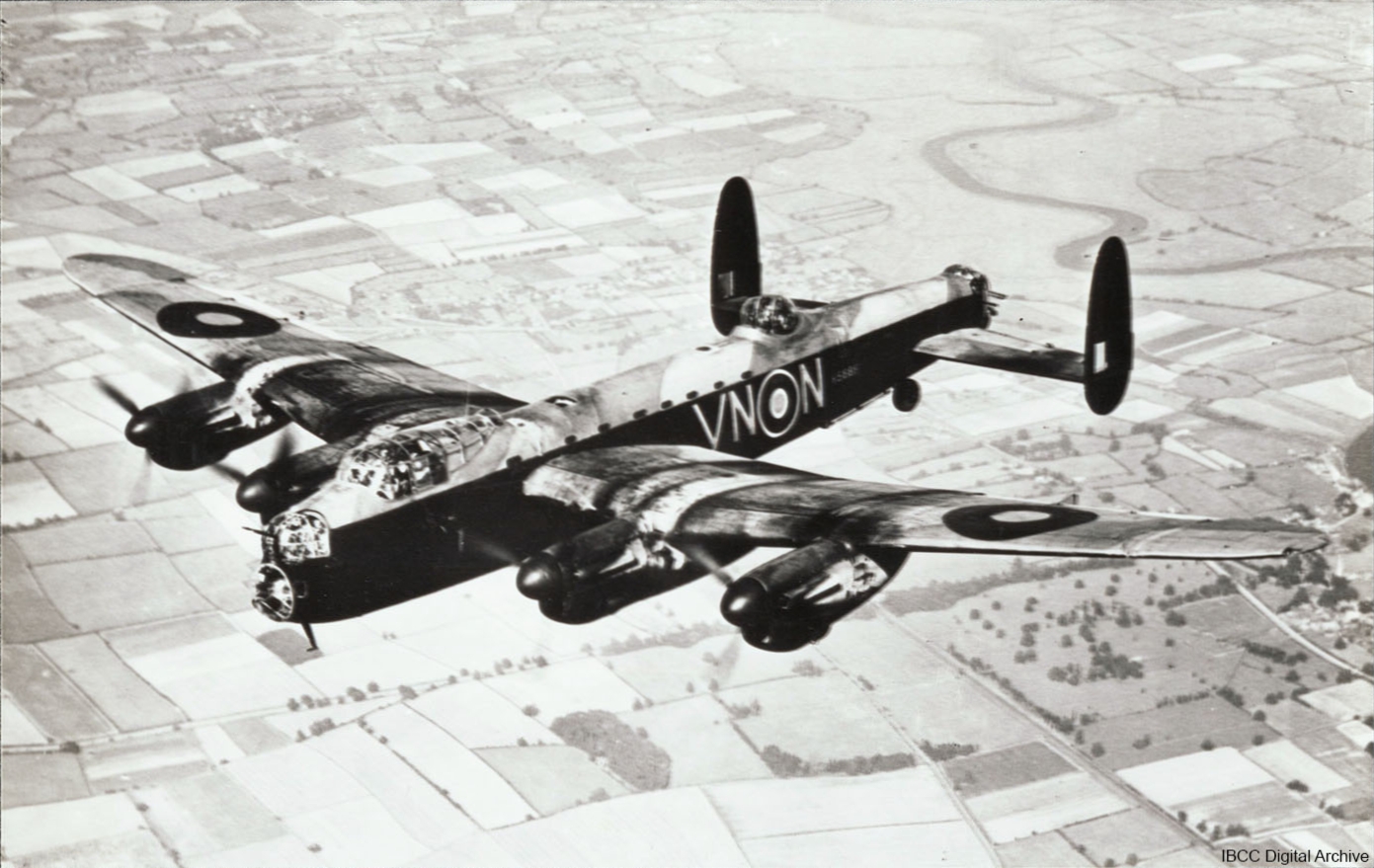
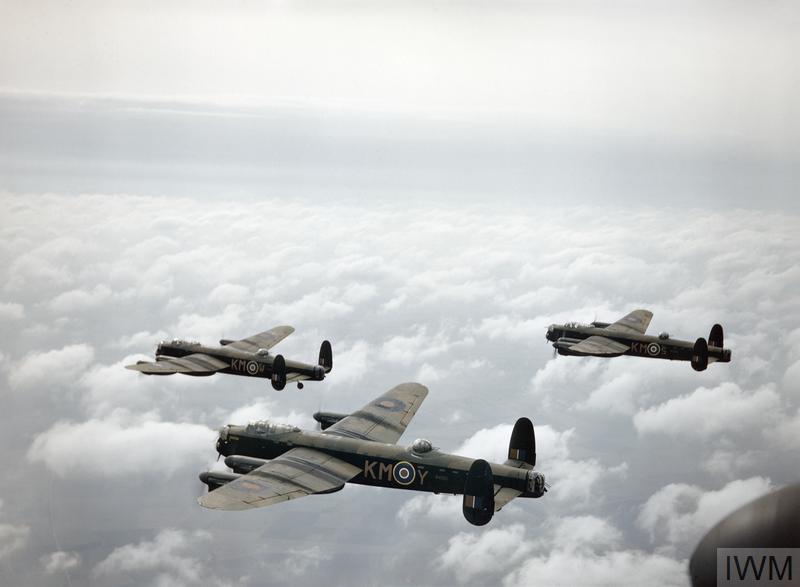
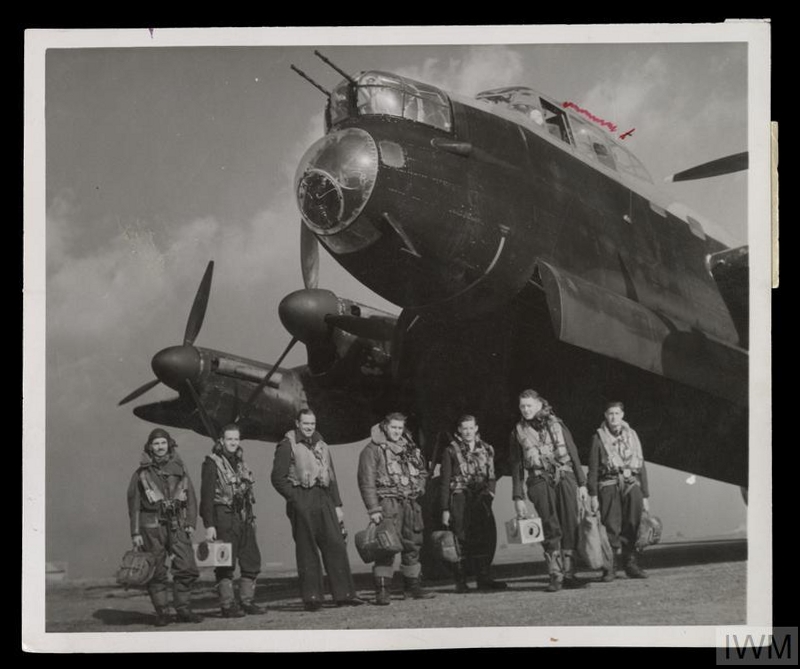
No. 5 Group RAF⤴ (5 Group, 5 Gp, V Group) in RAF Bomber Command⤴ of the Royal Air Force (RAF)⤴ planned and carried out the bombing raids on the Glane Passage during World War II. The attacks were carried out using the multirole attack aircraft De Havilland DH.98 “Mosquito”⤴ and the bomber Avro 683 “Lancaster”⤴. A Mosquito typically had a crew of 2, and a Lancaster typically had 7.
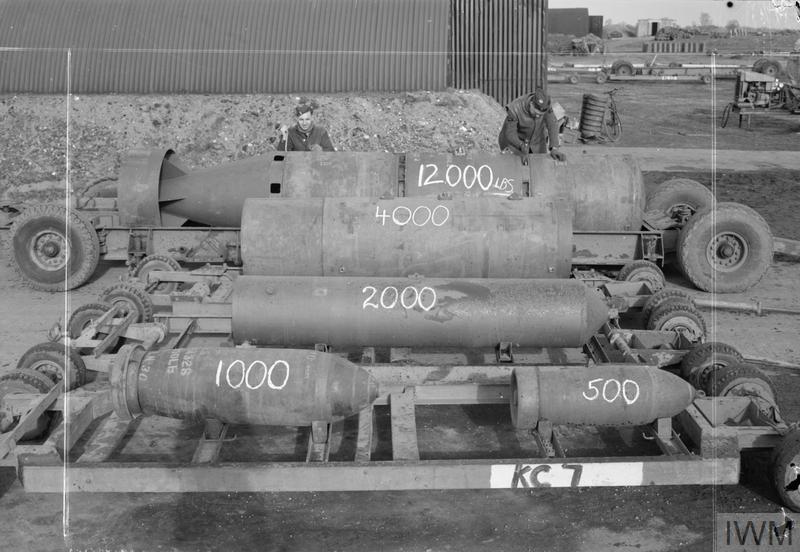
Raid on 23/24 July 1940
In the case of two-day missions, the aircraft took off from their home airfields in the evening according to a precise sequence plan and landed there again on the morning of the following day after a total flight time of around 5 to 6 hours. One-day missions were flown during the day.
Supreme Command of the Wehrmacht, Defence Economy and Armaments Office
Report on enemy air raids, bombing raids, mines and artillery fire directed at targets of strategic importance from 23 to 24 July 1940.
Rü In VI:
Saerbeck: 3 high-explosive bombs and several incendiary bombs near the Dortmund-Ems Canal. Damage to buildings. [Translation of the author] 27
Raid on 3 September 1940
Supreme Command of the Wehrmacht, Defence Economy and Armaments Office
Report on enemy air raids, bombing raids, mines and artillery fire directed at targets of strategic importance from 3 to 4 September 1940.
Follow-up to the report of 3 September 1940
Rü In VI:
Laerbeck [sic] Münster District: 5 high-explosive bombs, including 1 with a delayed-action fuse, dropped over open countryside. 1 high-explosive bomb detonated in the Dortmund-Ems Canal bed without causing any damage. The target was presumably the canal bridge.
Ladbergen: 7 high-explosive bombs, including 3 with delayed-action fuses, dropped over open countryside; minor damage to crops (impact 1.5 km from the Dortmund-Ems Canal). [Translation of the author] 28
Raid on 19/20 September 1940
Supreme Command of the Wehrmacht, Defence Economy and Armaments Office
Report on enemy air raids, bombing raids and mines directed at targets of strategic importance from 19 to 20 September 1940.
Detailed report
20. September 1940
Rü In VI:
Sarbeck [sic]: Three high-explosive bombs found in the Westladbergen farming community, near the security gate of the Dortmund-Ems Canal; no disruption to shipping; minor damage to farmland. [Translation of the author] 29
Commander-in-Chief of the Air Force, Command Staff Ic
Final summary of bomb drops, appendix to situational map 3, serial no. 277 (attacks), completed on 20 September 1940 at 08.00.
20 Sept. 1940
(Münster District)
(Glane culvert)
North Westphalia Münster Gau Leadership
muenster warendorf district:
air raid alert from 3 to 4.12 am. in saerbeck, 100 metres from the canal: two high-explosive bombs and one unexploded bomb. minor damage to surrounding countryside. [Translation of the author] 31
Raid on 24/25 September 1940
Supreme Command of the Wehrmacht, Defence Economy and Armaments Office
Report on enemy air raids, bombing raids and mines directed at targets of strategic importance from 25 to 26 September 1940.
Follow-up to the report of 24/25 September 1940:
Rü In VI:
Ladbergen: 8 high-explosive bombs, including 2 with delayed-action fuses; minor damage to buildings. [Translation of the author] 32
Commander-in-Chief of the Air Force, Command Staff Ic
Final summary of bomb drops completed on 25 September 1940 at 08.00, appendix to situational map 3, serial no. 282 (attacks).
24 Sept. 1940
(Tecklenburg District)
Raid on 26/27 September 1940
Supreme Command of the Wehrmacht, Defence Economy and Armaments Office
Report on enemy air raids, bombing raids and mines directed at targets of strategic importance from 26 to 27 September 1940.
Detailed report.
27. September 1940
Enemy air raids in two groups.
Northern group in the area of Rinköpping, Aarhus, Copenhagen, Mön, Doberan, Lübeck and Norderney. Mine drops suspected.
Western group in the area of Meppen, Vechta, Minden, Münster and Coesfeld.
No clear focal points.
Rü In VI:
Münster: 15 high-explosive bombs, near the Glane culvert beneath the Dortmund-Ems Canal. Impact craters on both sides of the canal and 1 km to the east of it. The canal embankment was slightly damaged; damage to surrounding fields.
Shipping was not impeded. [Translation of the author] 34
Commander-in-Chief of the Air Force, Command Staff Ic
“Final summary of bomb drops, appendix to situational map 3, serial no. 284 (attacks) completed on 27 September 1940 at 08.00.
0100
Münster District
The canal embankment was slightly damaged by four bomb impacts; otherwise, only minor damage to the surrounding countryside.
Navigation was not impeded.
0030
Münster District
Embankment suffered minor damage from one high-explosive bomb.” 35
Raid on 14/15 September 1943
“The raid (Operation Garlic) had been proposed and cancelled several times but took place initially on the 14th September 1943.” 36
RAF Bomber Command Campaign Diary
“8 Lancasters of 617 Squadron set out with the new 12,000lb bomb (not the 12,000lb Tallboy ‘earthquake’ bomb developed later) to attack the banks of the Dortmund-Ems Canal near Ladbergen. While the force was over the North Sea, however, a weather reconnaissance Mosquito reported that there was fog in the target area and the Lancasters were recalled. The aircraft of Flight Lieutenant DIH Maltby, one of the original members of the squadron that had attacked the Ruhr dams, crashed into the sea and the crew were all killed. Maltby’s body was washed ashore and is buried at Wickhambreux, near Canterbury in Kent; the names of the other 6 crew members are on the Runnymede Memorial for the Missing.” 37
Losses
- RAF Bomber Command suffered the following losses involving the RAF and RAFVR crew of the Lancaster bomber with serial number JA981⤴:
- Killed in action: 8 38
Raid on 15/16 September 1943
The attack (Operation Garlic), which had been called off on 14/15 September 1943, was repeated during the night of 15/16 September. 39
RAF Bomber Command Campaign Diary
“8 Lancasters of 617 Squadron took off to carry out the postponed raid on the Dortmund-Ems Canal but the area was misty and 5 aircraft were lost, including those of Pilot Officer LG Knight, another of the Dams Raid survivors, and the new squadron commander, Squadron Leader G Holden. These heavy losses, and the losses of the Dams Raid, confirmed that low-level attacks on German targets, even when away from major defended areas, were not viable with heavy bombers and this type of operation was not repeated. 617 Squadron now started retraining as a specialist high-altitude-bombing unit.” 37
Losses
- RAF Bomber Command suffered the following losses involving the RAF, RAAF, RAFVR and RCAF crews of the Lancaster bombers with serial numbers EE130⤴, EE144⤴, JA874⤴, JA898⤴ and JB144⤴:
- Killed in action: 33 38
- Civilian population
- Fatalities in Nordhorn: 1 40
Reconnaissance prior to 23 September 1944
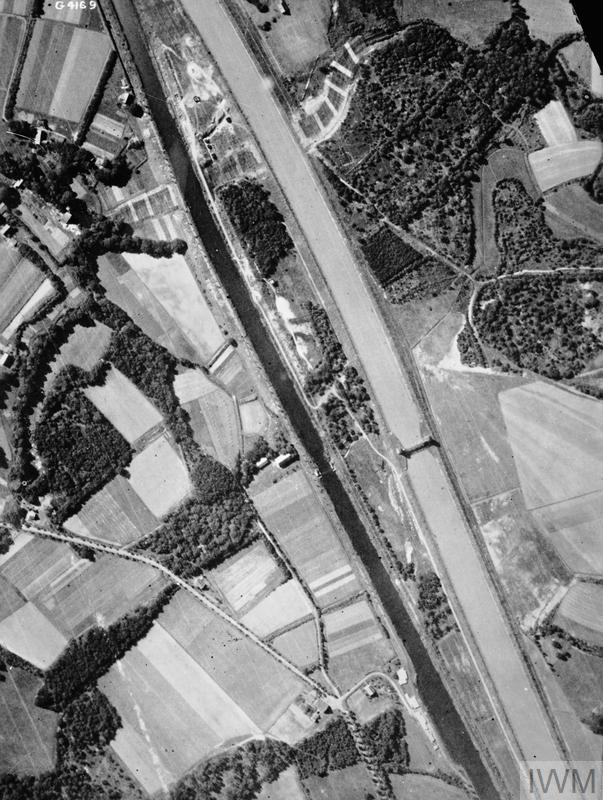
The second branch, situated to the west, can be seen in Figure to the right of the eastern ‘Alte Fahrt’. Ladbergen lies further east, to the left and outside the frame. The Glane (at the top of the image) is on the left, between and to the right of the two canal branches, and is fitted with camouflage devices. Just below the centre of the picture (i.e. north of the Glane culverts), the security gates can be seen in both branches of the canal. Ladbergen harbour is situated in the Alte Fahrt, at the bottom of the image on the left-hand side of the canal.
Raid on 23/24 September 1944
RAF Bomber Command Campaign Diary
“136 Lancasters and 5 Mosquitos of No 5 Group to bomb the banks of the 2 parallel branches of the Dortmund-Ems canal at a point near Ladbergen, north of Münster, where the level of the canal water was well above the level of the surrounding land. Despite the presence of 7/10ths cloud in the target area, breaches were made in the banks of both branches of the canal and a 6-mile stretch of it was drained. Most of this damage was caused by 2 direct hits by 12,000lb Tallboy bombs dropped by aircraft of No 617 Squadron at the opening of the raid. 14 Lancasters -more than 10 per cent of the Lancaster force – were lost.” 42
V Group News
“FOREWORD BY A.O.C.
September was a most successful month and a reward for the hard work which all ranks have put in throughout the Summer. The Group secured two prizes for which many have striven since the early days of the War, the Tirpitz and the Dortmund-Ems Canal. The attack on the Tirpitz was splendidly undertaken by Nos. 9 and 617 Squadrons and appears to have been highly successful in spite of a most efficient smoke screen. The attack on the Dortmund-Ems Canal has earned the following message from the Secretary of State for Air.
‘The War Cabinet have instructed me to convey to you and to all concerned their congratulations on the outstanding success achieved in the recent attack on the Dortmund-Ems Canal. Pressed home with great determination against strong opposition and in difficult weather it constituted yet another major blow against German War economy.’
These two attacks have once more shown the remarkable efficiency of the 12,000 lb. ‘Tallboy’ bomb when it hits the target. […]
DORTMUND-EMS CANAL, HANDORF AIRFIELD AND MUNSTER – 23/24TH SEPTEMBER.
Master Bomber:- Red Target: Wing Commander Woodroffe.
Green Target: Squadron Leader Owen.
A large force comprising 254 aircraft from all Bases in the Group was detailed to attack these targets, the first two being the primaries and the last, Munster, an alternative, should the weather present difficulties for marking and attack. Unfortunately 10/10ths cloud was encountered in the target area with base 8,000 ft.
PLAN No.53 Base plus 106 Squadron and 617 Squadron were ordered to attack the red target (Dortmund-Ems Canal) and Nos. 52 and 55 Bases the green target (Handorf Airfield). If the red target were not marked, the red force, excluding the Tallboy aircraft, were to attack the green target, or if the green target was not marked, the yellow target. Similarly, the green force were to attack the yellow target as an alternative.
RESULTS Dortmund-Ems Canal – Although the portion of the canal marked and attacked was some 7 miles North of the planned aiming point, a very successful attack ensued, and both branches of the embanked portion of the canal were breached. A stretch of 18 miles of the canal is now dry, and over 100 barges are stranded. A splendid result. Of the red force, 82 Lancasters attacked the primary, and 12 the alternative.” 43
Ladbergen Canal Construction Management
During the first attack – 23 September 1944 – no damage was found at the culverts. The western embankment of the old canal was breached between the safety gate and the Glane, causing the water to flow out from Fuestrup to Ladbergen.
The western embankment of the second section was breached approximately 100 m north of the safety gate, causing water to flow out along the Ladbergen–Bevergern stretch as well, totalling 30 km. The embankments along this stretch had partially subsided and were scarred.
The repair work proved very difficult in the first few days due to a lack of equipment. The dams were partially repaired manually by removing soil from the side of the dam section southeast of the new safety gate and then backfilling.
The damaged dam northwest of the safety gate was reinforced with 9.0 m long sheet piles and filled with sand.
The remaining damaged areas were repaired with sand and the soil compacted. The old canal north of the Glane culvert was fitted with a dam and reinforced with 6.00 m long sheet piles.
Shipping continued for a few days. [Translation of the author] 44
Losses
- RAF Bomber Command suffered the following losses involving the RAF, RAAF, RAFVR, RCAF and RNZAF crews of the Lancaster bombers with serial numbers LL914⤴, LM212⤴, LM223⤴, LM309⤴, LM718⤴, ME700⤴, ME732⤴, ND868⤴, ND988⤴, NF923⤴, PA974⤴ and PB409⤴:
- Killed in action: 55 38
Missing in action: 10 38
Died of wounds: 1 38 - German Wehrmacht
- Killed in action: 3 (Anti-aircraft soldiers) 45
- Civilian population
- Fatalities in Ladbergen: 17 46 45 1
Reconnaissance on 2 October 1944
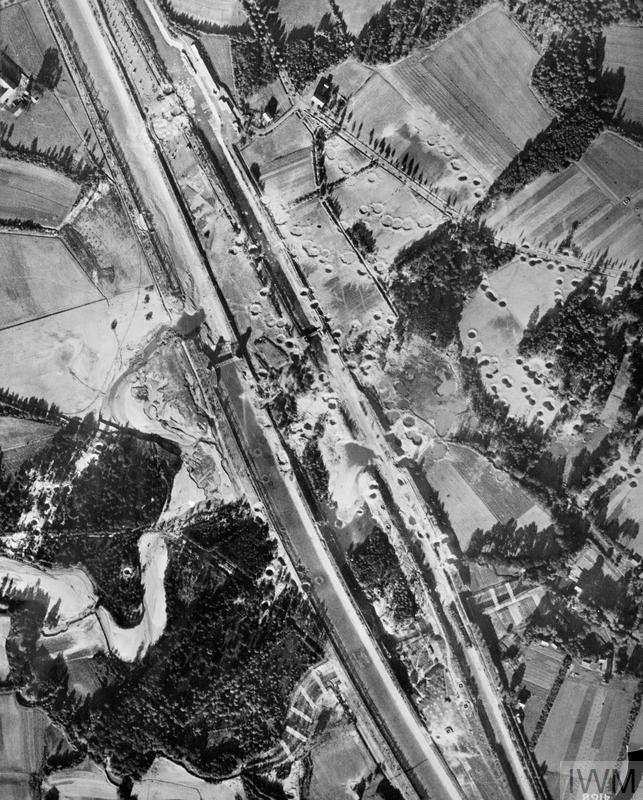
The second branch, situated to the west, can be seen in Figure to the left of the Alte Fahrt, which lies to the east. Ladbergen lies further east, to the right and outside the frame. The Glane (at the bottom of the image) is equipped with camouflage devices on the left, between and to the right of the two canal branches. Slightly above the centre of the image, the security gates can be seen in both canal branches. Ladbergen harbour is situated in the Alte Fahrt, at the top of the image on the right-hand side of the canal.
“Breaches have been made in the banks of two parallel branches of the canal, causing a six-mile stretch to be drained. Most of the damage was caused by two direct hits by 12,000-lb ‘Tallboy’ deep penetration bombs dropped by No. 617 Squadron RAF.” 47
Raid on 4/5 November 1944
RAF Bomber Command Campaign Diary
“174 Lancasters and 2 Mosquitos of No 5 Group. 3 Lancasters lost. The Germans had partly repaired the section of the canal north of Münster after the No 5 Group raid in September, so this further attack was required. The banks of both branches of the canal were again breached and water drained off, leaving barges stranded and the canal unusable. A report from Speer to Hitler, dated 11 November 1944, was captured at the end of the war and described how the bombing of the canal was preventing smelting coke from the Ruhr mines reaching 3 important steelworks – 2 near Brunswick and 1 at Osnabrück. In his post-war interrogation, Speer stated that these raids on the Dortmund-Ems Canal, together with attacks on the German railway system, produced more serious setbacks to the German war industry at this time than any other type of bombing.” 48
V Group News
“Master Bomber:- S/Ldr Smith
Deputy:- S/Ldr Churcher
The importance which the Germans attach to the Dortmund-Ems Canal as one of their main transport arteries was amply demonstrated by the fact that both branches of the canal, breached and emptied by the 5 Group raid on 23/24th September, were repaired within less than six weeks, and in full working order. The same stretch of canal was therefore attacked for a second time, by 176 main force aircraft on 4/5th November.
PLAN The aiming point, on the narrow island separating the two branches of the canal, was to be marked direct by Mosquitoes of No.54 Base with Red T.I’s. All aircraft carried a bomb load of 14 X 1,000 G.P’s and crews were ordered to aim the centre bomb of the stick at the red T.I’s.
RESULTS There was no cloud in the target area, and visibility was good. Illumination and marking was punctual, but the markers fell some two hundred yards N.N.E. of the marking point and these, together with the T.I’s dropped by the backers up, formed a concentration at which the main force aimed their bombs.
The resulting concentration was the best the Group has yet achieved. An analysis shows that all but 5% of the bombs are contained in a circle radius 530 yards about the M.P.I. This works out at 25 bombs per acre per 1,000 bombs dropped around the M.P.I. and far exceeds any previous results. Both branches of the canal were once again breached and drained, and where the eastern arm crosses the river Glane bombs have penetrated through the bed of the canal.
REMARKS This attack pulverised the Eastern subsidiary channel but only the fringe fell over the Western area with the result that the damage was soon repaired. It draws attention to the serious effect of even a slight vector or marking error when attacking such small targets.” 49
Ladbergen Canal Construction Management
During the second attack on 4 November 1944, the section south and north of the security gate was hit.
The old Glane culvert was destroyed and the embankments were gouged out. The north-eastern embankment between the security gate and the Westladbergen bridge had subsided in places by up to 2.50 m. North-west of the security gate, the embankment had been breached once again, and as the security gate at Bergeshövede could not be closed due to damage, and because of the damage at the Glane, the water flowed all the way to Bramsche, a distance of around 70 km.
At the gate structure and approx. 10 m from the security gate, two unexploded bombs were lying on the canal bed.
The breach in the embankment north-west of the security gate was rammed shut.
The embankments were repaired with sand. South of the old Glane culvert, the old canal was blocked off by an embankment. Work had begun on filling the canal; there was still 80 cm to go before it was navigable. [Translation of the author] 44
Losses
- RAF Bomber Command suffered the following losses involving the RAF and RAAF crews of the Lancaster bombers with serial numbers NE133⤴, PB192⤴ and PB370⤴:
- Killed in action: 17 50
- Civilian population
- Fatalities in Ladbergen: 9 (during the raids 4 November 1944 and 21 November 1944) 1 or 11 (during the raids on 4 November 1944, 21 November 1944, 1 January 1945, 7 February 1945 and 3 March 1945) 46
Reconnaissance on 6 November 1944
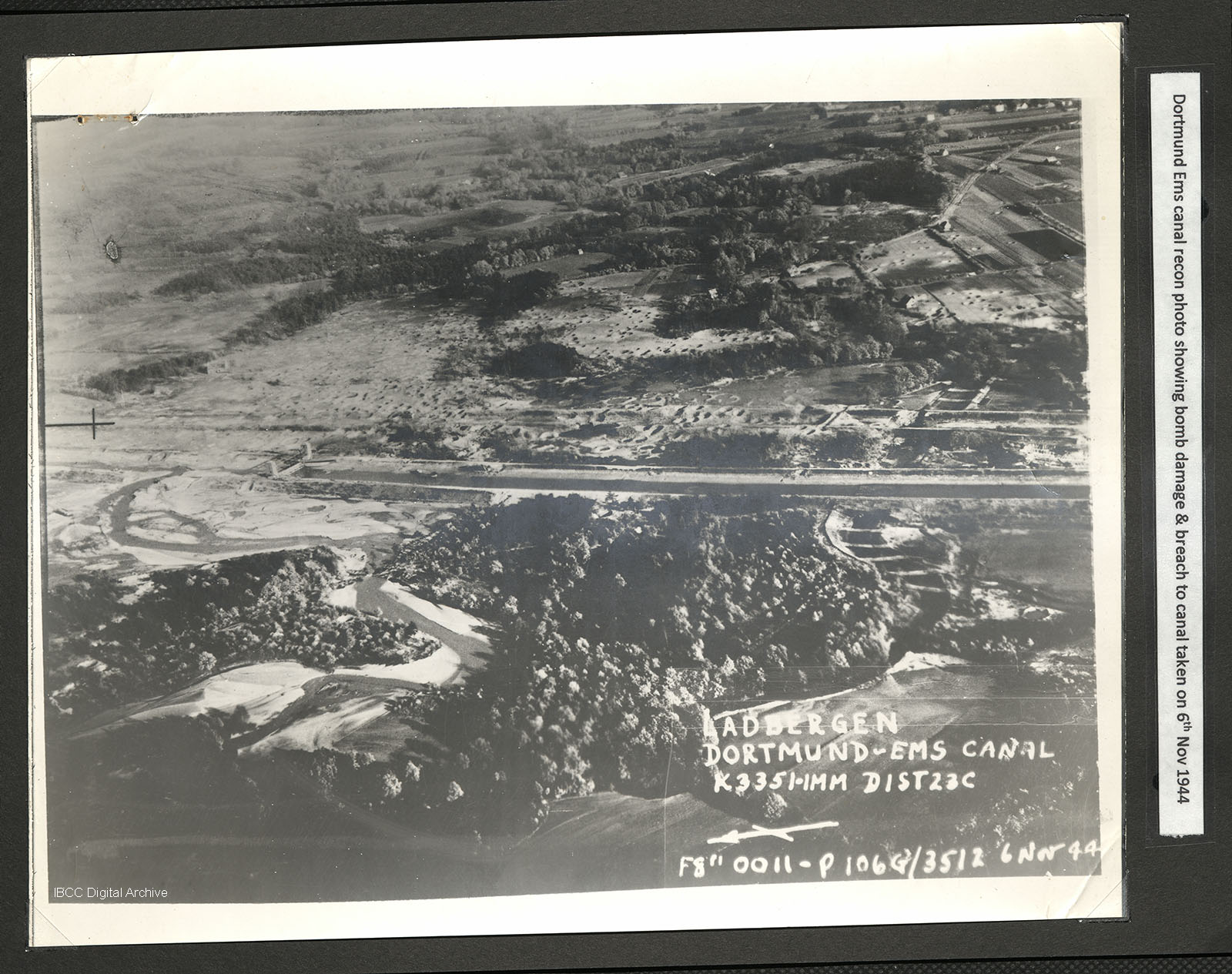
Figure was taken looking east. In the centre of the picture is the 2nd branch, with the Old Branch behind it. On the right, the River Glane flows through the culverts beneath the two canal branches, concealed by camouflage protection. On the left-hand side, in the 2nd branch north of the Glane culvert, is the closed security gate.
Raid on 21/22 November 1944
RAF Bomber Command Campaign Diary
“123 Lancasters and 5 Mosquitos of No 5 Group. No aircraft lost. The canal near Ladbergen was attacked, some of the Lancasters coming down to 4,000ft to get beneath the cloud. A breach was made in the only branch of the aqueduct here which had been repaired since the last raid and the water once again drained out of the canal.” 48
V Group News
“Master Bomber:- S/Ldr. Stubbs.
Reconnaissance revealed that the Germans were making strenuous efforts to repair the damage inflicted on this canal by 176 of the Group on 4/5th November. It was decided to attack this target in the same place once again, to prevent this repair work from being carried out and if possible to add to the damage caused in the previous attacks.
PLAN Illumination and marking in normal sequence. Mosquitoes to mark aiming point with Red T.I. Main force crews to aim the first bomb of the stick at the Red T.I. or as ordered by the Master Bomber. Bomb load maximum load 1,000 lb. A few aircraft carried 6 X 1,900 lb G.P. bombs.
RESULTS 123 Lancasters and 5 Mosquitoes attacked. The weather in the target area was 6 – 9/10ths strato cu. base 4,000 feet, with good visibility below. Flares were accurate and on time, and the Mosquitoes were able to identify and mark the aiming point. The Master Bomber called the main force in to bomb as planned and the attack was concluded without a hitch.
A very satisfactory concentration was achieved round the markers, and subsequent reconnaissance shows that very great damage has been done. Both branches of the canal have been breached where they cross the River Glane, and both arms have once again been drained, flooding considerable areas of surrounding countryside, and leaving many barges high and dry. The Western embankment of the main canal has been breached in one position for about 150 feet. The subsidiary arm of the canal has been so heavily cratered that its outline can scarcely be recognised. Once again a long stretch of this important canal has been drained, many barges have been destroyed, and others lie with their cargoes high and dry on the canal bed.” 49
Ladbergen Canal Construction Management
Then, on the evening of 21 November 1944, the third attack took place. During this, the old and new culverts were hit and the dams were breached. 150 m south-west of the Glane culvert, the dam had burst and been washed away over a length of 40 m.
The destroyed culvert roof of the second branch was demolished by miners from Salzgitter at the base of the canal to a length of approx. 48.0 m down to the lower edge of the roof cove. The two side openings were filled with concrete rubble and sand, and sealed on the east side with sheet pile ends. The damaged central walls were provisionally filled with concrete-filled sacks, and a concrete beam was constructed on the rubble in the side openings. T-beams NP 55, 8.50 m in length, were laid across the central opening at spaced 0.48 m apart, and a reinforced concrete slab was constructed above this down to the canal bed. The work was carried out whilst the water level in the Glane was high (the water reached the culvert top). The breach in the embankment south-west of the Glane culvert was sealed with sheet piling approx. 45.00 m long and the subsided embankment filled with sand. After the embankments were completed, the canal was filled and put into operation on 23 December 1944 at 14:30. [Translation of the author] 44
Losses
- Civilian population
- Fatalities in Ladbergen: 9 (during the raids 4 November 1944 and 21 November 1944) 1 or 11 (during the raids on 4 November 1944, 21 November 1944, 1 January 1945, 7 February 1945 and 3 March 1945) 46
Reconnaissance after 21/22 November 1944
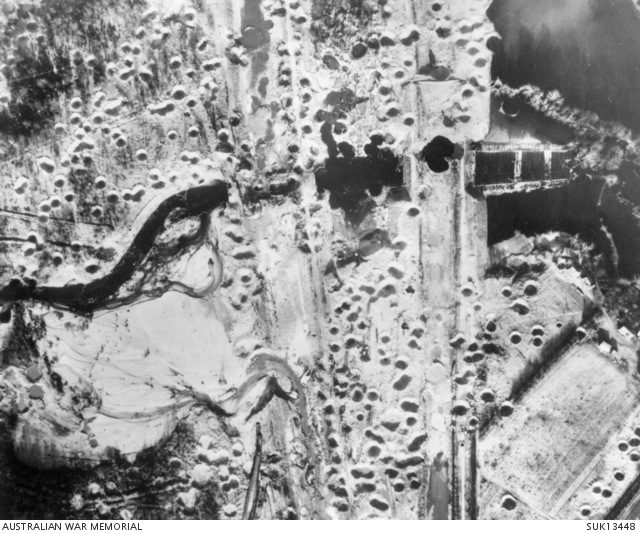
The following annotations have been made regarding the Figure :
A. Both arms of the canal have been penetrated where they cross the River Glane. Some of the camouflage used by the Germans to disguise this point still remains.
B. The water from the canal has flowed over the surrounding countryside from the penetrations.
C. A large break – 130 feet wide – made in the embankment, allowing the water to drain out of the canal.
D. This is a barge ramp, with a vehicle at work.
E. Much track activity. 53
Raid on 1 January 1945
V Group News
“The stretch of canal at LADBERGEN, newly repaired, was once again attacked, this time in daylight. Force employed – 102 Lancasters and 2 Mosquitos.
PLAN Two Mosquitos of No.54 Base were to mark the aiming point with Red T.I. cascading at 5,000 feet, burning for 12 minutes at H – 4. The leading Lancasters of No.54 Base were also to drop Red T.I. on the aiming point.
AIMING (a) Using the T.I’s as a guide to identification, crews were to aim the centre bomb of the stick at the Western branch of the canal. Care was to be exercised not to overshoot, as the Western branch was the primary objective.
(b) Normal gaggle formation was to be maintained until the Bomb Aimer could see the target. During the bombing run, aircraft on the flanks would automatically converge towards the centre. Immediately after bomb release, flank aircraft were to resume normal gaggle formation. Bombing heights 9,000 – 12,000 feet. Bomb load 14 x 1000lb MC/G.P.
RESULTS The weather at the target was clear, with good visibility, and crews identified the target visually. Once again the bombing was very concentrated, but results could not be assessed on the spot, as a large proportion of delay-action bombs was used. Owing to the frequency with which this target has been attacked, and the vast number of bomb craters, it is impossible accurately to estimate the degree of concentration, but it is apparent that as good a concentration was achieved on this daylight attack as on any of the night attacks.
The Western arm of the canal was breached once more, over a considerable distance, and there is much flooding both to the East and West of the canal.” 54
Ladbergen Canal Construction Management
On the morning of 1 January 1945, between 11.30 and 12.00, the fourth attack took place. The attack was carried out from a low altitude. The old culvert was hit and collapsed to such an extent that the entire water flow was blocked and the water backed up into the village of Ladbergen, flowing over the bed of the old canal. At the culvert of the 2nd branch, the eastern section was destroyed. The eastern culvert face wall and the southeastern wing sheet piling were breached. The embankments were scarred and the newly driven sheet pile wall south-west of the Glane culvert was exposed and destroyed. The embankments up to the Schulze-Farwick Bridge had subsided significantly, in places by up to 2.00 m.
The destroyed eastern culvert roof was exposed, during which an unexploded bomb was found on the culvert roof. Work was suspended for two days whilst the bomb was being cleared. After exposure, the roof was blasted by Salzgitter miners and constructed in the same style – approx. 16.00 m – as the central section, using T-beams NP 55 and cubically reinforced concrete. The end wall was repaired and raised to NN + 48.40.
Shipping was resumed. [Translation of the author] 44
Losses
- RAF Bomber Command suffered the following losses involving the RAF, RAFVR and RCAF crews of the Lancaster bombers with serial numbers NG223⤴, NG252⤴, PA169⤴, PD368⤴ and PD377⤴:
- Killed in action: 10 38
Died of wounds: 2 38 - Civilian population
- Fatalities in Ladbergen: 11 (during the raids on 4 November 1944, 21 November 1944, 1 January 1945, 7 February 1945 and 3 March 1945) 46
Reconnaissance on 2 January 1945
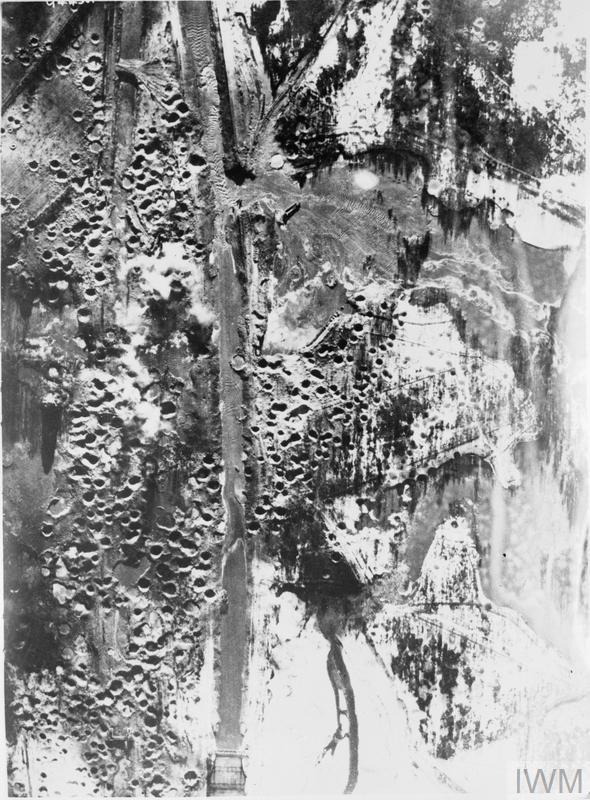
In Figure , the 2nd branch to the west can be seen slightly to the left of the centre of the image, and the Old Branch to the east is to the left of that. The north-south axis runs from bottom to top in this image. The security gate located in the 2nd branch south of the Glane culvert can be seen at the bottom of the image.
Raid on 7/8 February 1945
RAF Bomber Command Campaign Diary
“177 Lancasters and 11 Mosquitos of No 5 Group attacked the Dortmund-Ems Canal section near Ladbergen with delayed-action bombs. Later photographs showed that the banks had not been damaged; the bombs had fallen into nearby fields. 3 Lancasters were lost.” 56
Air Force Operations Staff Ic, Reporting
Morning Report for the Reich Territory, 8 February 1945.
1.) E n e m y .
23.30 – 00.20 A mixed formation – comprising around 100 Mosquitos and four-engine fighter aircraft – flew into the Münster area. Attacks were carried out in the Münster – Ladbergen area from 23:54 to 00:07 from altitudes of 400 to 5,000 metres. […]
3.) W e a t h e r .
Münster-Ladbergen area: 5 – 10/10, lower cloud base 1,000 m, upper cloud base 2,000 m, visibility 10 km. [Translation of the author] 57
Damage report on air raids on the Reich territory during the night of 7–8 February 1945
Regarding the sorties between 2330 and 0020 hours:
A mixed formation of 100–150 four-engined aircraft and Mosquitos flew in to attack the Dortmund-Ems Canal near Ladbergen.
A damage report is still pending due to a communication fault. [Translation of the author] 58
Ladbergen Canal Construction Management
On 7 February 1945, the fifth attack took place. Damage occurred in the section of the dam north and south of the security gate.
The damage to the dams was repaired with sand. Navigation continued for two days; between 0.55 and 16.30, 192 ships were towed through, and the water level was lowered to a depth of 1.50 m to prevent further damage to the dams. [Translation of the author] 44
Losses
- RAF Bomber Command suffered the following losses involving the RAF, RAAF, RAFVR, RCAF and SAAF crews of the Lancaster bombers with serial numbers ND961⤴, NG455⤴, NN724⤴, PB181⤴ and PD316⤴:
- Killed in action: 23 38
- Civilian population
- Fatalities in Ladbergen: 11 (during the raids on 4 November 1944, 21 November 1944, 1 January 1945, 7 February 1945 and 3 March 1945) 46
Fatalities in Leeden: 52 (Civilians, prisoners of war and forced labourers) 59
Raid on 24 February 1945
RAF Bomber Command Campaign Diary
“166 Lancasters and 4 Mosquitos of No 5 Group were ordered to abandon a raid on the Dortmund-Ems Canal without bombing because of cloud which covered the target area. All aircraft landed safely.” 56
Raid on 3/4 March 1945
RAF Bomber Command Campaign Diary
“212 Lancasters and 10 Mosquitos of No 5 Group attacked the Ladbergen aqueduct on the Dortmund-Ems Canal, breached it in 2 places and put it completely out of action. 7 Lancasters lost. The gunners in the No 619 Squadron Lancaster of Wing Commander SG Birch claimed to have shot down a V-1 flying bomb near the target area; the V-1 was probably aimed at the port of Antwerp.” 60
Ladbergen Canal Construction Management
On the evening of 3 March 1945, the sixth attack took place from an altitude of 2,000 m and was severe.
At the Glane culvert, on the western side, the culvert head with its end wall was demolished to a height of 6–7.00 m and the western wing sheet pile walls were destroyed. The western embankment was damaged and breached north of the security gate behind the driven sheet pile wall and had subsided by 0.00–2.50 m over a distance of 100 m to the north. In area of the security gate, there were five impacts in the northern canal bed between the sheet pile walls; the foundations of the control buildings, together with their superstructures, were leaning and had subsided by an average of 0.30 m. The concrete prisms in the northern base had been hurled away; the north-western wing sheet pile wall had been destroyed directly at the concrete structure. The eastern embankment north of the security gate, approx. 200 m long, had subsided by up to 2.50 m in places.
At the Glane culvert, a relief system consisting of three cement pipes – 80 cm in diameter – was to be constructed to allow water to drain more quickly from the canal via the culvert; for this purpose a 20 cm stone base with a cement grout was constructed over the remaining old culvert section and a 0.60 m wide concrete wall was erected on the broken-off end of the culvert up to the level of the canal bed.
The relief structure was to be fitted with a dam beam closure. The shut-off system was already complete and the cement pipes had been laid along their entire length, except for a remaining section.
The western embankment north of the security gate was filled only with sand, without sheet piling, and reinforced with additional fill; the same applied to the eastern embankment north of the security gate. At security gate, the bomb craters were filled with sand and the surrounding concrete blocks, and the bed levelled.
Due to the settling and shifting of the concrete structures of the security gate, the bridge supporting structure was in danger of slipping off its bearing; the main girders on the west side were extended by brackets. (Not completed).
The damaged north-western sheet pile wing was repaired by driving sheet piles behind it.
During the repair work from late September 1944 to late March 1945, operations were disrupted by low-level air raids; at night, only the piling work continued at night, whilst earthworks took place only during the day, as air raids and disruptive attacks meant that parts of the construction site could not be illuminated. On the construction site, following the individual attacks, 3,000–4,000 men (French, Dutch, Italian) and German miners, who were provided by various collieries in the Ruhr mining region and were housed in Ladbergen in the halls of the inns and in the stables and barns of the farms adjacent to the construction site. The last working day was Good Friday before Easter 1945.
Work was resumed in early July 1945 by the Hochtief-Büscher consortium from the Schulze-Farwick Bridge to the northern tip of the island, and the canal section was repaired with the assistance of British units. The Westladbergen Bridge was raised by the firm Philipp Holzmann A.G., the Schulze-Farwick Bridge was demolished, and the canal section was repaired by Holzmann from the Ladbergen border bridge by driving sheet piles at km 87.5 and km 88.3, as well as necessary earthworks and embankment works, restoration of the side ditches, etc. [Translation of the author] 44
Losses
- RAF Bomber Command suffered the following losses involving the RAF, RAAF, RAFVR, RCAF and RNZAF crews of the Lancaster bombers with serial numbers LM677⤴, ME442⤴, ME453⤴, NG170⤴, NG204⤴, NG325⤴, NG469⤴, PA197⤴ and PB806⤴:
- Killed in action: 47 38
Missing in action: 5 38 - Civilian population
- Fatalities in Ladbergen: 1 1 or 11 (during the raids on 4 November 1944, 21 November 1944, 1 January 1945, 7 February 1945 and 3 March 1945) 46
Reconnaissance on 20 March 1945
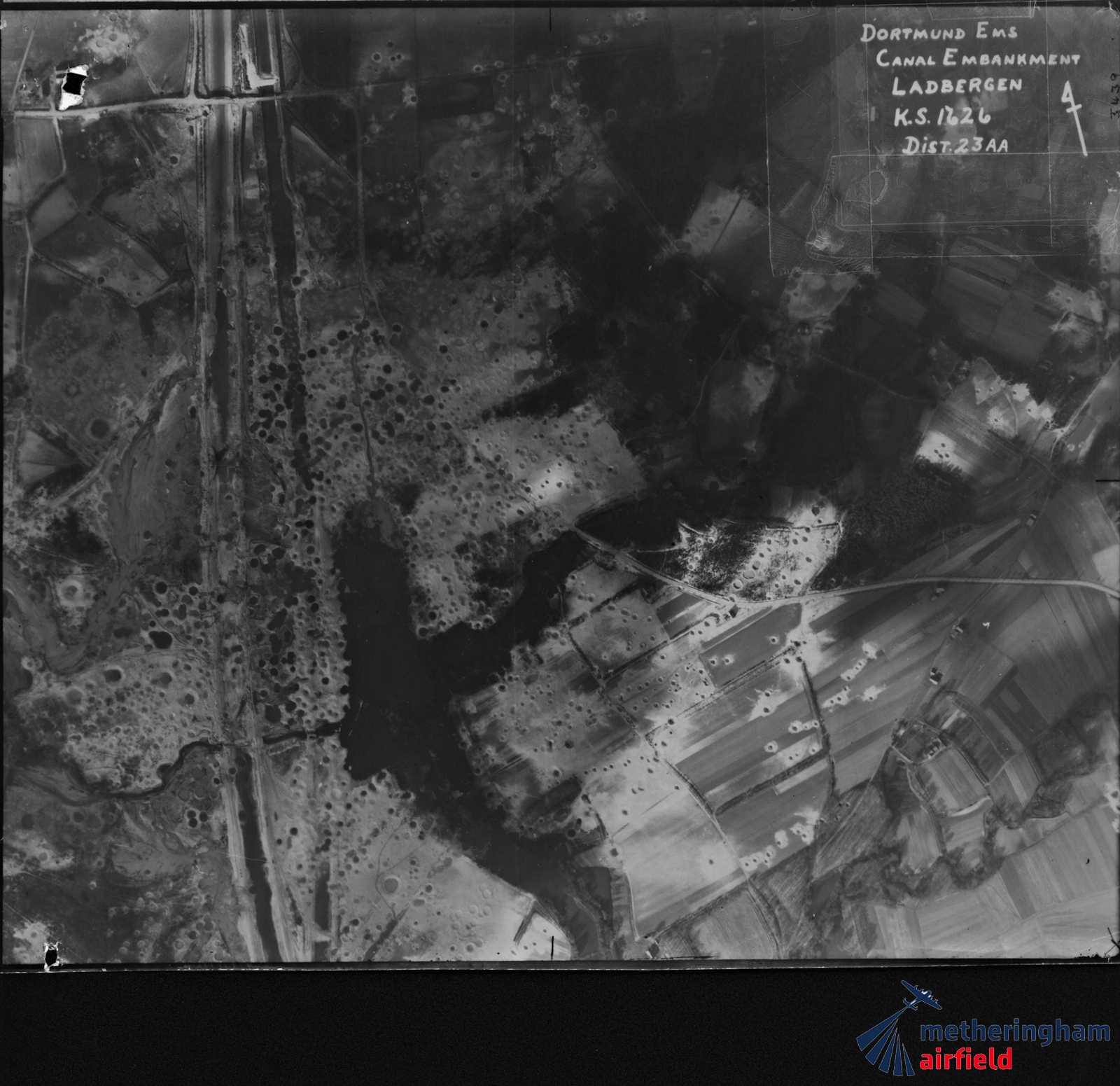
The reconnaissance photograph was taken by First Lieutenant R. H. Smythe in a Spitfire XIX RM 644 of No. 541 Squadron from an altitude of 25,000 feet between 13:52 and 17:12. 61 The arrow in the top right-hand corner of the image points north.
At the top of the image is the Westladbergen Bridge, and at the bottom is the River Glane, which is dammed up to the right – or east – of the Alte Fahrt due to the destroyed culvert. At the top and bottom edges of the image, the two barrier dams in the Alte Fahrt can be seen, which were constructed following the attacks on 23–24 September and 4–5 November 1944.
Canadian troops enter Ladbergen
As part of Operation Plunder, the 1st Canadian Parachute Battalion, advancing from Greven, captured Ladbergen on 1 April 1945. Greven lies to the south-west of Ladbergen. The German forces put up resistance with two 20-mm anti-aircraft guns and one 40-mm anti-aircraft gun, supported by about a platoon of infantry. Most were killed; a few were taken prisoner. During the night, one or two German shells struck Ladbergen. The unit spent 2 April 1945 in Ladbergen. Day and night, individual Germans or small groups came forward to surrender. A despatch rider was captured en route whilst attempting to deliver orders to the German commander in Ladbergen and to inform him that he could expect no further reinforcements. The following day, the unit travelled by lorries to Wissingen, east of Osnabrück. 62
Review of the results of Second World War Allied air attacks against the German waterway transportation systems
The RAND⤴ report “NATO Inland Transport as a Potential Rear-Area Target System: Lessons from German Experience in World War II” by Edmund Dews in 1980 “is based on published sources, particularly the detailed reports of the United States Strategic Bombing Survey, which assembled and analyzed German data and interviewed German officials at the end of the war.” 63 This report concludes:
“Failure to target the Datteln Pool embankments is the more surprising, because canal embankments nearby were carefully targeted and attacked successfully and repeatedly earlier in the war. The principal targets in these attacks were the Dortmund-Ems Canal at Ladbergen, about 30 km north of Munster [sic], where the river Glane passes under the canal, and the Mitteland Canal at Gravenhorst close to Ladbergen, where the river Aa passes under the canal. At both Ladbergen and Gravenhorst the canals were contained between earth embankments, and the water level was considerably higher than the surrounding country. Ladbergen was attacked first on 23 September 1944 [sic], the embankments were breached, the canal was drained, and all through traffic was stopped for four weeks. Gravenhorst was attacked first on 21 November 1944 with similar results, traffic being stopped for three weeks. Attacks on these targets every three or four weeks kept these two canals closed until the end of the war, except for very brief intervals. As at Datteln, the bomb damage to the embankments was greatly aggravated by the erosion caused by the water escaping from the canal […].
The effect of these attacks is shown by the record of traffic passing through the Munster [sic] locks on the Dortmund-Ems Canal just south of the point at which the two canals merged to form a single waterway. In the five months ending February 1945, monthly northbound traffic varied from 2 percent to 29 percent of normal; monthly southbound traffic varied from 2 percent to 30 percent of normal; total throughput in this period was reduced by nearly 90 percent. […]
The strategic air attacks delivered in 1944 against the German inland waterway system soon reduced long-haul waterborne traffic to a trickle and greatly curtailed even short-haul movements.
According to the USSBS, the damage, delay, and disruption caused by the Danube mine-laying campaign reduced deliveries and slowed traffic on that river decisively. In the northwest waterways, the air attacks involved a much greater sortie commitment and had even greater effectiveness.
In spite of intensive repair and salvage work and ingenious countermeasures, the effect of the Ladbergen-Gravenhorst raids and the destruction of the Cologne Bridge on inland waterway traffic in Germany was disastrous, and the breaching of the Datteln embankments ended water traffic in the Ruhr area […].
On the other hand, the targets chosen for attack were not the best available. The USSBS concluded that a small tonnage on a few carefully selected targets would stop all important north German canal traffic and through traffic upon the Rhine River for an indefinite period and . . . this could have been accomplished early in the war, thus diverting a tonnage which the railroads were not prepared to handle in full […].” 63
One of the four best targets identified by the United States Strategic Bombing Survey (USSBS) were the Münster Locks. “Damage would stop all waterway traffic from the Rhineland-Ruhr to the north and east for many months.” 63
Conclusion
“A report from Albert Speer to Hitler Dated 11.11.44 was captured at wars end, stating that ‘The raids on the Dortmund-Ems Canal and the rail system produced more serious setbacks to the German war industry at this time than any other type of bombing'” 64
Nowhere else in the German Reich were more bombs dropped per square metre during the Second World War than in the area of the Glane culverts. […] 4,444.3 tonnes of bombs were dropped during this period. [Translation of the author] 1
Memorials
Stele on the eastern canal embankment, north of the Schulze-Farwick Bridge
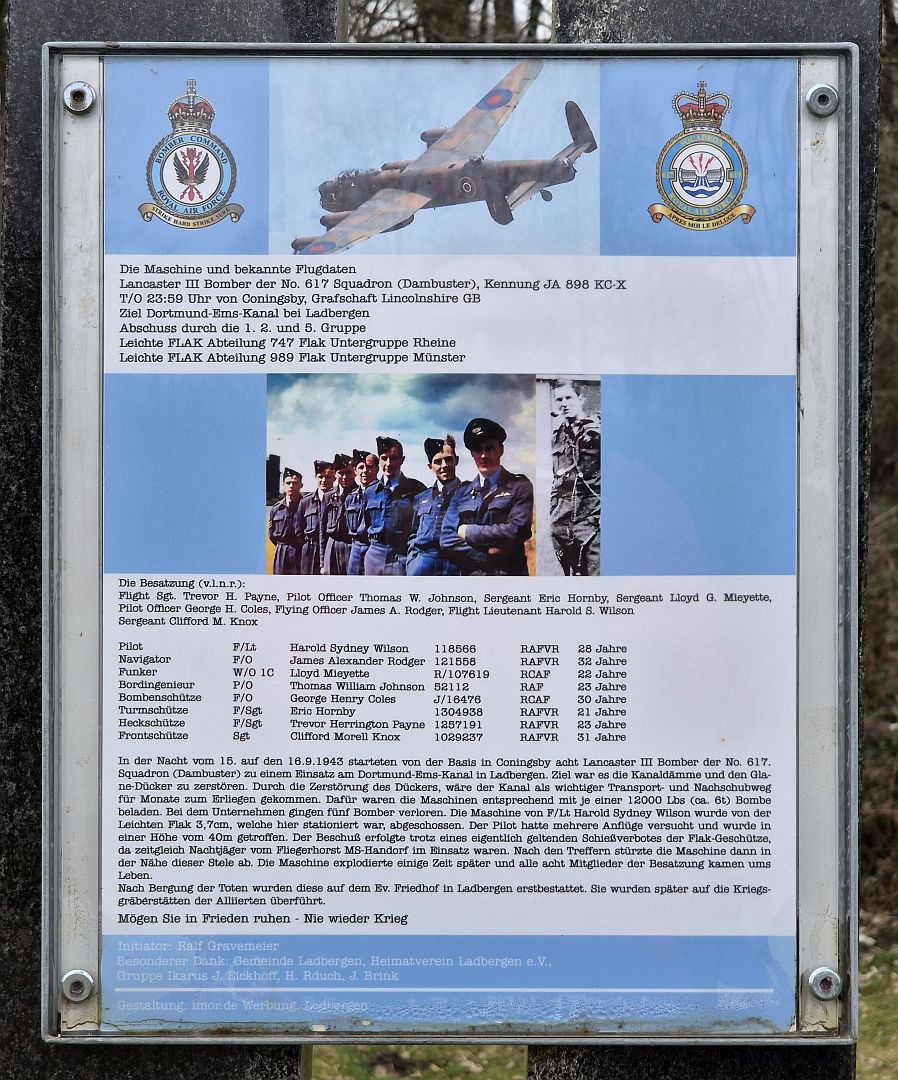
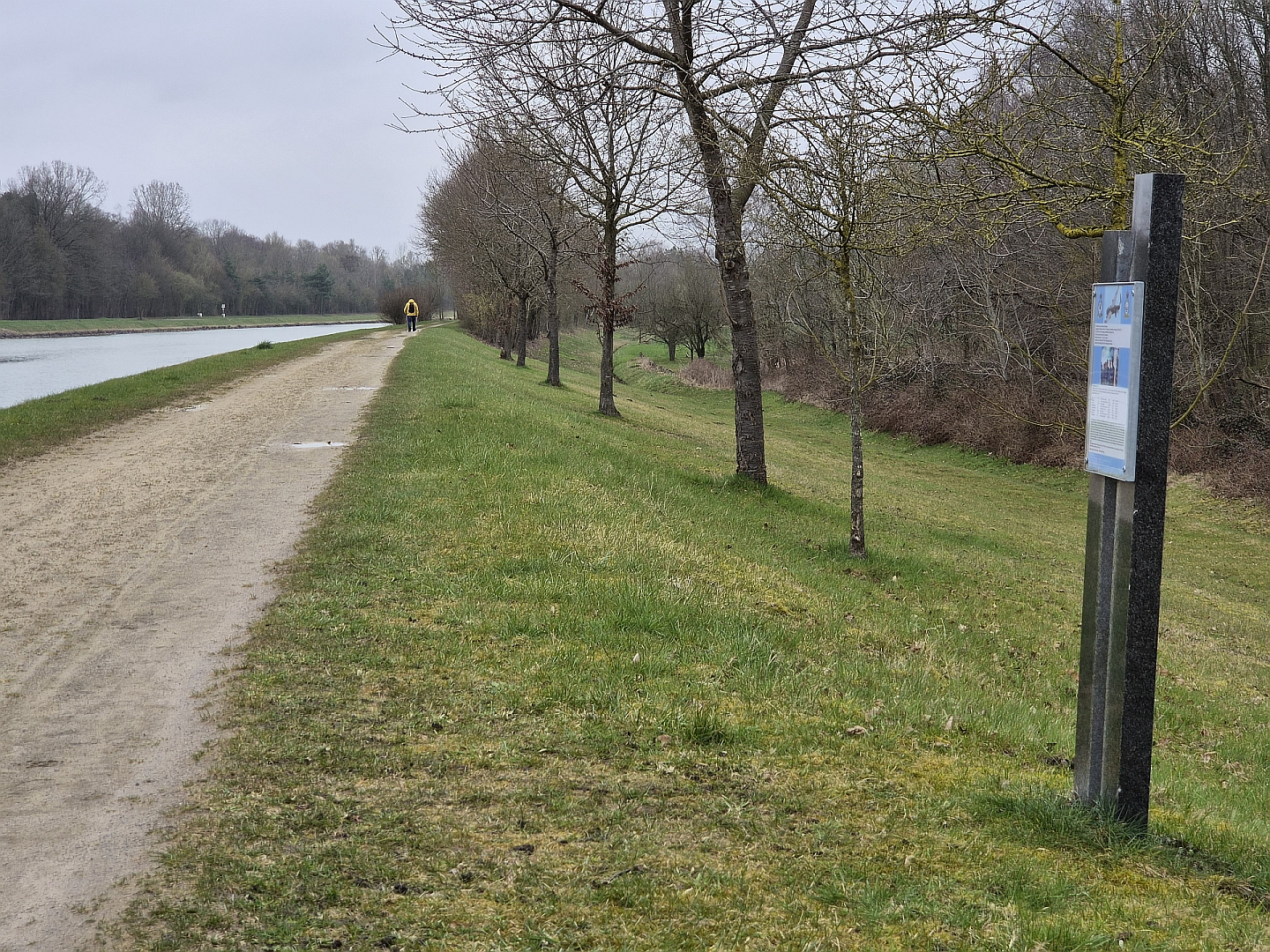
The memorial stele honouring the six British and two Canadian crew members of the Avro Lancaster Mk.III JA898 KC-X of No. 617 Squadron, which was shot down on 16 September 1943, was officially unveiled on 15 September 2023. 65
Flying at a low altitude of just 40 metres above the canal, the aircraft piloted by Harold Sydney Wilson was hit by fire from a light anti-aircraft gun and crashed not far from the memorial. 65 66 All eight crew members were killed.
Memorial stone in Greven-Pentrup
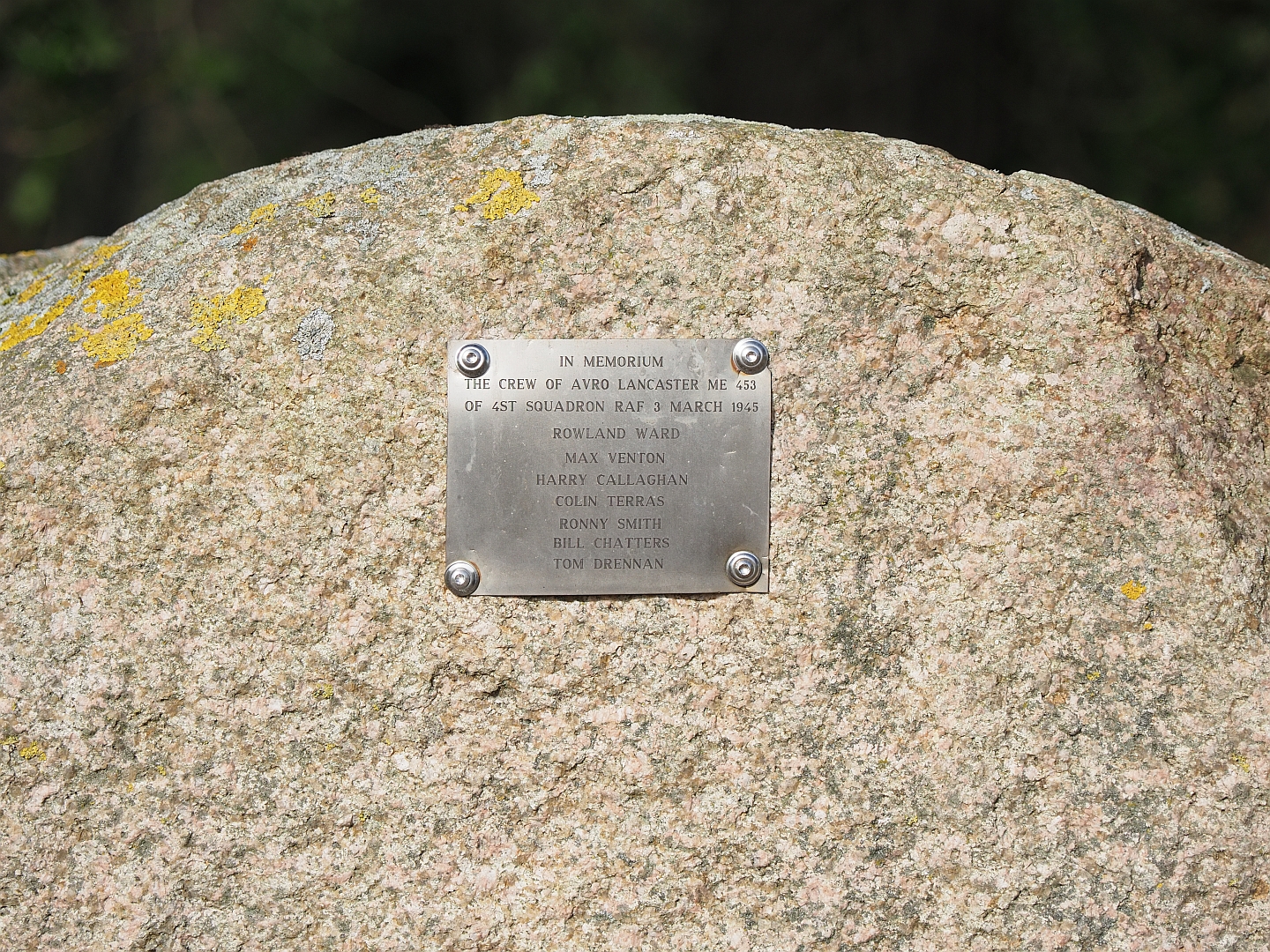
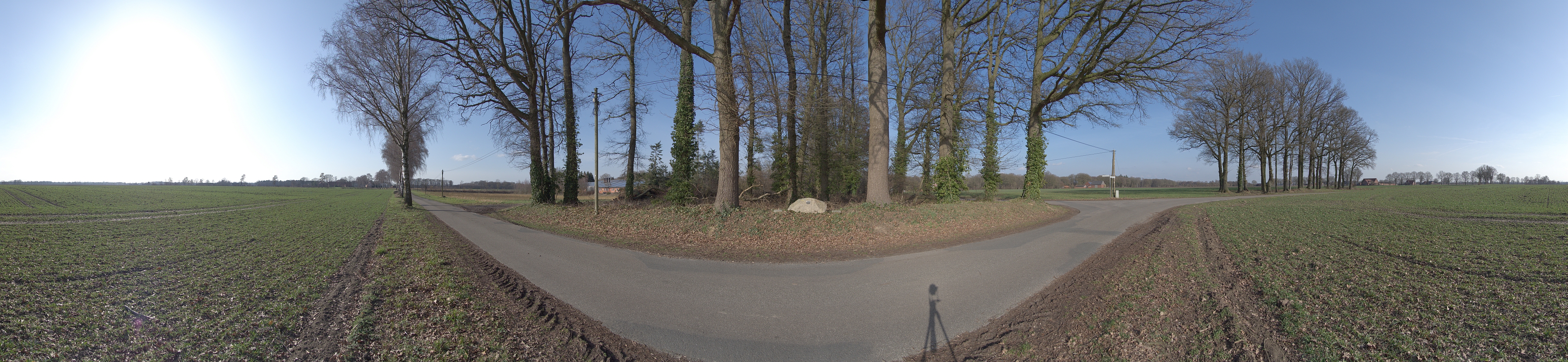
Even before the seven-man crew – comprising five Britons and two Australians – reached their target, the Glane culverts on the Dortmund-Ems Canal, in their Lancaster bomber ME453 PO-L on 3 March 1945, their aircraft was most likely shot down by a German night fighter. The aircraft crashed into a field⤴ belonging to the Langkamp family in the farming community of Greven-Pentrup. 67 All the crew members died. The oldest was 22 and the youngest were 20. 68
Max Williams has meticulously researched the careers of the crew members and the events of 3 March 1945, publishing his findings on his website An Ordinary Crew⤴.
Commemorative plaque at the Glane culvert
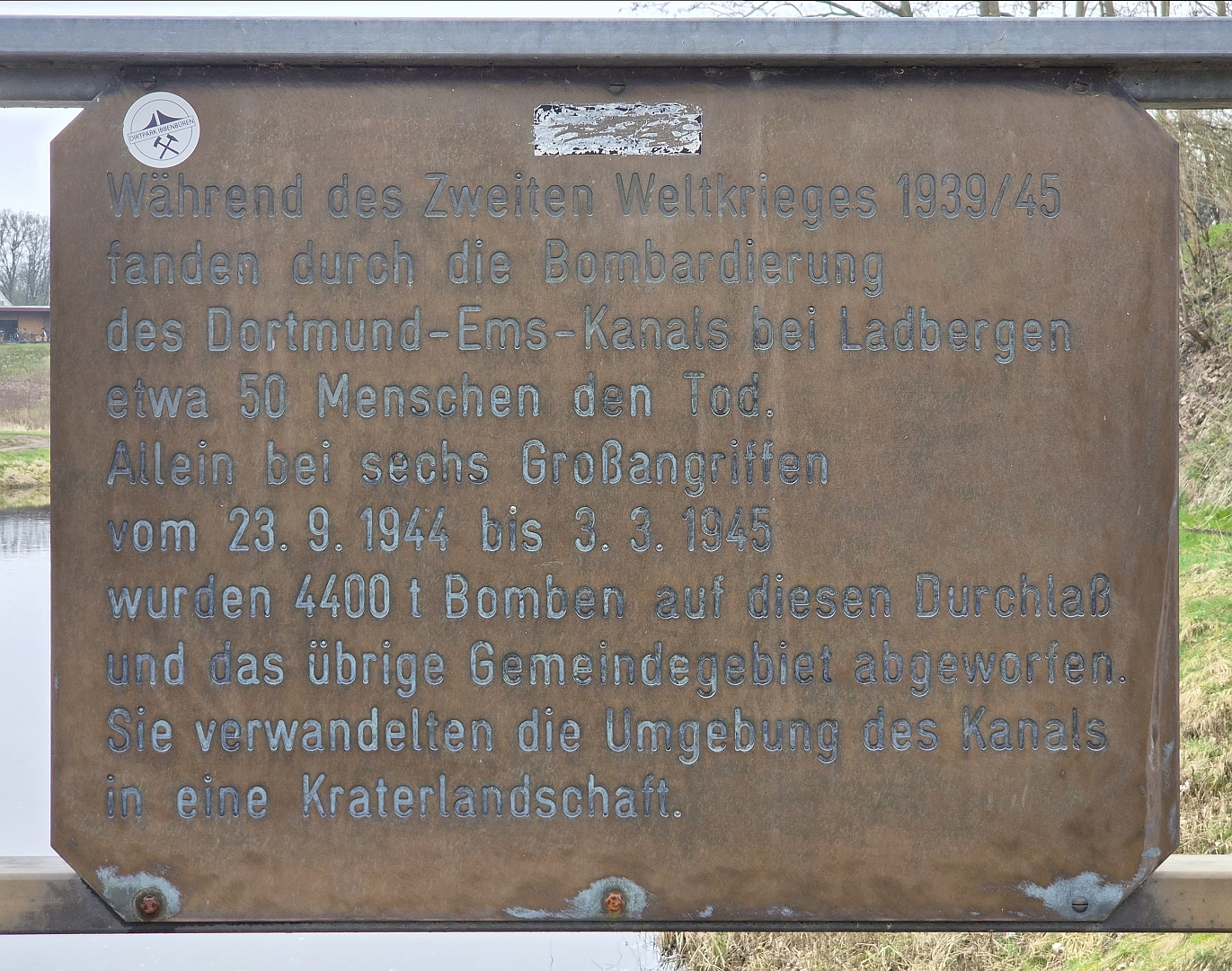
The inscription reads:
During the Second World War (1939–45), around 50 people lost their lives as a result of the bombing of the Dortmund-Ems Canal near Ladbergen.
In six major air raids alone, between 23 September 1944 and 3 March 1945, 4,400 tonnes of bombs were dropped on this section of the canal and the rest of the municipal area. They turned the area around the canal into a landscape of craters.
Artefacts
Ladbergen Local History Museum
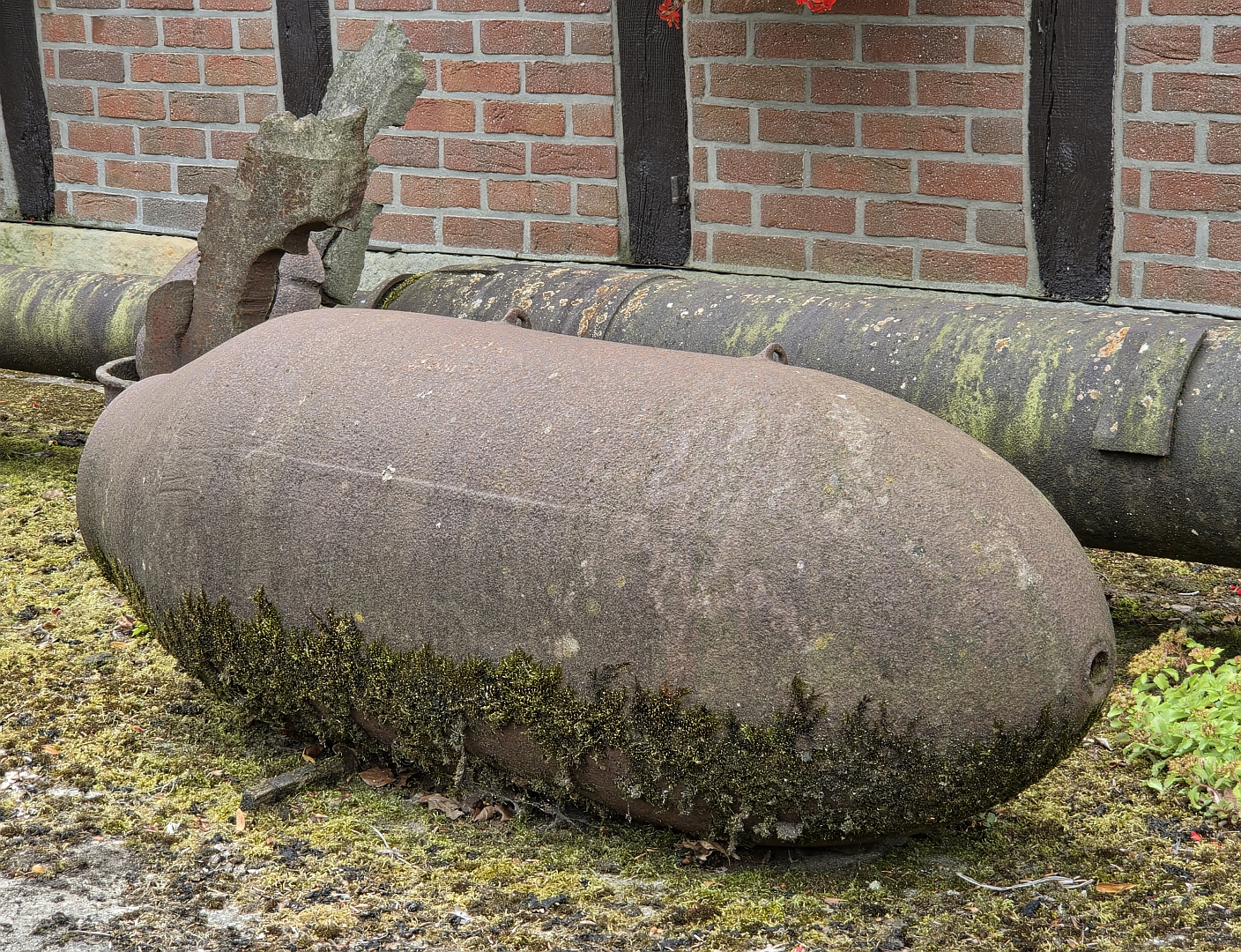
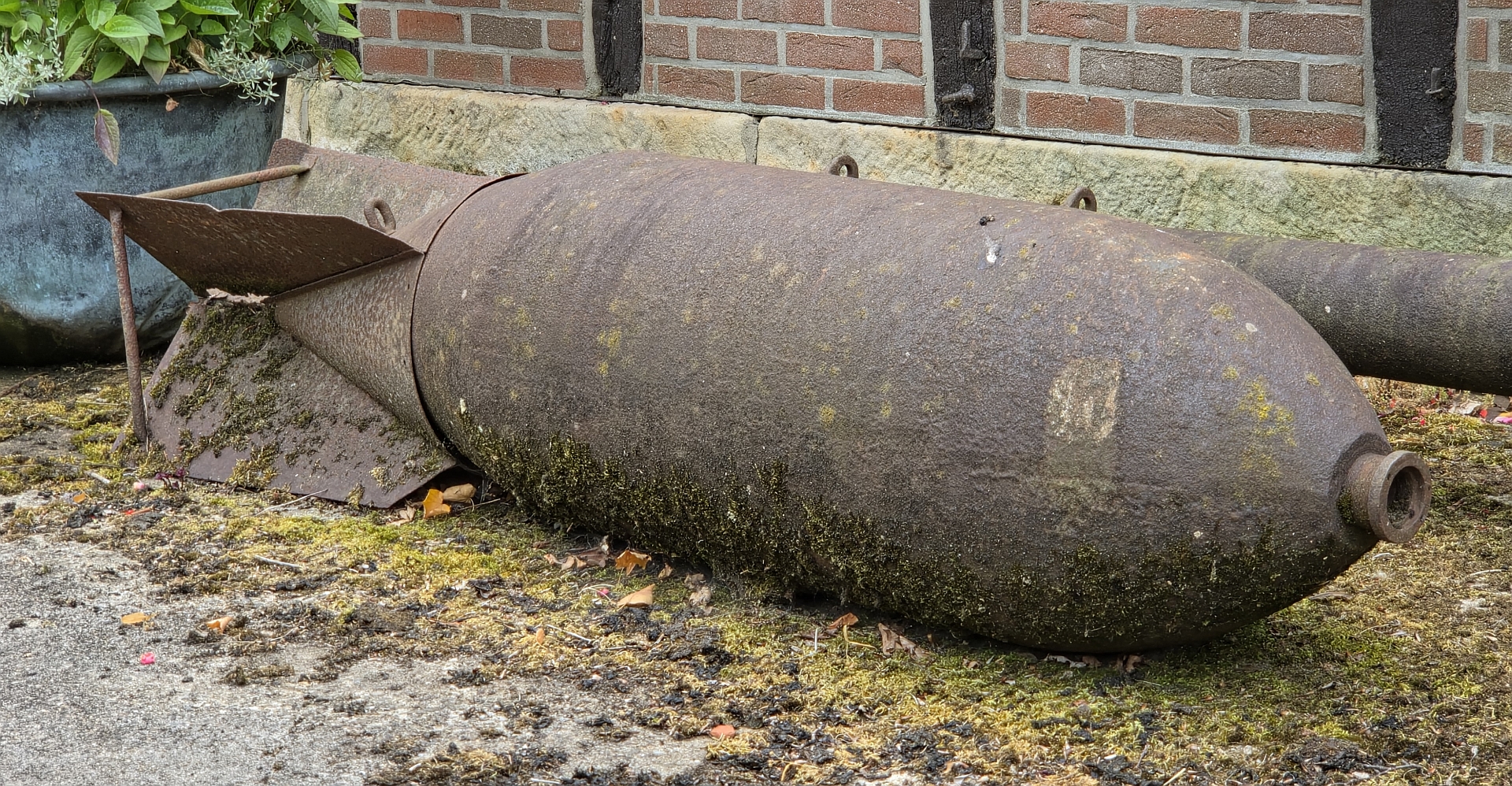
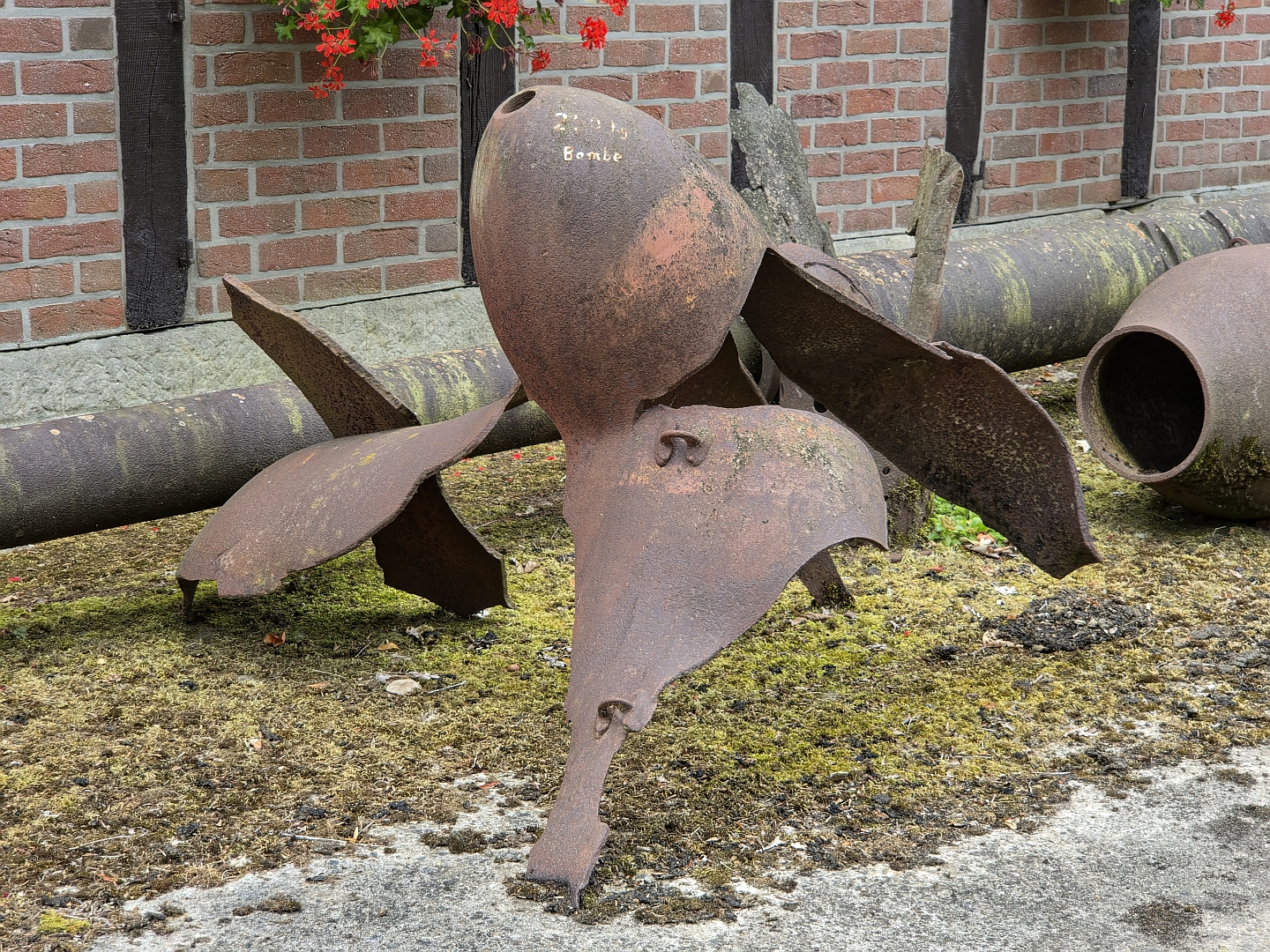
Crash site of the Avro Lancaster Mk.III ME453 PO-L in Greven-Pentrup
Martin Muller from Greven has found artefacts with his metal detector on the Langkamp family’s field⤴, where the Lancaster bomber crashed on 3 March 1945. Max Williams writes about this on his website, An Ordinary Crew⤴:
He found many pieces including exploded .303 bullet casings, parts of the engine casting, some small cockpit pieces, some perspex and some hydraulic valve joints, and happily he sent them to me. 67
Repair of the culvert after the Second World War
The Münster Waterways Authority describes the repair work in a file dated October 1947 (see Damage to and repairs of the Glane culvert beneath the second branch of the Dortmund-Ems Canal near Ladbergen between 1944 and 1947). Only the 2nd branch was repaired, but not the Alte Fahrt.
When work began on the major damage site at Ladbergen in July 1945 as part of the restoration of the Dortmund-Ems Canal, the priority under the prescribed conditions had to be the restoration of the Glane culvert and the creation of sufficient discharge capacity, even during floods. […] The initial measures therefore began with the clearance of the Glane downstream of the culvert, in order to gain access to the structure at all. For the culvert itself, a comprehensive repair programme was planned to restore it to full capacity and structural stability. [Translation of the author] 15
The first repair work was carried out in the winter of 1945–1946.
The extraordinary difficulties involved in getting a major construction site up and running immediately after the end of the war, combined with the extremely tight deadline set for the resumption of shipping, led to part of the Ladbergen construction project being taken over by a British engineering unit [935th Port Construction and Repair Company, Royal Engineers]. When the work areas were divided up, the section south of the security gate was taken over by this unit and, following initial refusal, the repair of the Glane culvert was also included shortly afterwards. However, this was not carried out to the extent deemed necessary by the Waterways Authority in the sense of a thorough structural renewal, as mentioned above […]. With the structure in this condition, the canal was filled and navigation resumed in February/March 1946 […]. [Translation of the author] 15
Extensive repairs were required in the summer of 1946.
The inadequacy of the culvert had already become apparent during the flood of early February 1946, when the canal was being filled. The discharge cross-sectional area was only around 13 m2, compared with 42 m2 for the undamaged structure, resulting in a 2.00 m backwater at the culvert inlet. In addition to widespread flooding along the upper reaches of the Glane, particularly in the village of Ladbergen, there was an acute threat to the newly embanked canal dyke, which was being washed over and eroded by the floodwaters on its eastern side. Under these circumstances, the filling of the canal had to be suspended and partially reversed. These experiences led to further repairs to the culvert in the summer of 1946 by the Waterways Authority, with the aim of improving the structure’s discharge capacity and remedying the uncertain stability conditions through appropriate measures.
The work was made particularly difficult by the need to maintain the outflow. To this end, the Glane stream had to be shut off upstream of the culvert and the water diverted through a pipe laid within the culvert. The water flow was regulated by three pipe valves in the barrier dam, which were activated on several occasions to discharge floodwater whilst work in the culvert was suspended.
The water seeping out at various points along the central walls – particularly on the north side – which originated from leaks in the channel bed, was channelled via pipes installed in the walls and directed along the shortest route into the central opening, in order to prevent water from accumulating and causing stress in the backfill of the side openings. Simultaneous extensive resealing with clay in the channel bed above and alongside the culvert to prevent water passage had only limited success. In general, damaged sections were repaired in order of priority according to the degree of risk, with work carried out first on those parts situated below the mean water level of the Glane, so as to be as independent as possible from the water levels of the Glane as the work progressed. The works were completed by the end of October 1946, with the exception of the western end walls of the side openings and one section of the culvert ceiling beneath the eastern embankment. Work on the remaining sections had begun but had to be suspended due to rising water levels in the Glane until the drainage pipework and the transport track had been removed from the culvert. [Translation of the author] 15
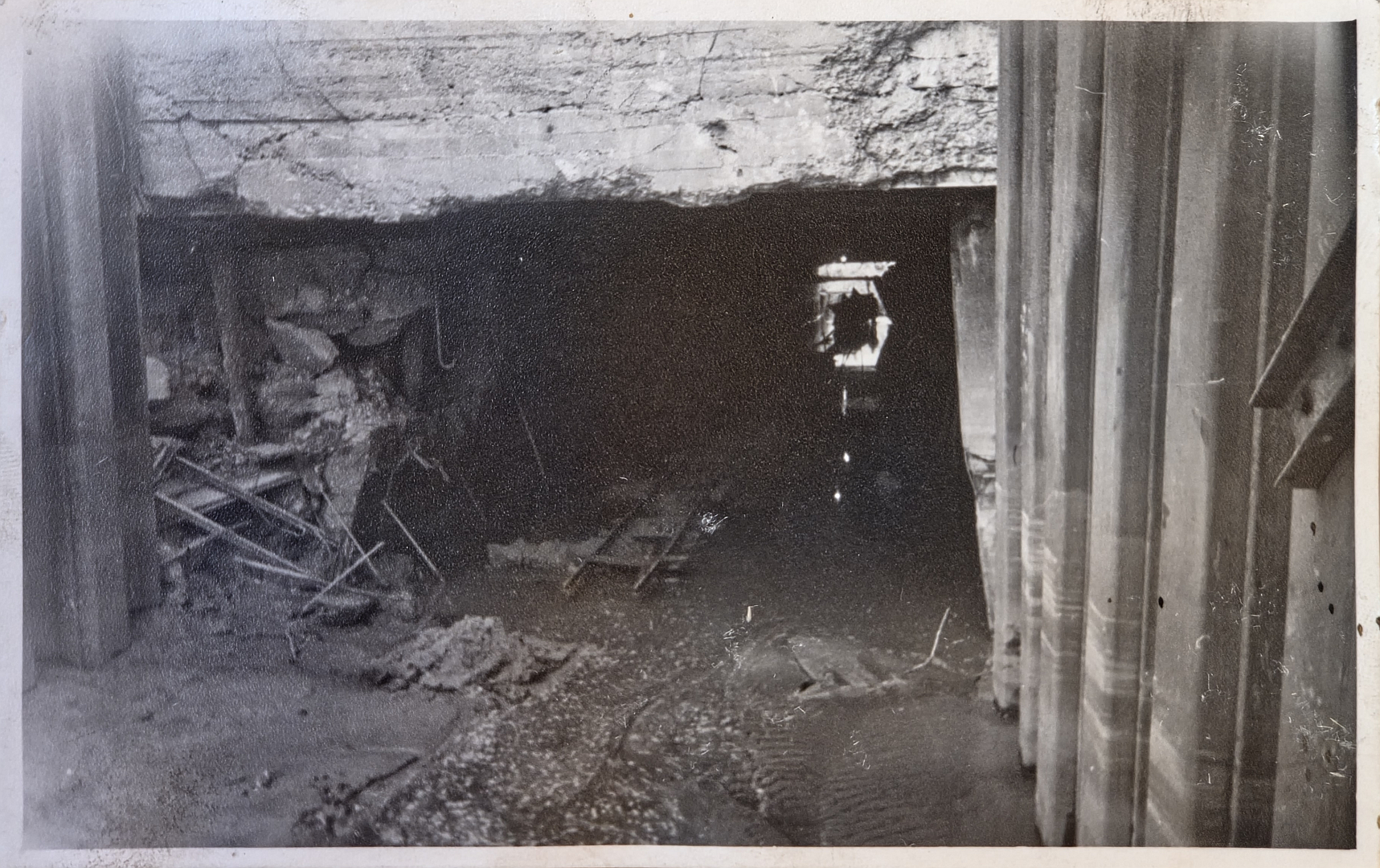
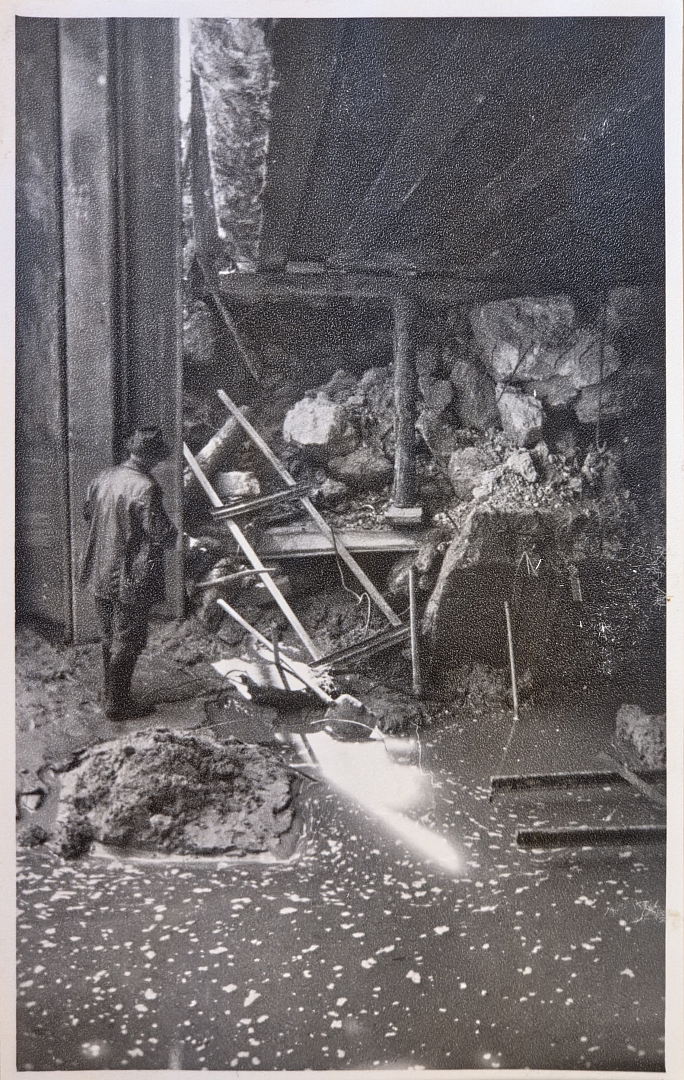
At the end of October 1946, a breach occurred in the dam above the eastern section of the culvert.
On 30 October 1946, significant seepage of water mixed with sand was unexpectedly observed at two or three points along the ceiling joint beneath the eastern embankment, which had remained completely dry throughout the several months of construction work on the culvert. Observations of the canal above the structure revealed a noticeable ingress of canal water, at the level of the water surface, through the stone fill of the embankment and into the canal embankment. Although this rapidly worsening situation was almost completely remedied within a few hours by emergency measures involving the installation of clay on the eastern embankment, it was deemed unacceptable to leave the situation as it was, as the cause and extent of the damage were uncertain due to the fact that exposure of the eastern section of the culvert had not been authorised at the time, and there were fears that the damage might spread further. In these circumstances, it was deemed necessary to fully expose the obviously defective culvert sections from above, and a comprehensive repair of the structure from the outside was subsequently carried out. […]
The success of this comprehensive refurbishment is demonstrated by the fact that all internal flow-through components, including the water collection pipes, remain completely dry after the canal has been filled.
The work was carried out in a continuous three-shift operation over a 24-hour period, with around 300 works [sc. presumably correctly ‘workers’] deployed each day. The shipping ban lasted from 31 October to 24 November 1946 inclusive.
This effective measure, taken in November 1946, if not entirely eliminated, at least significantly reduced the acute threat to the structural stability of the structure that had hitherto been feared. What remained was the restriction of the flood discharge cross-section to the central opening, the hydraulic effectiveness of which was, moreover, severely impaired by the installed supports. The difficulties involved in constructing a new culvert – which, prior to the November 1946 repairs, had been planned for completion in the shortest possible time – proved insurmountable in the summer of 1947. The fact that a delay in the new construction was unavoidable, and that the existing culvert would inevitably have to be maintained for several more years as a result, led in late summer 1947 to further supplementary repairs to the structure from the inside, with the aim of ensuring the structural stability of the culvert under all circumstances and improving the discharge capacity through a more hydraulically favourable cross-section and inlet design. [Translation of the author] 15
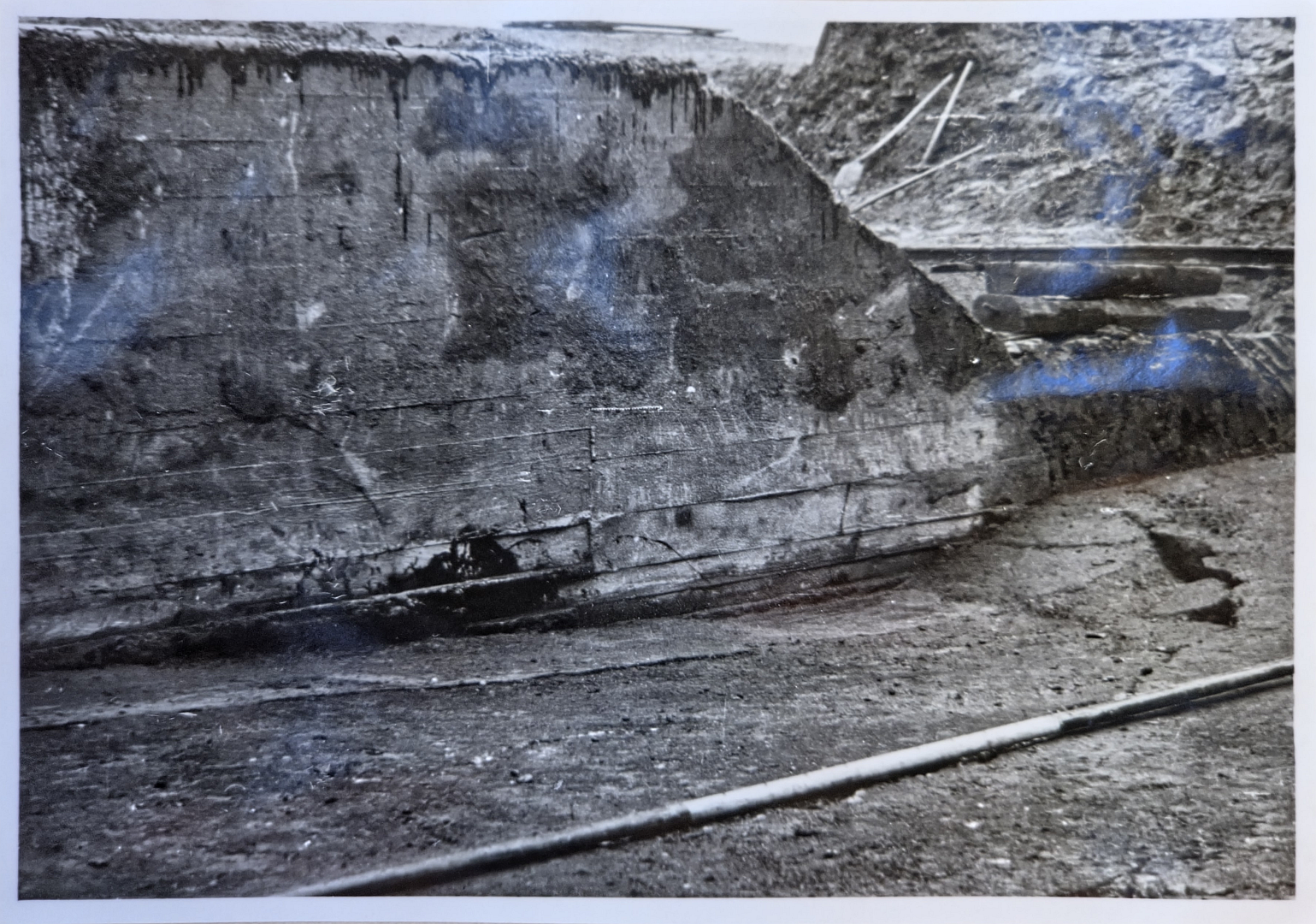
As a result of the measures, the Münster Waterways Authority established that the following state of completion had been achieved:
The maximum flood water level at the culvert inlet is expected to reach no more than 0.75 m in future, which is 1.25 m below the 1946 level. Given the gradient of the Glane stream and its source streams, the Aa-Bach and Mühlenbach, the flood’s extent is unlikely to exceed 1 km; its impact in terms of area can only be minimal in the narrow and relatively steeply incised stream valleys; this is all the less of a concern given that floods of such magnitude tend to occur exclusively in winter, and furthermore, significant parts of the stream valley have been destroyed by the bombing raids of 1944 and have not yet been reclaimed for agricultural use.
Given the current state of affairs, the old Glane culvert is likely to have achieved the structural stability that has been the aim of the repair work since 1944, as well as a level of performance that is, at the very least, acceptable. [Translation of the author] 15
Construction of the third branch at Ladbergen
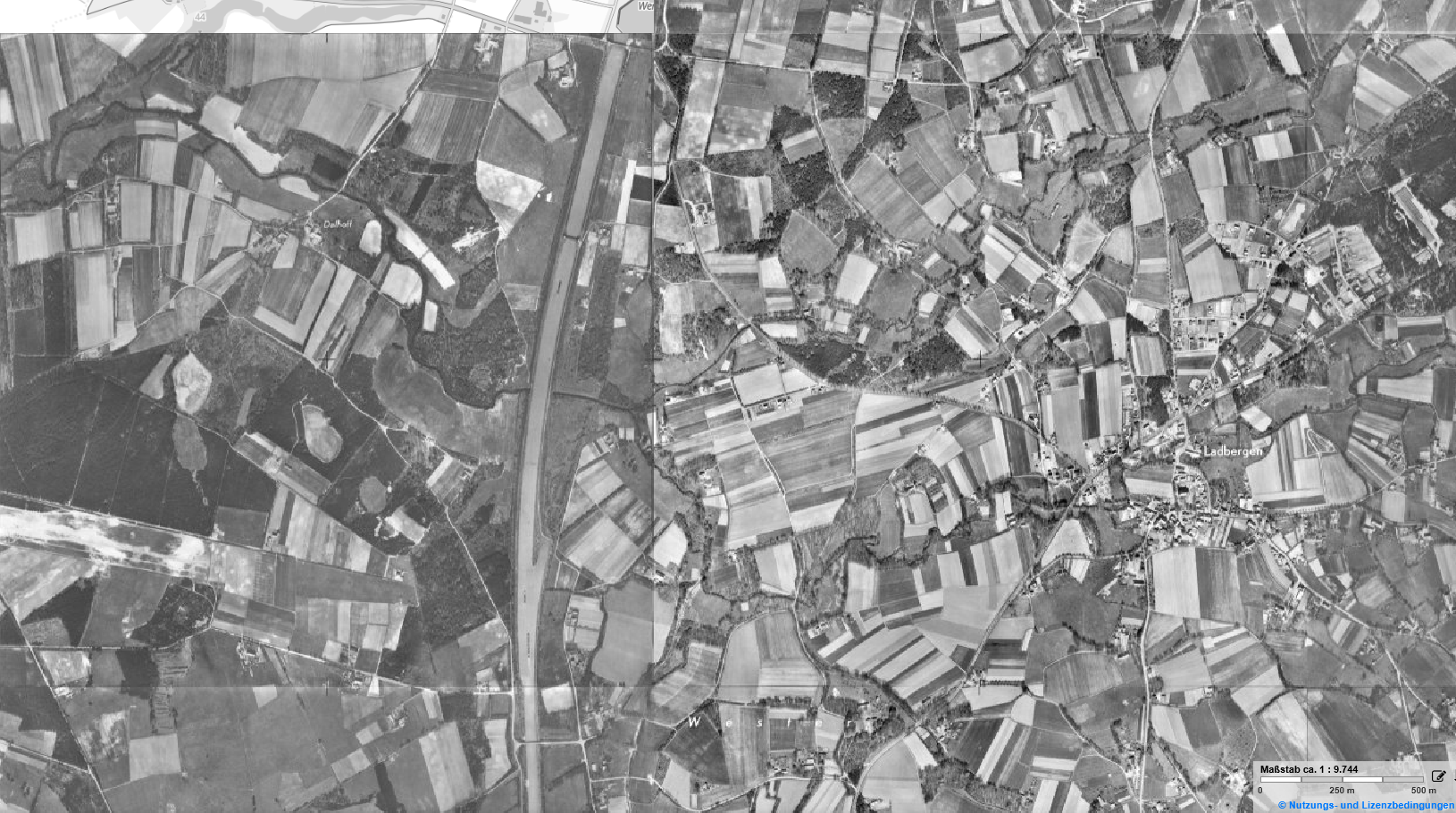
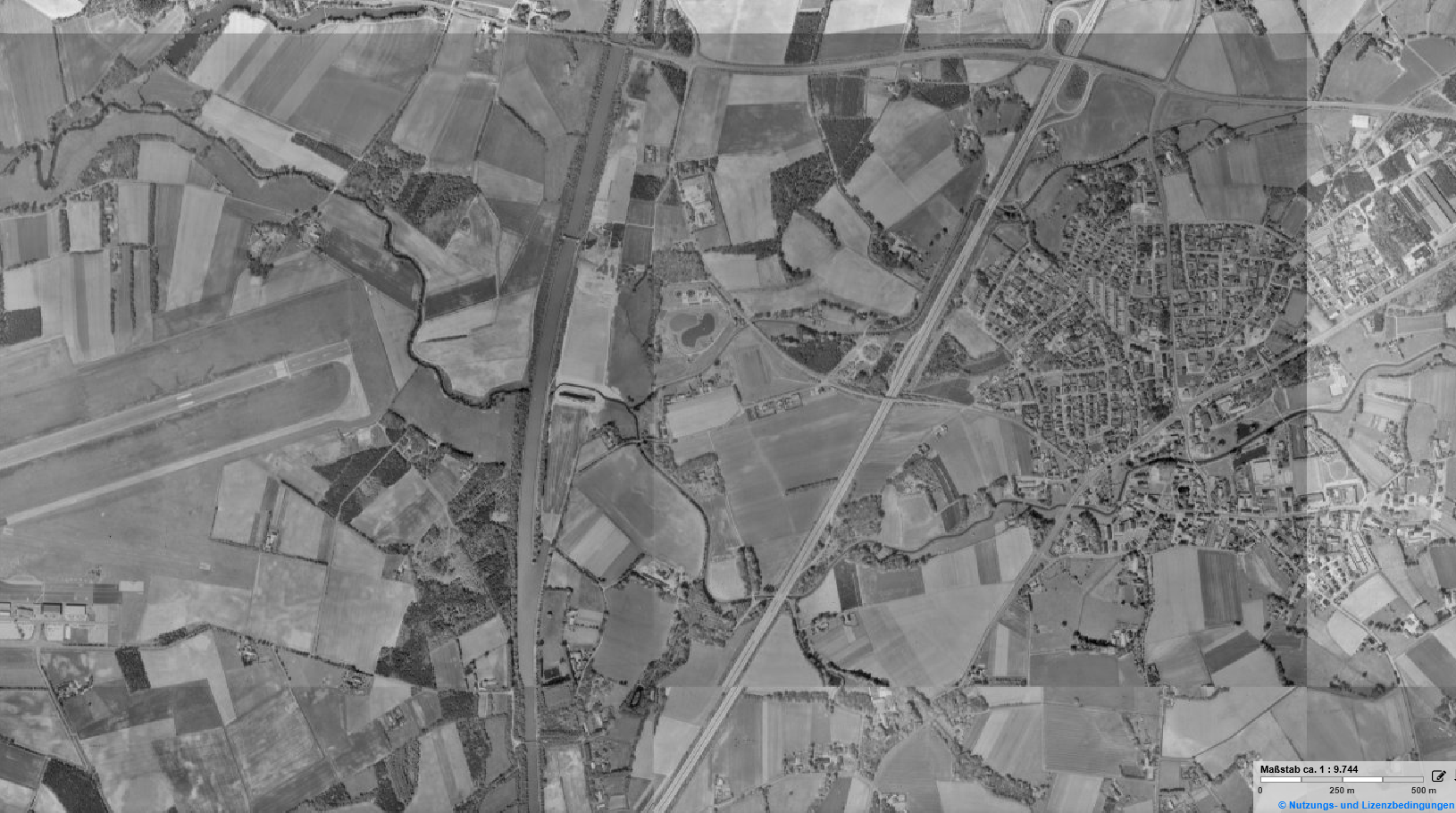
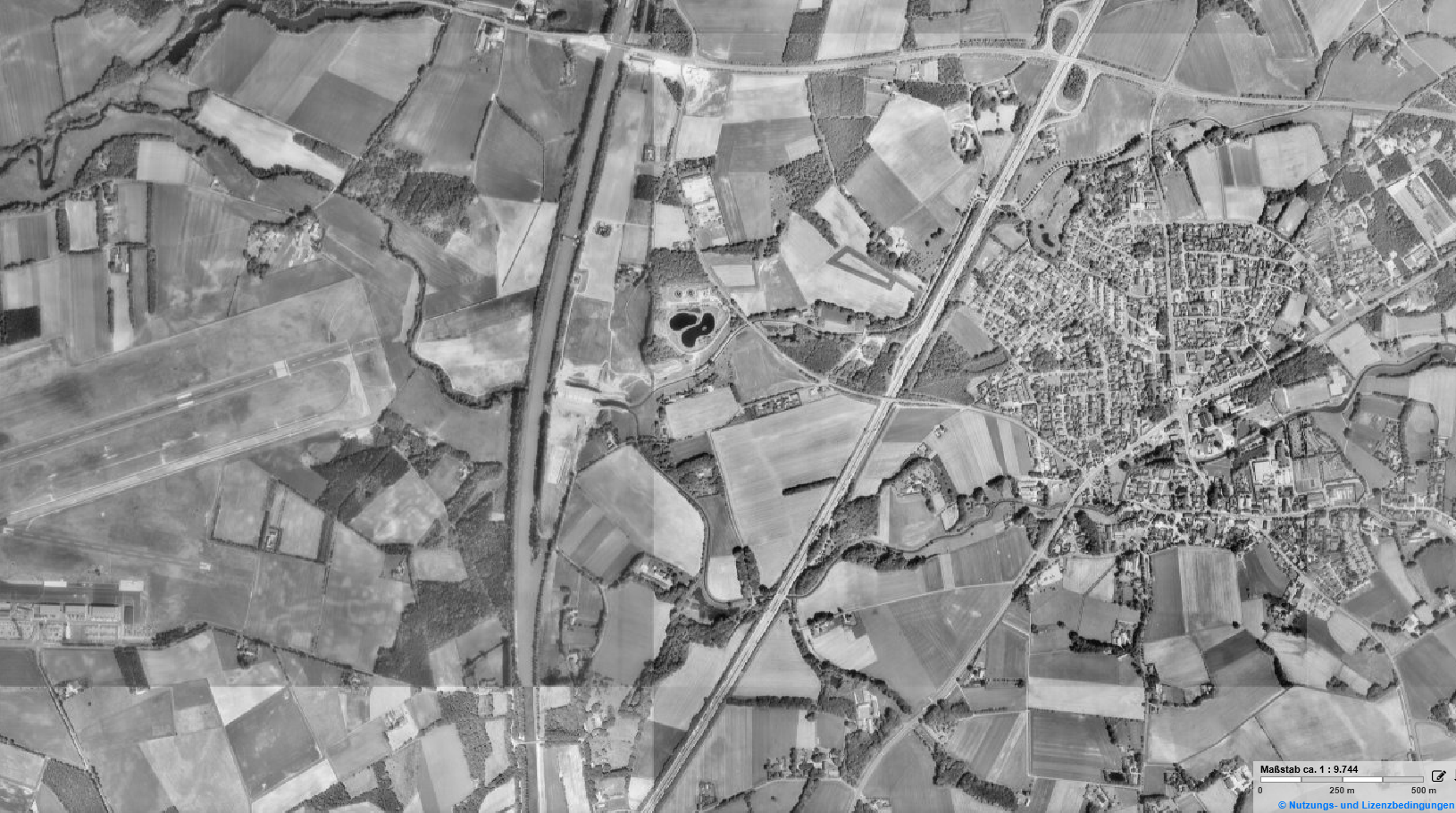
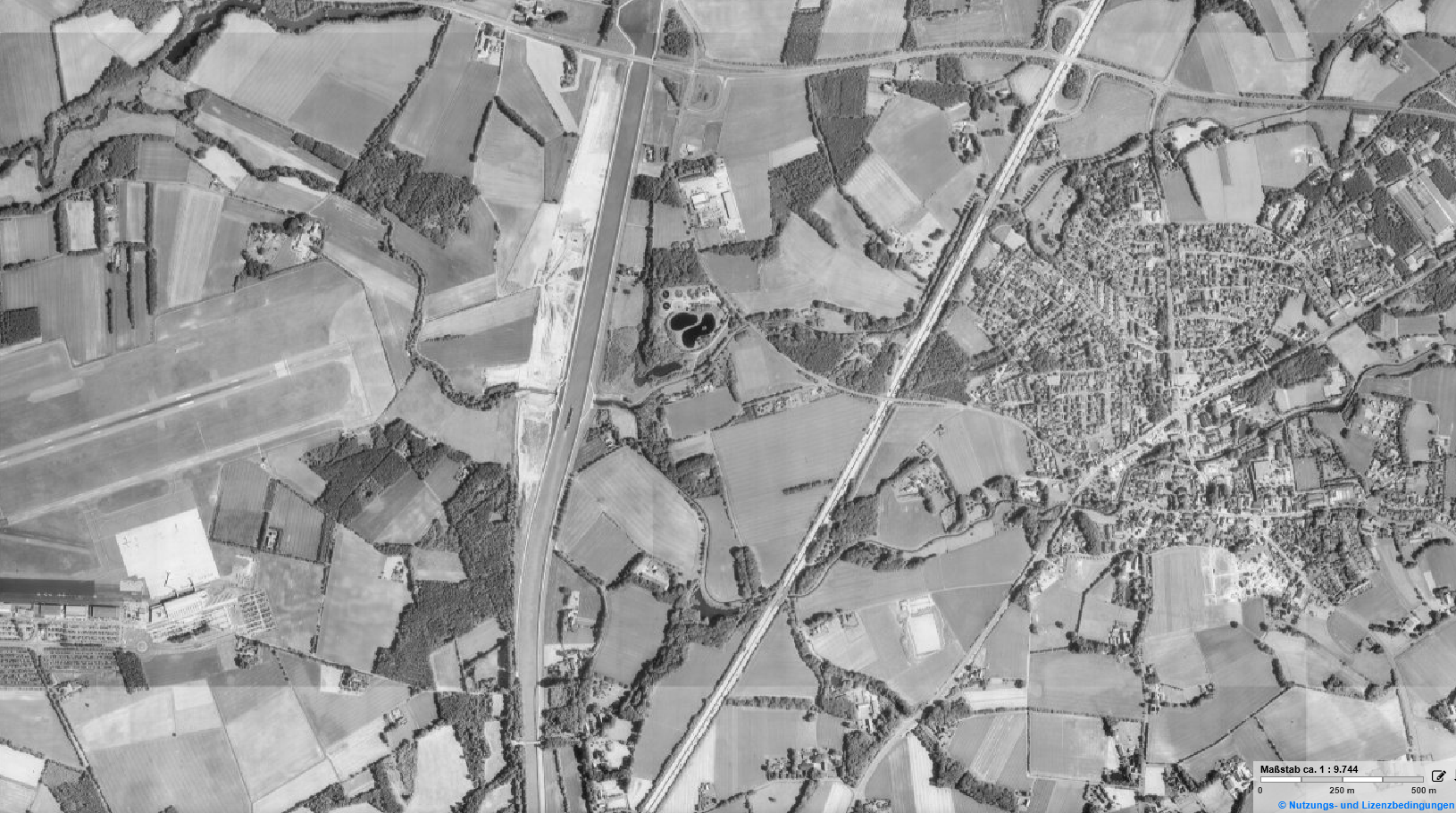
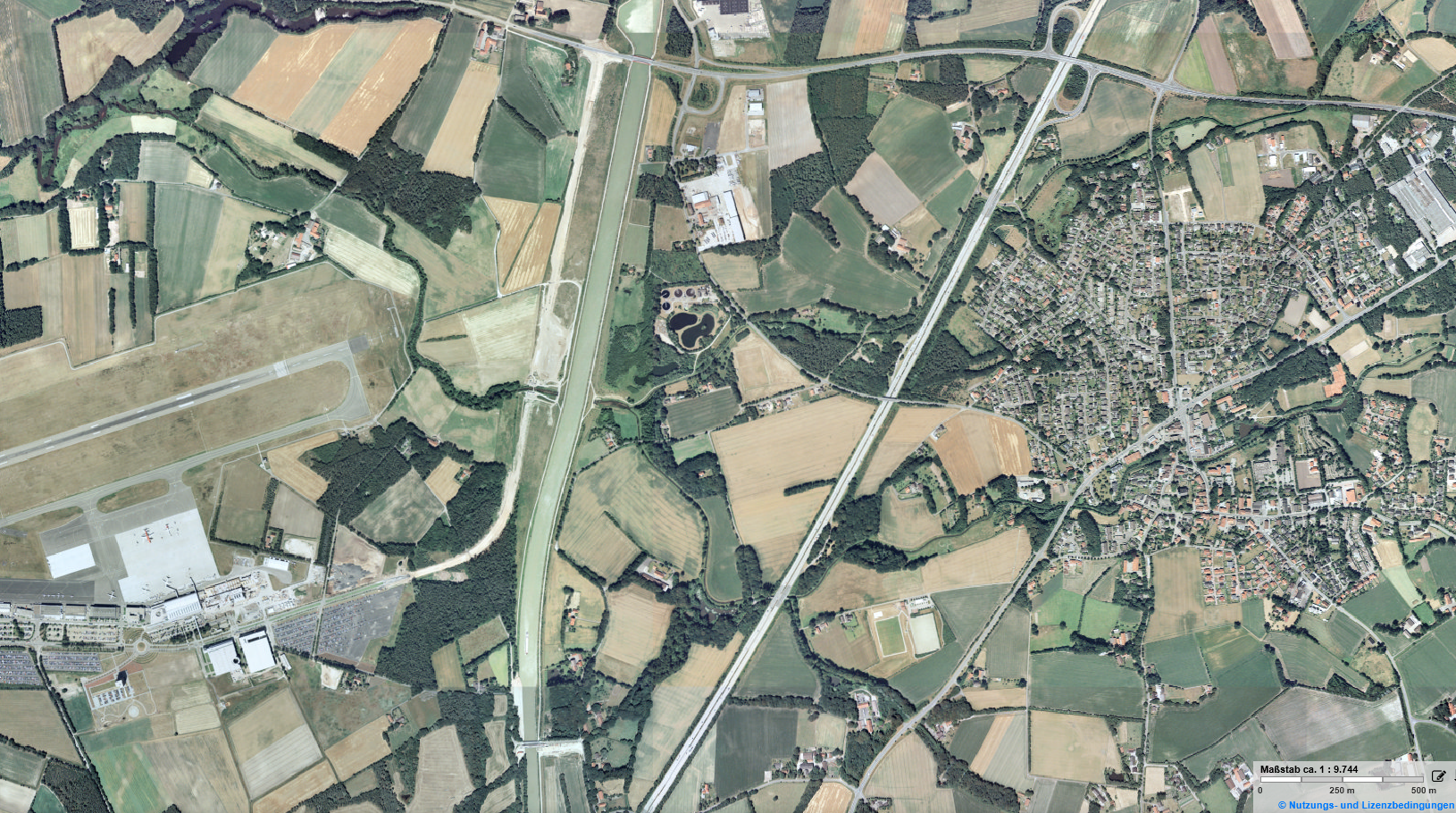
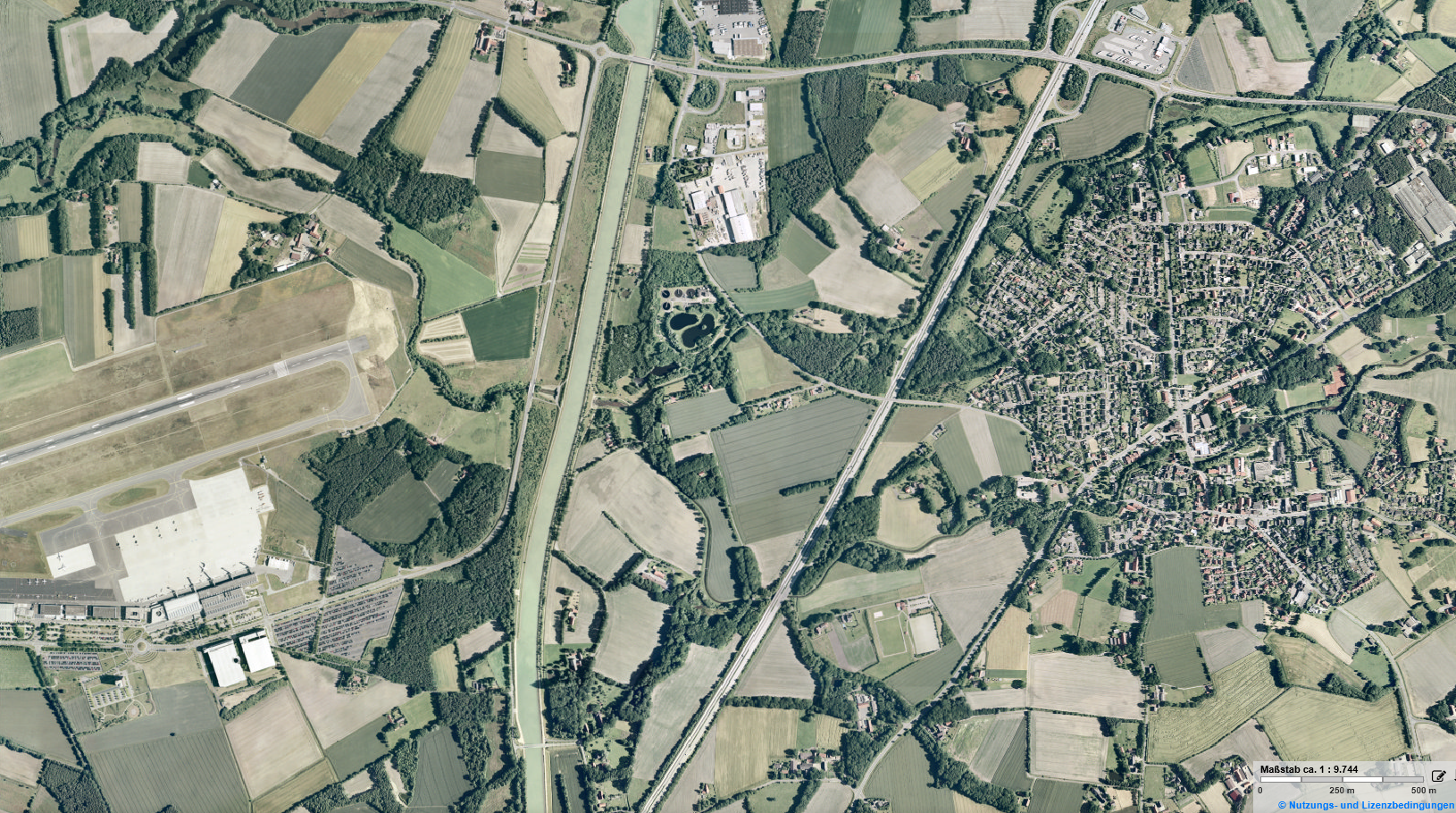
The chronology of the construction of the third branch (Author’s note: the official name is unknown) of the Dortmund-Ems Canal near Ladbergen can be traced using the following historical orthophotos (see Figures – ).
- 20 April 1960 (Figure )
- Condition prior to construction of the 3rd branch.
All that remains of the Alte Fahrt is a short ‘stump’ that branches off the 2nd branch to the north, between the Schulze-Farwick Bridge (pictured below) and the Glane culvert. - 13 May 1982 (Figure )
- The Glane is being diverted north of the new culvert, which is currently under construction.
Initial earthworks for the new canal bed between the ‘stummel’ of the Alte Fahrt and the Westladbergen Bridge (pictured above) have been carried out. - 14 May and 14 June 1988 (Figure )
- The River Glane flows through the newly completed culvert.
North of the Westladbergen Bridge, motor traffic is routed across the 2nd branch via a temporary bridge. The new Westladbergen Bridge over the future 3rd branch is currently under construction. - 27 June 1995 (Figure )
- The 3rd branch has been completed and opened to shipping.
The 2nd branch is being levelled to the ground.
The Glane culvert on the 2nd branch has been demolished.
The security gate on the 2nd branch, between the Glane culvert and the Westladbergen Bridge, has been demolished. A new security gate to the north of new Ladbergen Harbour was built between 1982 and 1988 (outside the orthophotos).
The new Westladbergen Bridge has been completed and opened to road traffic.
The new Ladbergen turning habour (shown at the top of the picture) has been completed. - 19 June 2000 (Figure )
- A new section of the K 9 district road is being built between the B 475 federal road (pictured above) and Münster/Osnabrück Airport (bottom left of the picture), on the site of the former 2nd branch.
The new Schulze-Farwick Bridge is currently under construction. - 19 June 2005 (Figure )
- The new section of the K9 district road between the B 475 and Münster/Osnabrück Airport has been completed and opened to traffic.
The new Schulze-Farwick Bridge has been completed and opened to traffic.
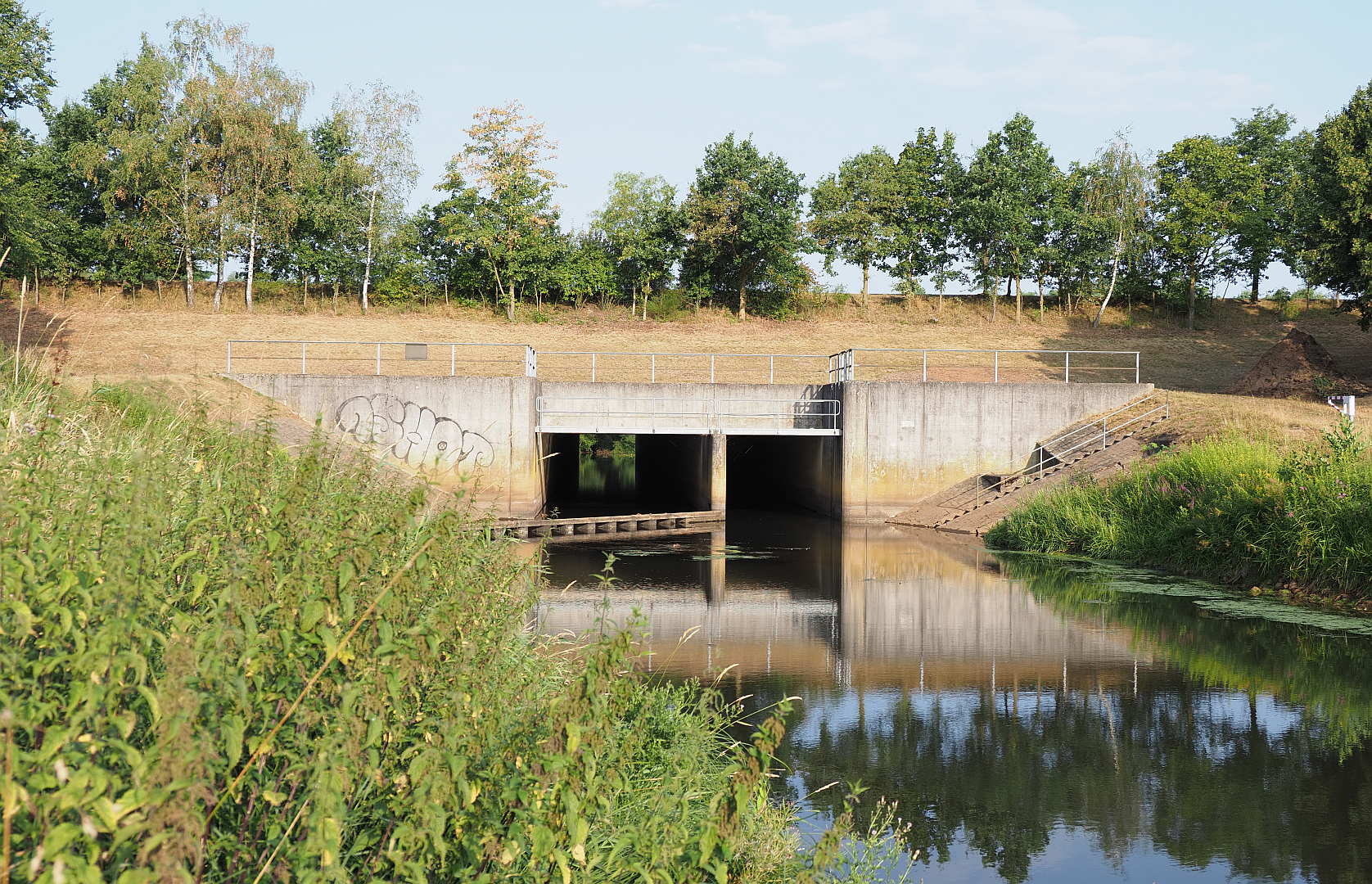
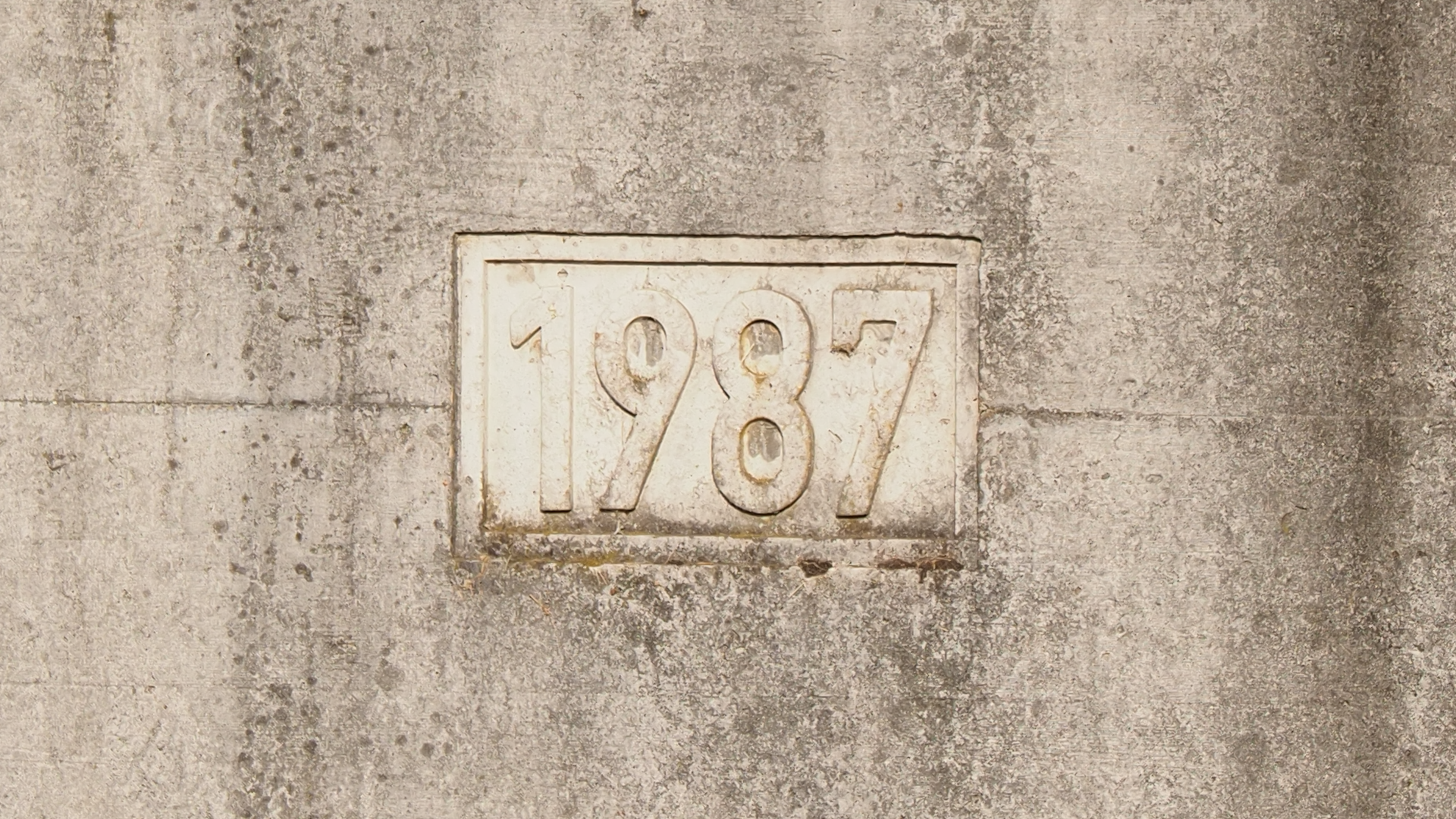
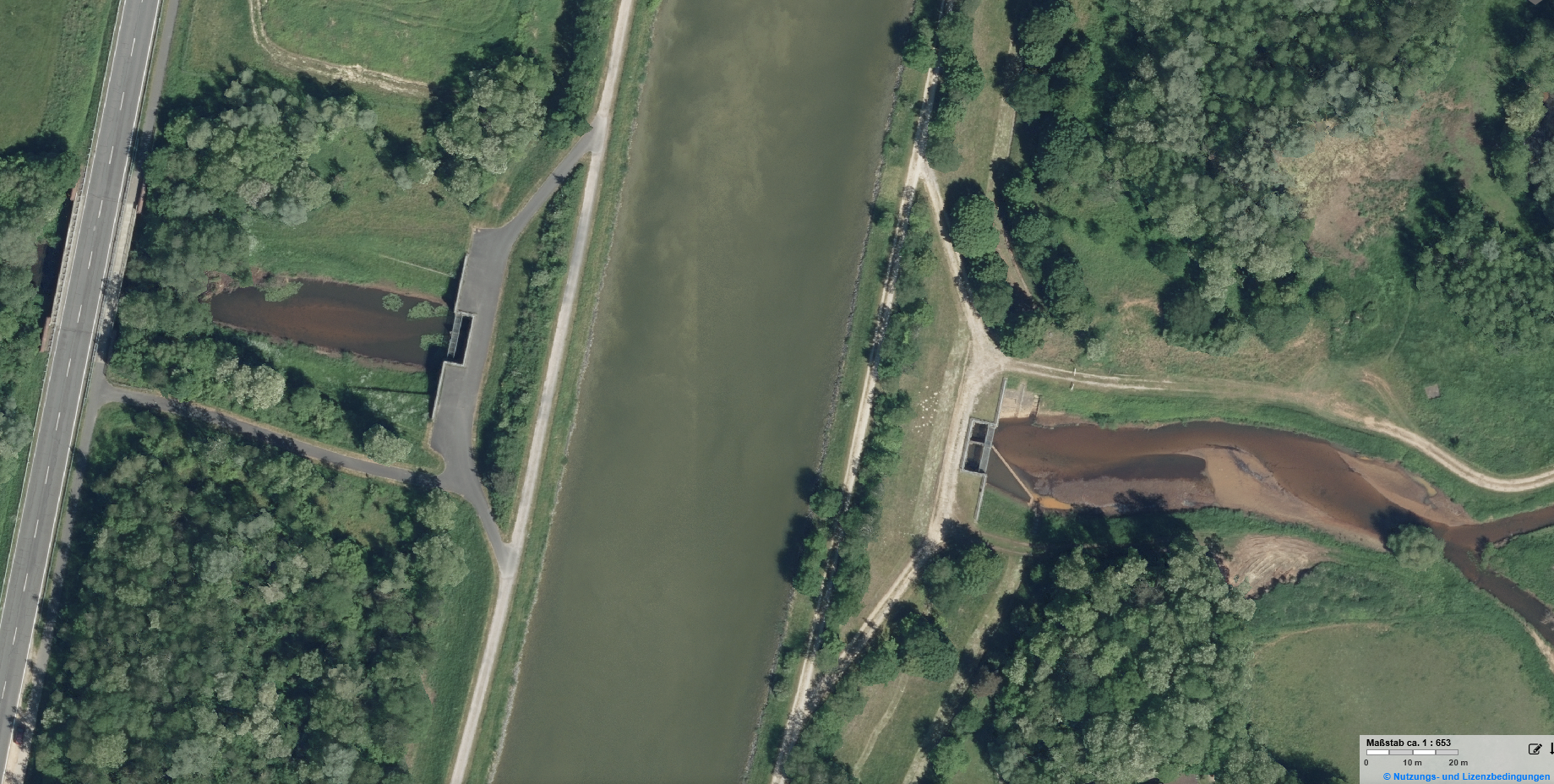
Present
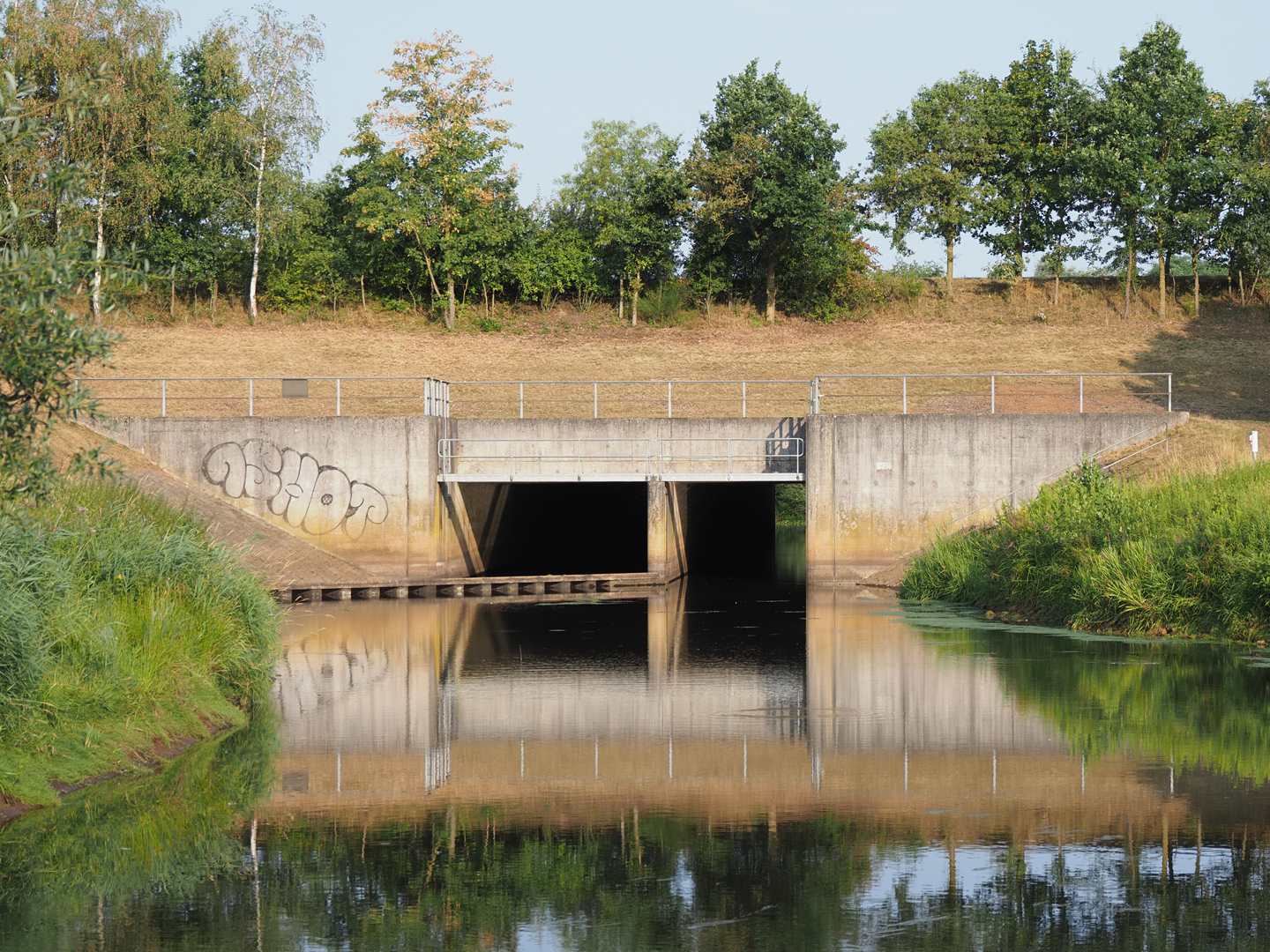
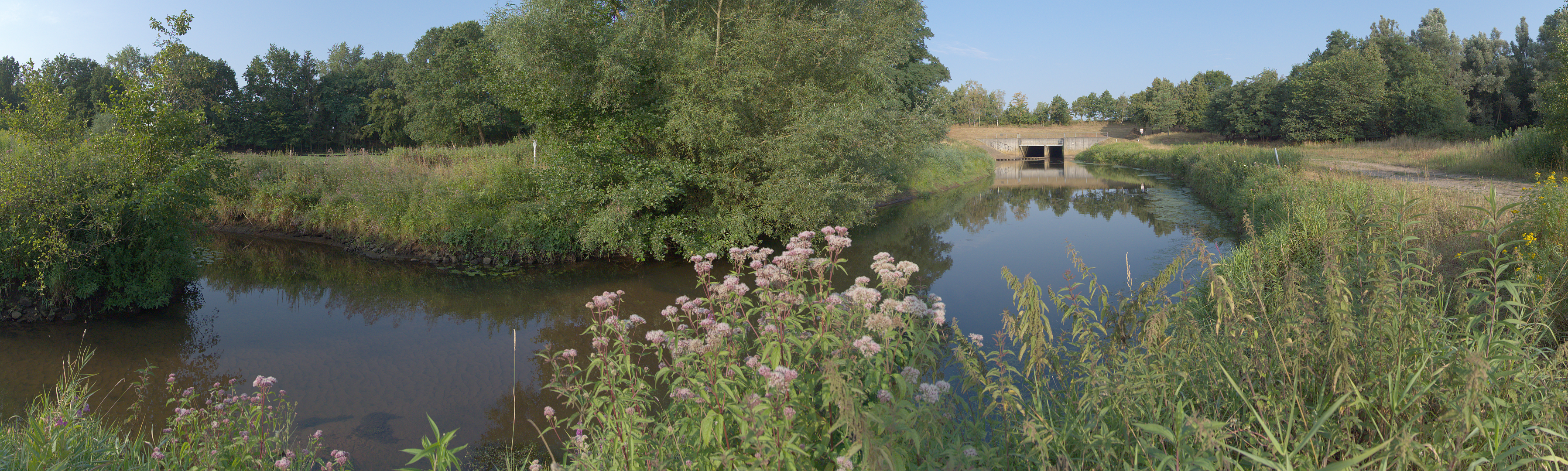
Weblinks
- Aircrew Remembered: Allied Air Forces Losses and Incidents Database
- Australian War Memorial⤴
- Charles Foster: Breaking the Dams⤴, Last Flight⤴
- Commonwealth War Graves Commission⤴
- Federal Waterways and Shipping Administration: The Dortmund-Ems Canal⤴ (German only)
- Imperial War Museums⤴
- Malcolm Brooke: Military Histories⤴
- Max Williams: An Ordinary Crew⤴
- University of Lincoln: International Bomber Command Centre Digital Archive⤴
- Wikipedia: Dortmund–Ems Canal⤴
- Wikipedia: Glane (Ems)⤴
References
- Cf. 4444,3 Tonnen Bomben prägten das Leben: in: Westfälische Nachrichten, 3 March 2020, https://www.wn.de/muensterland/kreis-steinfurt/ladbergen/44443-tonnen-bomben-pragten-das-leben-887057⤴. Retrieved 27 June 2026.[↩][↩][↩][↩][↩][↩][↩]
- Cf. Gewässerstationierungskarte 3E NRW: in: Landesamt für Natur, Umwelt und Klima Nordrhein-Westfalen, https://www.lanuv.nrw.de/fileadmin/lanuv/wasser/pdf/gsk3e_verzeichnis_gewaesser.xlsx⤴. Retrieved 30 May 2026[↩]
- © Land NRW, dl-de/by-2-0 (www.govdata.de/dl-de/by-2-0⤴) https://www.elwasweb.nrw.de⤴ 17 May 2026. Editing: Glane highlighted.[↩]
- © Bundesamt für Kartographie und Geodäsie 2026, Datenquellen: https://sgx.geodatenzentrum.de/web_public/gdz/datenquellen/Datenquellen_TopPlusOpen.html⤴. Editing: Glane highlighted.[↩]
- Meyers Lexikon: 3: Conti – Engmäuler, 7. Edition, Leipzig, Germany: Bibliograph. Inst., 1925.[↩][↩][↩]
- Festschrift zur Eröffnung des Dortmund-Ems-Kanals, Berlin, Germany: Sittenfeld, 1899. Archived⤴ at the Wayback Machine⤴. Retrieved 14 May 2026.[↩][↩][↩][↩]
- Cf. Schinkel, Eckhard (Ed.): Schlepper packen auf, 1st ed., Dortmund, Germany: Landschaftsverband Westfalen–Lippe, Westfälisches Industriemuseum, 1996, [online] https://www.lwl.org/wim-download/Publikationen/Schlepper%20Packen%20auf.pdf⤴. Retrieved 6 August 2026.[↩][↩]
- LWL-Medienzentrum für Westfalen, Binnenschiff auf dem Dortmund-Ems-Kanal, 01_1573⤴[↩]
- GEOportal.NRW “Data licence Germany – Zero – Version 2.0” (https://www.govdata.de/dl-de/zero-2-0⤴) [↩][↩][↩][↩][↩][↩][↩][↩][↩]
- Meyers Lexikon: 1: A – Bechstein, 7. Edition, Leipzig, Germany: Bibliograph. Inst., 1924.[↩]
- LWL Media Centre for Westphalia, Rheine Waterways Authority, photo album for District Administrator Theodor Offenberg on the occasion of his 25th service anniversary in 1931, 03_3169⤴[↩]
- Zander, Willi/Karl Wulkow: Dortmund-Ems-Kanal. Düker am Fehntjer Tief, Emden, in: Architekturmuseum der Technischen Universität Berlin, 28.4.2025, inventory number BZ-I 21,002, https://doi.org/10.25645/9vnm-qm1f⤴. Retrieved 25 June 2026.[↩]
- Dortmund-Ems-Kanal Unterführungen und Düker, in: Atlas zur Zeitschrift für Bauwesen, Blatt 67, Volume 51, 1901, inventory number ZFB 51,067, https://doi.org/10.25645/3mbf-0539⤴. Retrieved 29 July 2026.[↩]
- Dortmund-Ems-Kanal. Eltingsmühlbach-Durchlass, Schmedehausen: Errichtung der Gewölbe, in: Architekturmuseum der Technischen Universität Berlin, inventory number. BZ-F 17,029, https://doi.org/10.25645/6nkq-0m6q⤴. Retrieved 25 June 2026.[↩]
- Cf. Landesarchiv NRW Abteilung Westfalen, O 103 / Wasser- und Schifffahrtsämter / Wasser- und Schifffahrtsamt Münster, Nr. 1292[↩][↩][↩][↩][↩][↩]
- Cf. Landesarchiv NRW Abteilung Westfalen, O 103 / Wasser- und Schifffahrtsämter / Wasser- und Schifffahrtsamt Münster, Nr. 1325[↩][↩]
- Landesarchiv NRW Abteilung Westfalen, O 103 / Wasser- und Schifffahrtsämter / Wasser- und Schifffahrtsamt Münster, Nr. 1292[↩][↩][↩][↩][↩]
- Cf. Brooke, Malcolm: The German Defences, in: Military Histories, https://www.militaryhistories.co.uk/canal_raids/defences⤴. Retrieved 20 July 2026.[↩]
- Cf. Rüstungswirtschaftliche Abteilung Rü III: Anlagen zum Kriegstagebuch IV. W Rü, Anlage 106 zum Kriegstagebuch W Rü (Blatt 180), Wehrwirtschaftliche Auswertung der Feindangriffe auf Reichsgebiet durch Flieger, Artilleriebeschuss und Treibminen vom 10. Mai bis 10. Juli 1940, Berlin, Deutsches Reich: Oberkommando der Wehrmacht, 1940. Archived⤴ at the U.S. National Archives and Records Administration⤴. Retrieved 16 August 2026.[↩]
- Kriegstagebuch der Rüstungsinspektion VI Münster, Heft 1, Febr. – Juli 1940. Archived⤴ at the Bundesarchiv⤴. Retrieved 16 August 2026.[↩]
- Herbert Adams, “Plotting Map and logs for operation to Dortmund-Ems Aqueduct,” IBCC Digital Archive, accessed June 29, 2026, https://ibccdigitalarchive.lincoln.ac.uk/collections/document/43035.[↩]
- © IWM⤴ (E(MOS) 884⤴) [↩]
- “Lancaster in flight,” IBCC Digital Archive, accessed May 16, 2026, https://ibccdigitalarchive.lincoln.ac.uk/collections/document/7450⤴[↩]
- © IWM⤴ (TR 198⤴) [↩]
- © IWM⤴ (CH 7487⤴) [↩]
- © IWM⤴ (CH 12450⤴) [↩]
- Cf. Rüstungswirtschaftliche Abteilung Rü III: Anlagen zum Kriegstagebuch IV. W Rü, Anlage 113 zum Kriegstagebuch W Rü (Blatt 184), Berlin, Deutsches Reich: Oberkommando der Wehrmacht, 1940. Archived⤴ at the U.S. National Archives and Records Administration⤴. Retrieved 18 August 2026.[↩]
- Cf. Rüstungswirtschaftliche Abteilung Rü III: Anlagen zum Kriegstagebuch IV. W Rü, Anlage 170 zum Kriegstagebuch W Rü (Blatt 206), Berlin, Deutsches Reich: Oberkommando der Wehrmacht, 1940. Archived⤴ at the U.S. National Archives and Records Administration⤴. Retrieved 18 August 2026.[↩]
- Cf. Rüstungswirtschaftliche Abteilung Rü III: Anlagen zum Kriegstagebuch IV. W Rü, Anlage 188 zum Kriegstagebuch W Rü (Blatt 211), Berlin, Deutsches Reich: Oberkommando der Wehrmacht, 1940. Archived⤴ by the U.S. National Archives and Records Administration⤴. Retrieved 19 August 2026.[↩]
- Cf. Führungsstab Ic: Lagebericht Nr. 381, Anlage 2a zum Lagebericht Nr. 381, Berlin, Deutsches Reich: Oberbefehlshaber der Luftwaffe, 1940. Archived⤴ by the U.S. National Archives and Records Administration⤴. Retrieved 20 August 2026.[↩]
- Cf. Fernschreiben Nr. 758 20.9.1940: Gauleitung Westfalen Nord Münster, 1940. Archived⤴ by the U.S. National Archives and Records Administration⤴. Retrieved 21 August 2026.[↩]
- Rüstungswirtschaftliche Abteilung Rü III: Anlagen zum Kriegstagebuch IV. W Rü, Anlage 194 zum Kriegstagebuch W Rü (Blatt 217), Berlin, Deutsches Reich: Oberkommando der Wehrmacht, 1940. Archived⤴ by the U.S. National Archives and Records Administration⤴. Retrieved 19 August 2026.[↩]
- Cf. Führungsstab Ic: Lagebericht Nr. 386, Anlage 2a zum Lagebericht Nr. 386, Berlin, Deutsches Reich: Oberbefehlshaber der Luftwaffe, 1940. Archived⤴ by the U.S. National Archives and Records Administration⤴. Retrieved 20 August 2026.[↩]
- Cf. Rüstungswirtschaftliche Abteilung Rü III: Anlagen zum Kriegstagebuch IV. W Rü, Bl. [sic] 195 zum Kriegstagebuch W Rü (Blatt 217), Berlin, Deutsches Reich: Oberkommando der Wehrmacht, 1940. Archived⤴ by the U.S. National Archives and Records Administration⤴. Retrieved 19 August 2026.[↩]
- Cf. Führungsstab Ic: Lagebericht Nr. 388, Anlage 2 a zum Lagebericht Nr. 388, Berlin, Deutsches Reich: Oberbefehlshaber der Luftwaffe, 1940. Archived⤴ by the U.S. National Archives and Records Administration⤴. Retrieved 20 August 2026.[↩]
- Dortmund – Dortmund Ems Canal, in: The Dambusters, https://www.dambusters.org.uk/after-the-dams/raids/dortmund/. Archived⤴ 7 March 2023 at the Wayback Machine⤴. Retrieved 22 July 2026.[↩]
- Bomber Command: Royal Air Force Bomber Command 60th Anniversary, Campaign Diary September 1943, in: Royal Air Force, 2004, http://www.raf.mod.uk/bombercommand/sep43.html. Archived⤴ 7 June 2007 at the Wayback Machine⤴. Retrieved 30 April 2026.[↩][↩]
- Cf. Aircrew Remembered: Allied Air Forces Losses and Incidents Database, in: Aircrew Remembered, https://aircrewremembered.com/AlliedLossesIncidents/?q=ladbergen&search_only=Mission⤴. Retrieved 2 June 2026.[↩][↩][↩][↩][↩][↩][↩][↩][↩][↩]
- Cf. Dortmund – Dortmund Ems Canal, in: The Dambusters, https://www.dambusters.org.uk/after-the-dams/raids/dortmund/. Archived⤴ 7 March 2023 at the Wayback Machine⤴. Retrieved 22 July 2026.[↩]
- Cf. Stadt Nordhorn: Zum Gedenken an die Opfer des Luftkrieges im II. Weltkrieg, in: Stadt Nordhorn, https://www.nordhorn.de/portal/seiten/zum-gedenken-an-die-opfer-des-luftkrieges-im-ii-weltkrieg-900000817-26710.html⤴. Retrieved 25 June 2026.[↩]
- © IWM⤴ (C 4665⤴) [↩]
- Bomber Command: Royal Air Force Bomber Command 60th Anniversary, Campaign Diary September 1944, in: Royal Air Force, 2004, http://www.raf.mod.uk/bombercommand/sep44.html. Archived⤴ 7 June 2007 at the Wayback Machine⤴. Retrieved 30 April 2026.[↩]
- “V Group News, September 1944,” IBCC Digital Archive, accessed May 16, 2026, https://ibccdigitalarchive.lincoln.ac.uk/collections/document/18282⤴[↩]
- Cf. Landesarchiv NRW Abteilung Westfalen, O 103 / Wasser- und Schifffahrtsämter / Wasser- und Schifffahrtsamt Münster, Nr. 1300[↩][↩][↩][↩][↩][↩]
- Cf. Teuber, Sigmar: . . . und sie bringen den Tod: in: Westfälische Nachrichten, 24 September 2014, https://www.wn.de/muensterland/kreis-steinfurt/ladbergen/-und-sie-bringen-den-tod-1888937⤴. Retrieved 27 June 2026.[↩][↩]
- Cf. Brooke, Malcolm: The Effect on the Local Communities, in: Military Histories, https://www.militaryhistories.co.uk/canal_raids/ladeffects⤴. Retrieved 3 June 2026.[↩][↩][↩][↩][↩][↩]
- © IWM (C 4667⤴) [↩][↩]
- Bomber Command: Royal Air Force Bomber Command 60th Anniversary, Campaign Diary November 1944, in: Royal Air Force, 2004, http://www.raf.mod.uk/bombercommand/nov44.html. Archived⤴ 7 June 2007 at the Wayback Machine⤴. Retrieved 30 April 2026.[↩][↩]
- “V Group News, November 1944,” IBCC Digital Archive, accessed May 12, 2026, https://ibccdigitalarchive.lincoln.ac.uk/collections/document/18550⤴[↩][↩]
- Cf. Brooke, Malcolm: The Losses (by date), in: Military Histories, https://www.militaryhistories.co.uk/canal_raids/losses/losses_by_date#tab1944⤴. Retrieved 3 June 2026.[↩]
- Great Britain. Royal Air Force, “Ladbergen Dortmund Ems Canal,” IBCC Digital Archive, accessed May 13, 2026, https://ibccdigitalarchive.lincoln.ac.uk/collections/document/50369⤴[↩]
- Ladbergen, Germany. C. 1944-11. A section of the Dortmund Ems Canal at Ladbergen after Bomber Command’s Lancaster attack on the night of 1944-11-21/22: in: Australian War Memorial, https://www.awm.gov.au/collection/C278469⤴. Retrieved 20. July 2026.[↩]
- Cf. Ladbergen, Germany. C. 1944-11. A section of the Dortmund Ems Canal at Ladbergen after Bomber Command’s Lancaster attack on the night of 1944-11-21/22: in: Australian War Memorial, https://www.awm.gov.au/collection/C278469⤴. Retrieved 20. July 2026.[↩]
- “V Group News, January 1945,” IBCC Digital Archive, accessed May 12, 2026, https://ibccdigitalarchive.lincoln.ac.uk/collections/document/18667⤴[↩]
- © IWM (CL 1756⤴) [↩]
- Bomber Command: Royal Air Force Bomber Command 60th Anniversary, Campaign Diary February 1945, in: Royal Air Force, 2004, http://www.raf.mod.uk/bombercommand/feb45.html. Archived⤴ 7 June 2007 at the Wayback Machine⤴. Retrieved 15 May 2026.[↩][↩]
- Cf. Luftwaffenführungsstab Ic: Morgenmeldung Reichsgebiet vom 8.2.1945, Berlin, Deutsches Reich: Chef des Generalstabs der Luftwaffe, 1945. Archived⤴ by the U.S. National Archives and Records Administration⤴. Retrieved 19 August 2026.[↩]
- Cf. Luftwaffenführungsstab Ic: Schadensmeldung zu den Einflügen Reichsgebiet i.d.Nacht vom 7./8.2.1945, Berlin, Deutsches Reich: Chef des Generalstabs der Luftwaffe, 1945. Archived⤴ von U.S. National Archives and Records Administration⤴. Retrieved 19 August 2026.[↩]
- Cf. Als die Bomben auf Leeden fielen: in: Westfälische Nachrichten, 26 January 2015, https://www.wn.de/muensterland/kreis-steinfurt/tecklenburg/als-die-bomben-auf-leeden-fielen-1863392⤴. Retrieved 25 June 2026.[↩]
- Bomber Command: Royal Air Force Bomber Command 60th Anniversary, Campaign Diary March 1945, in: Royal Air Force, 2004, http://www.raf.mod.uk/bombercommand/mar45.html. Archived⤴ 7 June 2007 at the Wayback Machine⤴. Retrieved 15 May 2026.[↩]
- “Dortmund Ems Canal at Ladbergen,” IBCC Digital Archive, accessed May 16, 2026, https://ibccdigitalarchive.lincoln.ac.uk/collections/document/58496⤴[↩][↩]
- Cf. Hickman, Mark: 1st Canadian Parachute Battalion: War Diaries, in: The Pegasus Archive, The British Airborne Forces, https://www.pegasusarchive.org/varsity/war_1stCdn.htm. Retrieved 9 August 2026.[↩]
- Dews, Edmund: NATO Inland Transport as a Potential Rear-Area Target System: Lessons from German Experience in World War II, Santa Monica, United States of America: Rand, 1980, https://www.rand.org/content/dam/rand/pubs/notes/2007/N1522.pdf⤴.[↩][↩][↩]
- H G Adams, “Bomber Raids on the Dortmund-Ems canal,” IBCC Digital Archive, accessed July 22, 2026, https://ibccdigitalarchive.lincoln.ac.uk/collections/document/27305⤴.[↩]
- Cf. Eine Mahnung für den Frieden: in: Westfälische Nachrichten, 17 September 2023, https://www.wn.de/muensterland/kreis-steinfurt/ladbergen/gedenkstele-zweiter-weltkrieg-kanal-bombadiert-2828834⤴. Retrieved 25 July 2026.[↩][↩]
- Cf. Brooke, Malcolm: The 617 Sqn raid on Ladbergen in 1943, in: Military Histories, https://www.militaryhistories.co.uk/canal_raids/ladbergen43⤴. Retrieved 25 July 2026.[↩]
- Cf. Williams, Max: The Crash site!, in: An Ordinary Crew, https://www.ordinarycrew.co.uk/about-1⤴. Retrieved 25 July 2026.[↩][↩]
- Cf. Williams, Max: The Worst News, in: An Ordinary Crew, https://www.ordinarycrew.co.uk/the-worst-news⤴. Retrieved 25 July 2026.[↩]
- “Geobasis NRW, Hansa Luftbild AG, Landesarchiv NRW, RW 0230”. “Data licence Germany – attribution – Version 2.0” (https://www.govdata.de/dl-de/by-2-0⤴) [↩]