Table of contents
Transcription
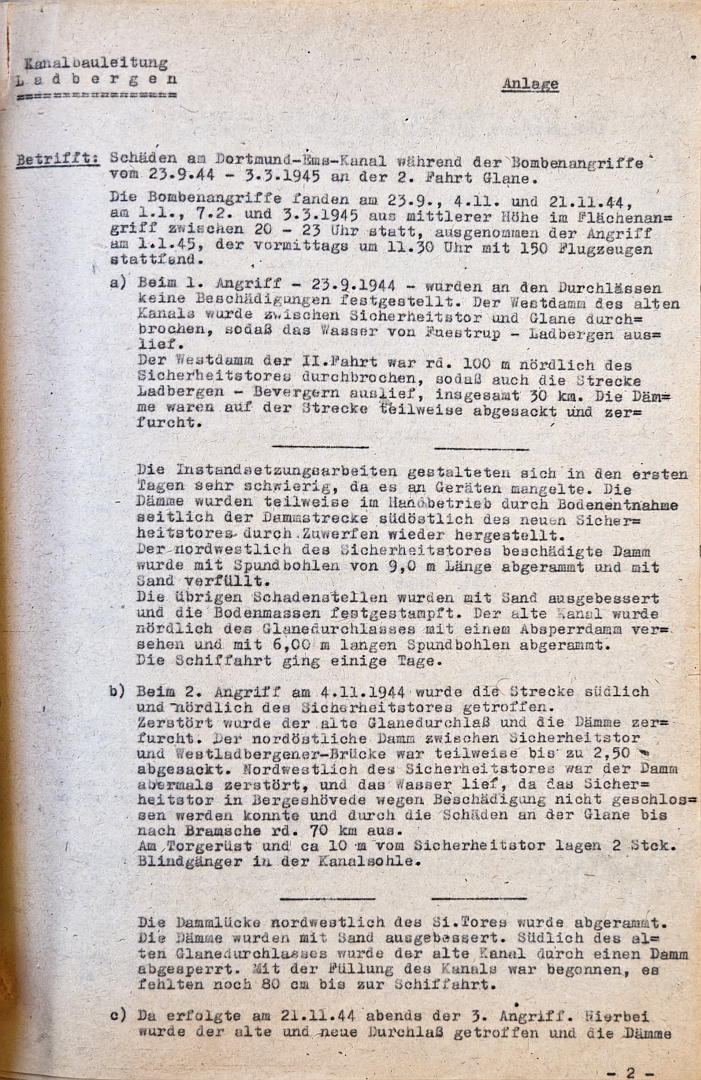
Canal Construction Management
Ladbergen
Annex
Re:
Damage to the Dortmund-Ems Canal during the bombing raids from 23 September 1944 to 3 March 1945 on the 2nd Glane branch.
The bombing raids took place on 23 September, 4 November and 21 November 1944, and on 1 January, 7 February and 3 March 1945, from medium altitude in carpet bombing between 8 pm and 11 pm, with the exception of the attack on 1 January 1945, which took place in the morning at 11.30 am involving 150 aircraft.
a)
During the first attack – 23 September 1944 – no damage was found at the culverts. The western embankment of the old canal was breached between the security gate and the Glane, so that the water flowed from Fuestrup – Ladbergen.
The western embankment of the second branch was breached approx. 100 m north of the security gate, causing the Ladbergen – Bevergern section to flood as well, a total of 30 km. The embankments along this section had partially subsided and were furrowed.
The repair work proved very difficult in the early days due to a lack of equipment. The embankments were partially restored by hand, removing soil from the sides of the embankment south-east of the new security gate and backfilling the area.
The embankment damaged north-west of the security gate was shored up with 9.0 m long sheet piles and filled with sand.
The remaining damaged sections were repaired with sand and the soil compacted. The old canal was fitted with a cofferdam north of the Glane culvert and shored up with 6.00 m long sheet piles.
Navigation resumed after a few days.
b)
During the second attack on 4 November 1944, the section south and north of the security gate was hit.
The old Glane culvert was destroyed and the embankments were gouged out. The north-eastern embankment between the security gate and the Westladbergen bridge had subsided in places by up to 2.50 m. North-west of the security gate, the embankment had been breached once again, and as the security gate at Bergeshövede could not be closed due to damage, and because of the damage at the Glane, the water flowed all the way to Bramsche, a distance of around 70 km.
At the gate structure and approx. 10 m from the security gate, two unexploded bombs were lying on the canal bed.
The breach in the embankment north-west of the security gate was rammed shut.
The embankments were repaired with sand. South of the old Glane culvert, the old canal was blocked off by an embankment. Work had begun on filling the canal; there was still 80 cm to go before it was navigable.
c)
Then, on the evening of 21 November 1944, the third attack took place. During this, the old and new culverts were hit and the dams were breached. 150 m south-west of the Glane culvert, the dam had burst and been washed away over a length of 40 m.
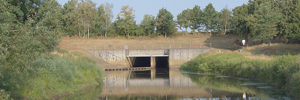
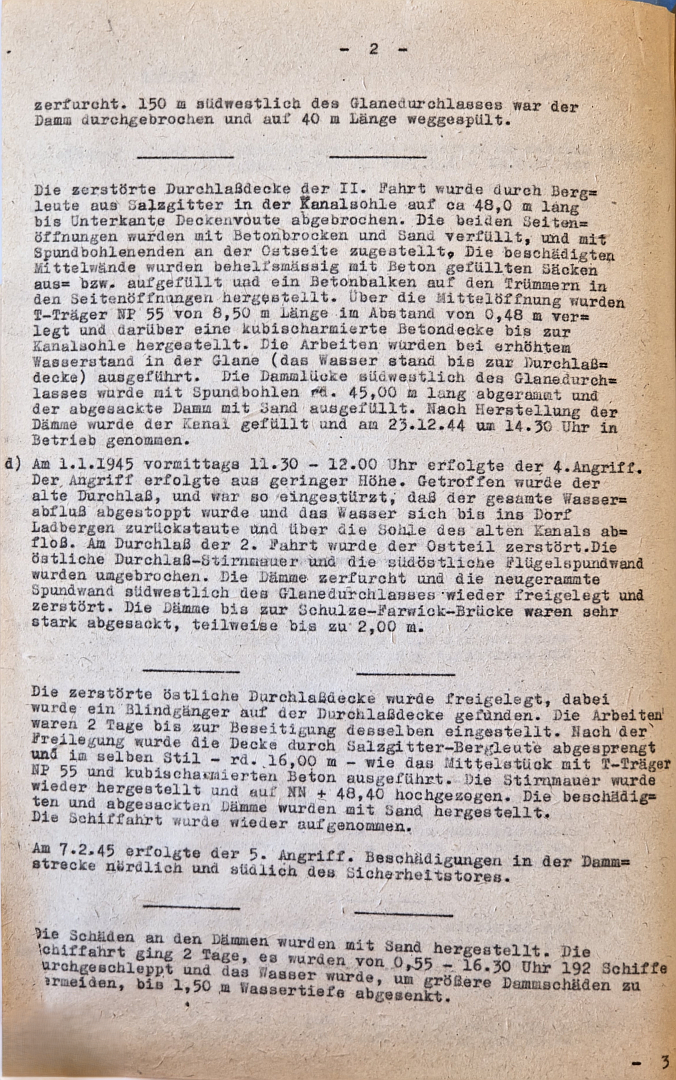
The destroyed culvert roof of the second branch was demolished by miners from Salzgitter at the base of the canal to a length of approx. 48.0 m down to the lower edge of the roof cove. The two side openings were filled with concrete rubble and sand, and sealed on the east side with sheet pile ends. The damaged central walls were provisionally filled with concrete-filled sacks, and a concrete beam was constructed on the rubble in the side openings. T-beams NP 55, 8.50 m in length, were laid across the central opening at spaced 0.48 m apart, and a reinforced concrete slab was constructed above this down to the canal bed. The work was carried out whilst the water level in the Glane was high (the water reached the culvert top). The breach in the embankment south-west of the Glane culvert was sealed with sheet piling approx. 45.00 m long and the subsided embankment filled with sand. After the embankments were completed, the canal was filled and put into operation on 23 December 1944 at 14:30.
d)
On the morning of 1 January 1945, between 11.30 and 12.00, the fourth attack took place. The attack was carried out from a low altitude. The old culvert was hit and collapsed to such an extent that the entire water flow was blocked and the water backed up into the village of Ladbergen, flowing over the bed of the old canal. At the culvert of the 2nd branch, the eastern section was destroyed. The eastern culvert face wall and the southeastern wing sheet piling were breached. The embankments were scarred and the newly driven sheet pile wall south-west of the Glane culvert was exposed and destroyed. The embankments up to the Schulze-Farwick Bridge had subsided significantly, in places by up to 2.00 m.
The destroyed eastern culvert roof was exposed, during which an unexploded bomb was found on the culvert roof. Work was suspended for two days whilst the bomb was being cleared. After exposure, the roof was blasted by Salzgitter miners and constructed in the same style – approx. 16.00 m – as the central section, using T-beams NP 55 and cubically reinforced concrete. The end wall was repaired and raised to NN + 48.40.
Navigation was resumed.
e)
On 7 February 1945, the fifth attack took place. Damage occurred in the section of the dam north and south of the security gate.
The damage to the dams was repaired with sand. Navigation continued for two days; between 0.55 and 16.30, 192 ships were towed through, and the water level was lowered to a depth of 1.50 m to prevent further damage to the dams.
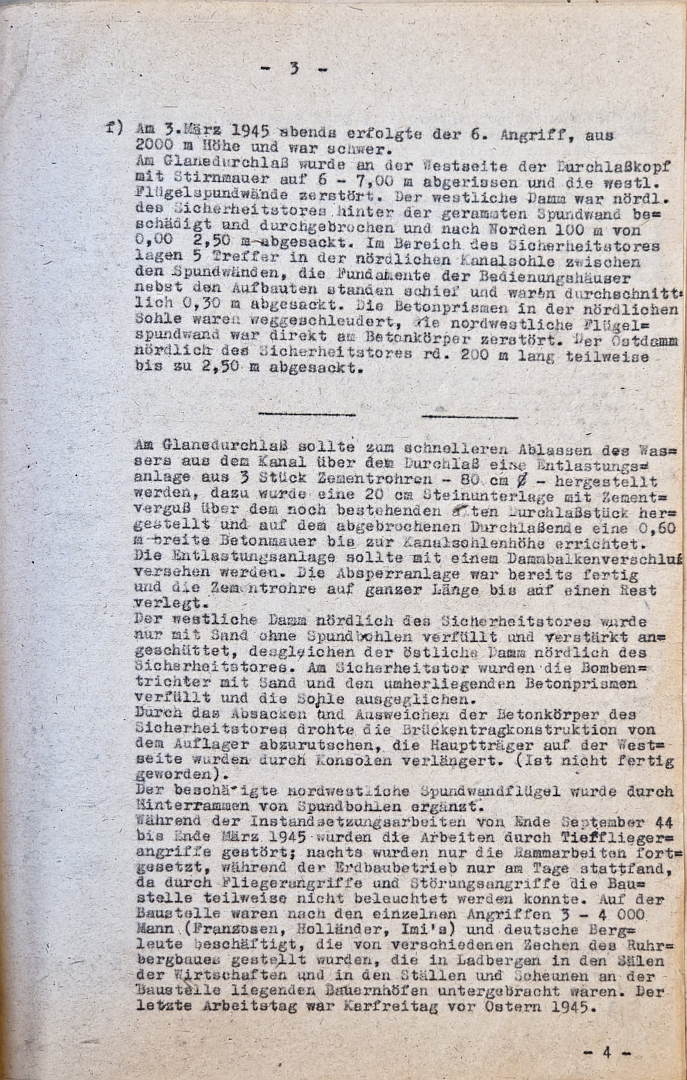
f)
On the evening of 3 March 1945, the sixth attack took place from an altitude of 2,000 m and was severe.
At the Glane culvert, on the western side, the culvert head with its end wall was demolished to a height of 6-7.00 m and the western wing sheet pile walls were destroyed. The western embankment was damaged and breached north of the security gate behind the driven sheet pile wall and had subsided by 0.00-2.50 m over a distance of 100 m to the north. In area of the security gate, there were five impacts in the northern canal bed between the sheet pile walls; the foundations of the control buildings, together with their superstructures, were leaning and had subsided by an average of 0.30 m. The concrete prisms in the northern base had been hurled away; the north-western wing sheet pile wall had been destroyed directly at the concrete structure. The eastern embankment north of the security gate, approx. 200 m long, had subsided by up to 2.50 m in places.
At the Glane culvert, a relief system consisting of three cement pipes – 80 cm in diameter – was to be constructed to allow water to drain more quickly from the canal via the culvert; for this purpose a 20 cm stone base with a cement grout was constructed over the remaining old culvert section and a 0.60 m wide concrete wall was erected on the broken-off end of the culvert up to the level of the canal bed.
The relief structure was to be fitted with a dam beam closure. The shut-off system was already complete and the cement pipes had been laid along their entire length, except for a remaining section.
The western embankment north of the security gate was filled only with sand, without sheet piling, and reinforced with additional fill; the same applied to the eastern embankment north of the security gate. At security gate, the bomb craters were filled with sand and the surrounding concrete blocks, and the bed levelled.
Due to the settling and shifting of the concrete structures of the security gate, the bridge supporting structure was in danger of slipping off its bearing; the main girders on the west side were extended by brackets. (Not completed).
The damaged north-western sheet pile wing was repaired by driving sheet piles behind it.
During the repair work from late September 1944 to late March 1945, operations were disrupted by low-level air raids; at night, only the piling work continued at night, whilst earthworks took place only during the day, as air raids and disruptive attacks meant that parts of the construction site could not be illuminated. On the construction site, following the individual attacks, 3,000-4,000 men (French, Dutch, Italian) and German miners, who were provided by various collieries in the Ruhr mining region and were housed in Ladbergen in the halls of the inns and in the stables and barns of the farms adjacent to the construction site. The last working day was Good Friday before Easter 1945.
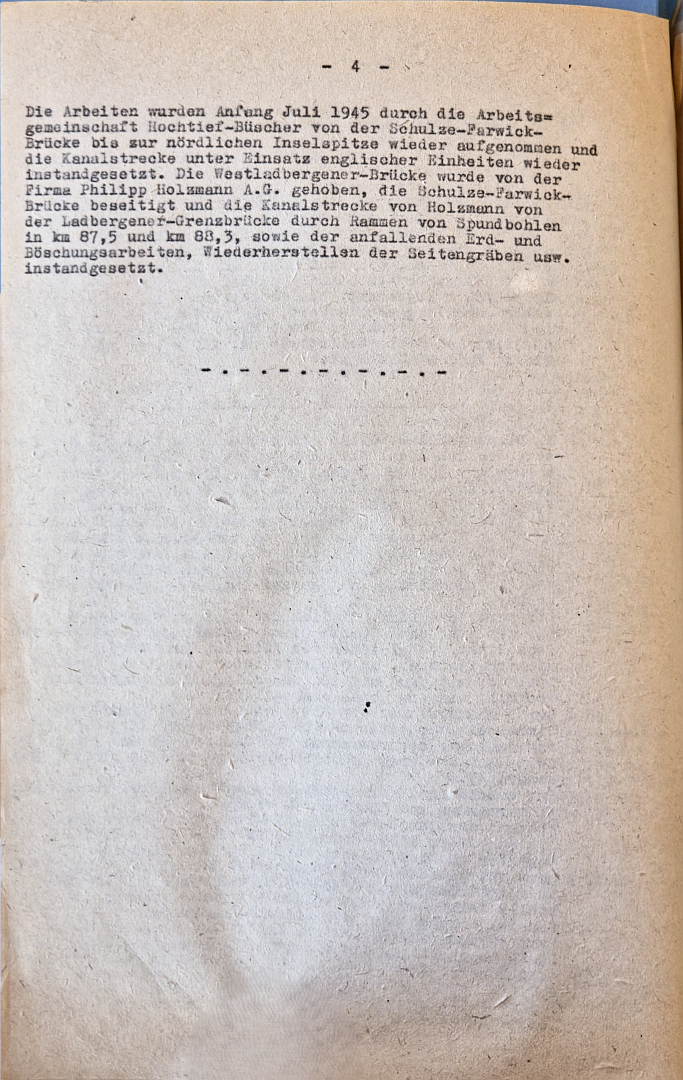
Work was resumed in early July 1945 by the Hochtief-Büscher consortium from the Schulze-Farwick Bridge to the northern tip of the island, and the canal section was repaired with the assistance of British units. The Westladbergen Bridge was raised by the firm Philipp Holzmann A.G., the Schulze-Farwick Bridge was demolished, and the canal section was repaired by Holzmann from the Ladbergen border bridge by driving sheet piles at km 87.5 and km 88.3, as well as necessary earthworks and embankment works, restoration of the side ditches, etc.
Photos of the document
Source: Landesarchiv NRW Abteilung Westfalen, O 103 / Wasser- und Schifffahrtsämter / Wasser- und Schifffahrtsamt Münster, Nr. 1300